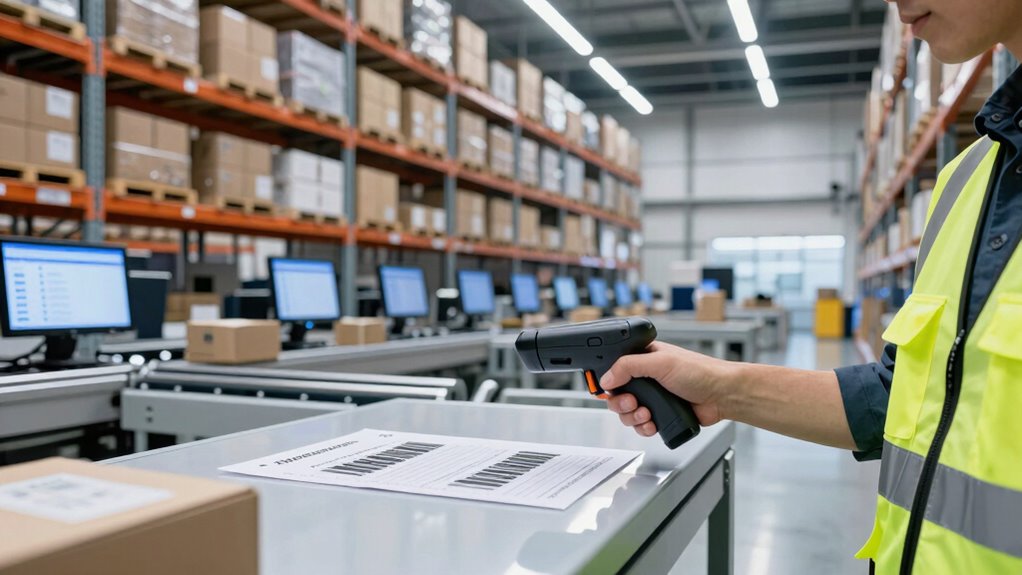

Barcode scanners still matter in smart warehouses because they offer a simple, reliable way to track inventory quickly and accurately, without the high costs or complexity of other technologies. You can scan hundreds of items in seconds, reducing errors and boosting efficiency. They integrate easily with existing systems and support automation. Their practicality in challenging environments keeps them essential, ensuring smooth operations. Stay with us to discover how these trusted tools continue to shape modern warehouses.

Get business pricing on tech for your team
- Business-only prices and quantity discounts
- Tax-exempt purchasing
- Multiple users, one account, clear invoices
Key Takeaways
- Barcode scanners provide quick, accurate inventory tracking essential for efficient warehouse operations.
- They integrate seamlessly with automation systems for real-time data updates and process triggers.
- Offer a cost-effective, reliable solution adaptable to various environments and product types.
- Maintain simplicity and speed, reducing manual errors and increasing throughput.
- Serve as a practical complement to advanced technologies, ensuring operational continuity and flexibility.
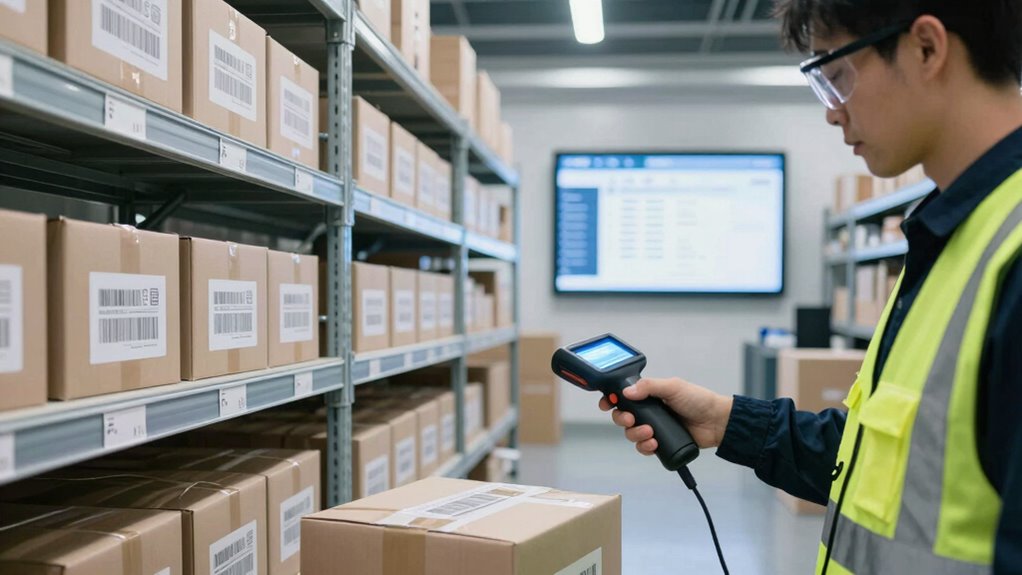
In the evolving landscape of smart warehouses, barcode scanners play a vital role in streamlining operations and boosting efficiency. While RFID integration and automation technologies are transforming inventory management, barcode scanners remain essential tools that complement these advancements. They offer a straightforward, cost-effective solution for tracking items, verifying orders, and maintaining accurate stock levels. You’ll find that barcode scanners are reliable, easy to use, and adaptable to various warehouse environments, making them indispensable even as technology evolves.
Barcode scanners remain essential for efficient, accurate inventory management in modern, evolving warehouses.
One of the key reasons barcode scanners continue to matter is their simplicity and speed. They require minimal setup and training, allowing your team to quickly adopt and integrate them into daily routines. You can scan hundreds of items in seconds, reducing manual data entry errors and increasing throughput. Despite the rise of RFID, barcode scanners still provide a precise way to identify and verify products, especially when RFID tags are not feasible due to cost or environmental constraints. They serve as a backup or complementary system, ensuring that your inventory data remains accurate and up-to-date.
Moreover, barcode scanners fit seamlessly into automation technologies without requiring extensive infrastructure changes. They can be integrated into existing warehouse management systems (WMS) with relative ease, providing real-time data updates that enhance overall operational visibility. This compatibility means that barcode data can trigger automated processes, such as updating stock levels, generating picking lists, or initiating reorder points. You’re able to leverage automation to improve efficiency without overhauling your entire tracking system. Additionally, their cost-effectiveness makes them a practical choice for warehouses looking to optimize their operations without significant capital investment. Incorporating reliable data capture from barcode scanners can significantly improve decision-making accuracy and inventory control.
RFID integration, while powerful, isn’t always practical in every scenario. It can be costly and complex to implement across large facilities, especially when dealing with smaller or more variable items. Barcode scanners offer a flexible alternative, capable of handling diverse product types and packaging formats. They’re also less susceptible to interference from environmental factors like metal or liquids, which can affect RFID performance. This reliability ensures that your warehouse operations remain consistent and accurate. In an environment where environmental factors can impact technology performance, barcode scanners provide a dependable solution to maintain operational integrity.
In short, barcode scanners continue to be a fundamental component of modern warehouses. They provide a straightforward, dependable method for tracking inventory, supporting automation, and maintaining operational accuracy. As your warehouse adopts new technologies, these scanners act as a bridge—enhancing existing systems and offering a practical solution that complements RFID integration and automation technologies. Their continued relevance ensures that your warehouse remains efficient, responsive, and precise in an increasingly complex logistics landscape. Their simplicity and speed make them a valuable asset in maintaining operational efficiency.
handheld barcode scanner for warehouse
As an affiliate, we earn on qualifying purchases.
As an affiliate, we earn on qualifying purchases.
Frequently Asked Questions
How Do Barcode Scanners Integrate With Warehouse Management Systems?
You integrate barcode scanners with warehouse management systems (WMS) by linking the scanners to your software through wired or wireless connections. This setup enhances inventory accuracy by allowing real-time data updates. To guarantee smooth operation, you should provide employee training on scanner use and system protocols. Proper integration streamlines processes, reduces errors, and improves overall efficiency in your warehouse operations.
What Are the Latest Technological Advancements in Barcode Scanning?
Did you know that over 90% of warehouses now adopt advanced barcode scanning tech? Latest advancements include enhanced durability for harsh environments and improved ergonomics, reducing user fatigue. Innovations like 2D barcode scanners capture more data, while wireless, compact models boost efficiency. These upgrades guarantee your scanners withstand tough conditions and are comfortable to use, making them essential for maintaining accuracy and speed in today’s smart warehouses.
How Do Barcode Scanners Impact Warehouse Safety Protocols?
Barcode scanners greatly improve warehouse safety protocols by reducing human error through accurate data capture. When you incorporate safety training on scanner use, you prevent accidents caused by mislabeling or mishandling items. These devices streamline inventory processes, helping you identify hazards quickly and prevent accidents before they happen. Overall, barcode scanners are essential for accident prevention, ensuring a safer work environment and enhancing your warehouse’s safety standards.
What Are Common Challenges in Implementing Barcode Scanners?
Did you know that 60% of warehouse errors stem from improper barcode scanner implementation? You might face challenges like maintaining high inventory accuracy and ensuring all-encompassing employee training. Integrating new technology can be complex, requiring staff to adapt quickly. Overcoming these hurdles involves investing in thorough training programs and choosing user-friendly scanners, which ultimately boosts accuracy and operational efficiency.
How Do Barcode Scanners Compare to RFID in Warehouses?
You’ll find barcode scanners excel in warehouses with their high barcode accuracy and reliable scanner durability. They offer precise data capture, making inventory management straightforward. RFID, however, can scan multiple tags simultaneously and work without direct line-of-sight, but often at a higher cost and slightly lower accuracy for individual items. Overall, barcode scanners remain a dependable choice, especially where accuracy and durability are critical, and budgets are tighter.
As an affiliate, we earn on qualifying purchases.
Conclusion
So, even with all the advanced technology out there, do you really think barcode scanners aren’t vital in smart warehouses? They’re simple, reliable, and cost-effective tools that keep your inventory accurate and operations smooth. As automation evolves, these scanners still play a key role in bridging manual processes with high-tech solutions. Don’t overlook the power of a good barcode scanner — isn’t efficiency worth keeping it in your warehouse arsenal?
wireless barcode scanner for inventory
As an affiliate, we earn on qualifying purchases.
As an affiliate, we earn on qualifying purchases.
rugged barcode scanner for logistics
As an affiliate, we earn on qualifying purchases.
As an affiliate, we earn on qualifying purchases.
Halloween Picks
halloween
As an affiliate, we earn on qualifying purchases.