
📊 Full opportunity report: Change-order risk detector for landscaping contractors on IdeaNavigator AI — validation score, market gap, and execution plan.

Get business pricing on tech for your team
- Business-only prices and quantity discounts
- Tax-exempt purchasing
- Multiple users, one account, clear invoices
TL;DR
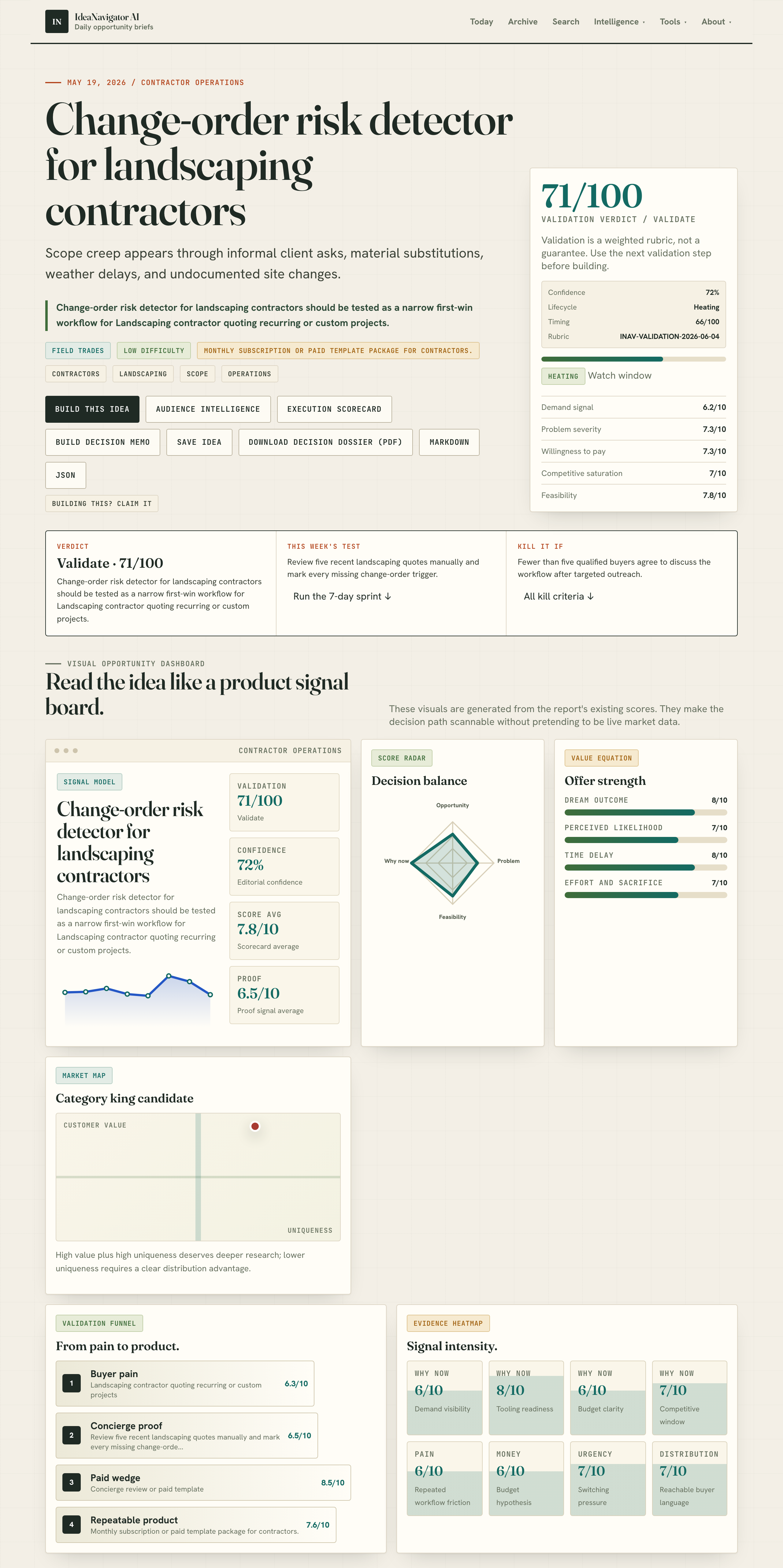
A change-order risk detector is in development for landscaping contractors, designed to flag scope creep and undocumented changes in project quotes. It aims to help small contractors better manage margins amid high uncertainty.
A new change-order risk detector workflow is being developed and tested for landscaping contractors to flag scope creep and undocumented project changes during the quoting process, aiming to improve margin control for small firms.
The proposed tool is designed specifically for landscaping contractors handling recurring or custom projects. It functions as a quote and job-note checker that automatically flags missing exclusions, triggers for change orders, and necessary approval language. This aims to address common issues like scope creep caused by informal client asks, material substitutions, weather delays, and undocumented site changes, which often erode margins.
The initiative responds to the high levels of uncertainty faced by small contractors, especially regarding labor costs, material prices, and scheduling. By providing a standardized check during quoting, the tool seeks to help contractors prevent scope creep before work begins, potentially saving time and reducing financial risk. The MVP involves reviewing five recent landscaping quotes manually to identify missing change-order triggers, which will inform further development.
Funding for this development is expected through a monthly subscription model or a paid template package, targeting contractor operations. The testing phase aims to validate the effectiveness of the workflow before broader deployment.
Potential Impact on Small Landscaping Firms’ Profit Margins
This risk detector could significantly improve profit margins for small landscaping contractors by reducing scope creep and unplanned costs. As margins are often tight, especially with fluctuating labor and material costs, a tool that proactively flags potential issues during quoting can prevent costly disputes or overruns. If successful, it may set a new standard for project management workflows in the industry, encouraging wider adoption of automated risk detection tools.
landscaping project management software
As an affiliate, we earn on qualifying purchases.
As an affiliate, we earn on qualifying purchases.
Industry Need for Better Scope Management Tools
Small landscaping contractors frequently encounter scope creep due to informal client requests, material substitutions, weather delays, and undocumented site changes. These issues can lead to budget overruns and reduced profitability. Currently, many rely on manual checks and informal communication, which are prone to oversight. The development of a change-order risk detector aims to address this gap by providing a systematic, automated approach to identify potential risks early in the quoting process.
This initiative aligns with broader industry trends toward digitalization and automation, as contractors seek tools to improve operational efficiency and financial stability amidst ongoing market uncertainties.
“The workflow aims to serve as a first-line check to catch missing exclusions and change-order triggers before the project begins.”
— an anonymous researcher
landscaping quote checklist template
As an affiliate, we earn on qualifying purchases.
As an affiliate, we earn on qualifying purchases.
Uncertainties About Workflow Effectiveness and Adoption
It is not yet clear how accurately the workflow will identify all relevant change-order risks in practice, or how quickly contractors will adopt the new tool. The validation process involves reviewing five recent quotes, but broader testing and user feedback are still pending. Additionally, questions remain about integration with existing contractor management systems and the potential for false positives or missed triggers.
change order risk detection tool for contractors
As an affiliate, we earn on qualifying purchases.
As an affiliate, we earn on qualifying purchases.
Next Steps in Validating and Deploying the Risk Detector
The next phase involves testing the workflow with a broader sample of contractor quotes and collecting user feedback to refine its accuracy and usability. Developers plan to analyze the results of the initial validation, improve the detection algorithms, and explore integration options. A wider rollout could follow if the workflow demonstrates clear benefits in reducing scope creep and enhancing margin control.
As an affiliate, we earn on qualifying purchases.
Key Questions
How does the change-order risk detector work?
The workflow functions as a checklist during the quoting process, automatically flagging missing exclusions, change-order triggers, and approval language based on predefined criteria.
Who is the target user for this tool?
Small landscaping contractors handling recurring or custom projects who want to better manage scope creep and protect profit margins.
Will this replace manual checks?
No, it is designed to supplement existing processes by providing an automated first-line review to catch common risks early.
When will the workflow be widely available?
Wider deployment depends on the results of ongoing testing and validation; a timeline has not yet been set.
What are the main benefits for contractors?
Improved margin control, reduced scope creep, and less time spent on manual risk assessment during quoting.
Source: IdeaNavigator AI
Halloween Picks
halloween
As an affiliate, we earn on qualifying purchases.