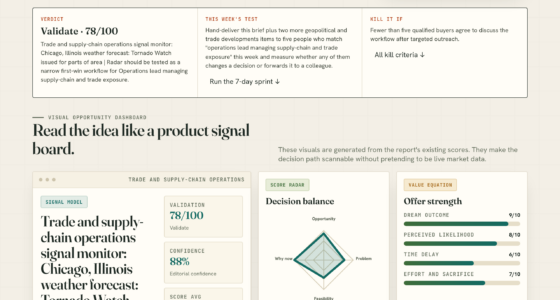
📊 Full opportunity report: Europe’s AI Shift: Diversifying Vendors And Moving Away From Palantir on ThorstenMeyerAI.com — validation score, market gap, and execution plan.
TL;DR
European countries are shifting away from Palantir for defense and intelligence software, awarding contracts to local and alternative vendors. This marks a significant move toward sovereignty and vendor diversification, with key procurement deadlines set for the next two years.
European governments are actively moving away from Palantir for defense and intelligence systems, awarding contracts to local firms such as France’s ChapsVision and testing new alternatives. This shift reflects growing concerns over data sovereignty and dependence on US-based vendors, especially after recent NATO deployments. The change is confirmed by multiple procurement awards and public statements from European agencies.
In May 2026, Germany’s domestic intelligence agency (BfV) awarded a large-scale data analysis contract to France’s ChapsVision, explicitly over Palantir, which had previously been a leading contender in the European market. This marks a clear move toward local and European vendors. The Dutch defense ministry announced in early June a two-year timeline to develop a ‘fully fledged alternative’ to Palantir, citing operational risks associated with reliance on US-based systems. Additionally, the UK parliamentary committee criticized the NHS’s £330 million deal with Palantir, calling dependence on the company an ‘unacceptable weakness.’ France is testing Arcadia, a NATO-interoperable battlefield AI system built on Artemis/Athea, as a sovereign alternative to Palantir’s Maven platform. Several other European vendors, including Helsing (Germany), Systematic (Denmark), and Italy’s Octostar, are advancing their own solutions, though none yet match Palantir’s breadth or maturity.
Despite these developments, Palantir’s products remain deeply embedded in some European government systems, with switching costs high due to data models, analyst training, and operational workflows. The recent procurement trends, however, indicate a strategic push for diversification and sovereignty, with official deadlines and contracts now publicly set. Industry insiders note that consolidation among European vendors is likely in the next two years to offer comprehensive alternatives to Palantir’s integrated platform.
Europe Is Actually Shopping
for Its Palantir Exit
Same-day-verified market pulse · from conference-panel phrase to procurement category in ninety days
How sentiment became procurement
The contender field — honestly assessed
STEELMAN: WHY PALANTIR KEEPS WINNING ANYWAY
Mature, integrated, combat-proven at alliance scale — and switching costs in intelligence tooling are brutal. No European contender today offers the full bundle; several governments funding alternatives still run Palantir somewhere in the stack. The Dutch two-year timeline exists precisely because rip-and-replace carries real operational risk.
The signal: named contracts, named deadlines, named systems under test — demand has moved from sentiment to procurement. Supply is credible but fragmented; expect consolidation and consortiums, because buyers now want the bundle without the flag. Decided in the next 24 months.
European Defense Agencies Shift to Local AI Vendors
This development signifies a strategic shift in European defense and intelligence operations, emphasizing sovereignty and reducing dependence on US vendors. The move could reshape the landscape of military AI procurement across the continent, potentially leading to a fragmented but more autonomous vendor ecosystem. For European policymakers and defense agencies, this transition aims to mitigate operational risks associated with geopolitical tensions and data security concerns, especially after NATO’s deployment of Palantir’s Maven system. The ongoing vendor diversification efforts also signal a broader push to develop indigenous capabilities and foster regional technological sovereignty, impacting future procurement strategies and international alliances.

Computer Security – ESORICS 2025: 30th European Symposium on Research in Computer Security, Toulouse, France, September 22–24, 2025, Proceedings, Part II (Lecture Notes in Computer Science)
As an affiliate, we earn on qualifying purchases.
As an affiliate, we earn on qualifying purchases.
Recent European Moves Toward Sovereign AI Solutions
Over the past two years, European governments have increasingly questioned their reliance on Palantir, which has been dominant in the region’s intelligence and defense sectors. The NATO adoption of Palantir’s Maven in March 2025 concentrated critical intelligence tools within a US vendor, raising sovereignty concerns. In March 2026, Palantir publicly highlighted Maven’s role in operations against Iran, which reportedly caused discomfort among European allies wary of routing sensitive data through a US-controlled system. Germany’s BfV awarded its recent contract to France’s ChapsVision, and the Netherlands announced a two-year timeline for developing an alternative. France’s testing of Arcadia and other European vendors’ progress underline a concerted effort to build sovereign capabilities. Despite these efforts, Palantir remains embedded in some systems, and the transition involves significant operational and technical challenges.
“The recent procurement decisions mark a decisive shift in Europe’s approach to AI sovereignty, moving from rhetorical support to concrete contracts and timelines.”
— an anonymous researcher

Intelligent Health: The Movement to Unify Data, Harness AI, and Empower People to Thrive
As an affiliate, we earn on qualifying purchases.
As an affiliate, we earn on qualifying purchases.
Remaining Uncertainties in European AI Vendor Transition
It is still unclear whether European vendors will be able to fully replace Palantir’s comprehensive platform within the next two years, given the high switching costs and operational complexity. The extent to which Palantir will lose market share remains uncertain, as some European governments continue to operate Palantir systems while funding alternatives. The future landscape will depend on vendor consolidation, technical performance, and political will, which are all still evolving.
As an affiliate, we earn on qualifying purchases.
Next Steps in European Defense AI Procurement
European governments are expected to finalize their vendor selections within the next 12 to 24 months, with key contracts and testing phases underway. Industry consolidation among European vendors is likely, aiming to develop integrated solutions comparable to Palantir’s Foundry. Additionally, more countries may publicly announce their timelines and procurement strategies, further accelerating the shift toward sovereignty-focused AI systems.

Modes of Thinking for Qualitative Data Analysis
As an affiliate, we earn on qualifying purchases.
As an affiliate, we earn on qualifying purchases.
Key Questions
Why are European countries moving away from Palantir?
European countries are concerned about data sovereignty, dependence on US-based vendors, and recent geopolitical developments that have highlighted operational risks associated with relying on Palantir’s systems controlled by a foreign company.
What are the main European vendors competing with Palantir?
Key contenders include France’s ChapsVision and Arcadia, Germany’s Helsing, Denmark’s Systematic, Italy’s Octostar, and Finland’s ICEYE, each offering different capabilities in AI and data analysis.
How long will it take for Europe to fully replace Palantir?
Most experts estimate a timeline of at least two years, with significant procurement and integration efforts ongoing to develop sovereign alternatives that can match Palantir’s capabilities.
Will Palantir still have a presence in Europe?
Yes, some European governments continue to operate Palantir systems while funding its replacement, indicating a gradual transition rather than an immediate exit.
What does this mean for the future of European defense AI?
This shift signals a move toward greater autonomy and regional control over critical defense AI systems, potentially reshaping alliances and procurement strategies in the coming years.
Source: ThorstenMeyerAI.com