📊 Full opportunity report: How Instant Business Closure Notifications Accelerate Asset Purchases on IdeaNavigator AI — validation score, market gap, and execution plan.

Get business pricing on tech for your team
- Business-only prices and quantity discounts
- Tax-exempt purchasing
- Multiple users, one account, clear invoices
TL;DR
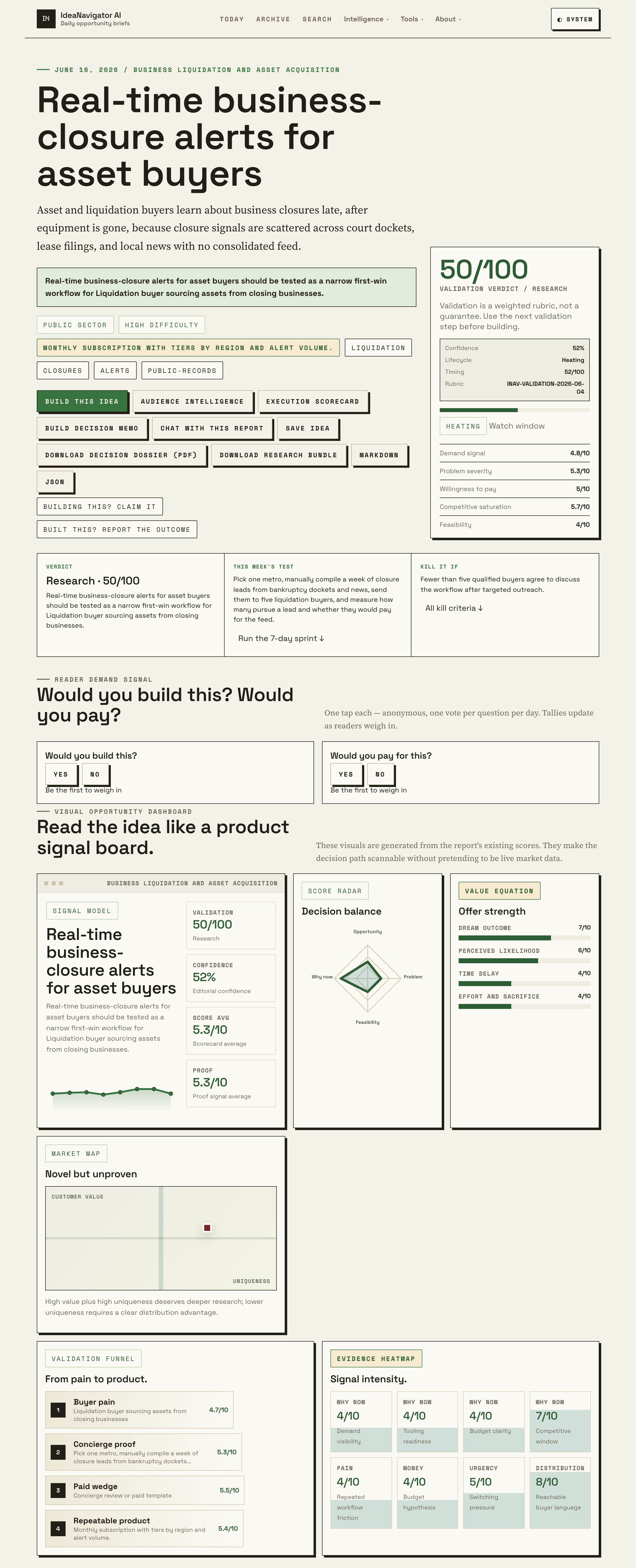
A new system providing instant alerts of business closures is being tested to help liquidation and asset buyers acquire assets more quickly. This innovation leverages electronically filed records to address delays caused by scattered information sources.
Liquidation and asset buyers are beginning to test a new system that delivers instant notifications of business closures, allowing them to act faster in acquiring assets. This development addresses longstanding delays caused by scattered sources of closure signals, such as court dockets, lease filings, and local news.
The initiative involves a manually curated daily alert system where buyers specify a region and asset category. Human analysts then scan bankruptcy dockets and local news to identify relevant closures, providing details such as business type, estimated asset value, and closure timeline. This process aims to streamline the acquisition pipeline by delivering timely leads.
According to an anonymous researcher involved in the project, the system is designed as a minimal viable product (MVP) with subscription tiers based on region and alert volume. The goal is to validate its effectiveness by tracking how many buyers pursue leads and whether they are willing to pay for such real-time notifications. The approach is currently being tested in one metro area, with plans to expand based on initial results.
Impact of Instant Closure Alerts on Asset Acquisition Efficiency
This development matters because it could significantly reduce the time lag between business closure and asset purchase, helping liquidation buyers recover more assets before they are removed or repurposed. Faster acquisition cycles can lead to increased market liquidity and better asset valuation, especially in a post-pandemic economy where business closures remain elevated.
By addressing the historic challenge of scattered and delayed information, the alert system has the potential to transform how liquidation markets operate, making asset sourcing more proactive and data-driven. This could also influence the broader liquidation industry by setting new standards for real-time intelligence.
business closure notification alert system
As an affiliate, we earn on qualifying purchases.
As an affiliate, we earn on qualifying purchases.
Post-Pandemic Rise in Business Closures Spurs Need for Faster Data
Following the COVID-19 pandemic, small-business closures and bankruptcies have remained elevated, intensifying the need for timely information. Traditionally, signals of business shutdowns have been dispersed across various sources such as court filings, lease agreements, and local news reports, often arriving too late for asset buyers to act effectively.
Recent advancements in electronic filing systems and data accessibility have made it feasible to aggregate closure signals in real time. The concept of instant alerts for business closures has gained traction as a practical solution to this longstanding problem, with initial pilot programs now underway to test its viability in specific markets.
“The goal is to deliver timely, actionable leads to buyers, reducing the delay caused by scattered information sources.”
— an anonymous researcher
As an affiliate, we earn on qualifying purchases.
Uncertainties Around System Effectiveness and Adoption
It is not yet clear how many buyers will adopt the alert system at scale or how much it will improve acquisition speeds in practice. The pilot is still in early stages, and results are pending. Additionally, questions remain about the system’s ability to accurately identify relevant closures without excessive false positives, and whether buyers will find sufficient value to pay for the service.
As an affiliate, we earn on qualifying purchases.
Next Steps in Testing and Scaling the Alert System
The initial pilot in one metropolitan area will continue over the coming weeks, with data collected on lead pursuit and buyer willingness to subscribe. Based on these results, developers plan to refine the alert process, expand coverage to additional regions, and potentially introduce automated data aggregation to reduce manual effort. Broader industry adoption will depend on demonstrated effectiveness and cost-benefit analysis.
As an affiliate, we earn on qualifying purchases.
Key Questions
How does the real-time alert system work?
The system involves human analysts who scan bankruptcy dockets and local news daily, then send alerts with relevant closure details based on buyer preferences for region and asset category.
What are the benefits of instant closure notifications?
They enable buyers to act faster, potentially securing assets before they are removed or sold elsewhere, increasing recovery rates and market liquidity.
Is this system available to all liquidation buyers now?
Currently, it is in a testing phase with a limited pilot program. Broader availability will depend on pilot results and further development.
What challenges might affect the system’s success?
Challenges include ensuring accurate identification of relevant closures, managing false positives, and convincing buyers of the value to pay for the alerts.
Will this system replace existing methods of tracking closures?
It aims to supplement current sources by providing more timely notifications, but it is unlikely to fully replace traditional methods in the near term.
Source: IdeaNavigator AI
Halloween Picks
halloween
As an affiliate, we earn on qualifying purchases.