

TL;DR
The International Energy Agency says data centre electricity use rose 17% in 2025, while energy per AI task has fallen sharply. The IEA links efficiency gains to wider adoption of AI services, a pattern known as the Jevons paradox, though efficiency does not always increase total energy use.
The International Energy Agency (IEA) says electricity use by data centres rose 17% in 2025, even as the energy needed for an AI task fell by at least an order of magnitude annually in recent years. The agency says efficiency is helping broaden AI adoption, a pattern called the Jevons paradox, and projects that total data centre demand will keep growing.

Get business pricing on tech for your team
- Business-only prices and quantity discounts
- Tax-exempt purchasing
- Multiple users, one account, clear invoices
The IEA’s figures show different trends in efficiency and total consumption. Energy used per AI task has fallen rapidly, while electricity use rose by 50% in data centres built for AI in 2025. Across all data centres, the total reached 485 terawatt-hours, according to the source material’s account of the agency’s report. These totals describe electricity use across facilities; they do not say how much power any single prompt consumes.
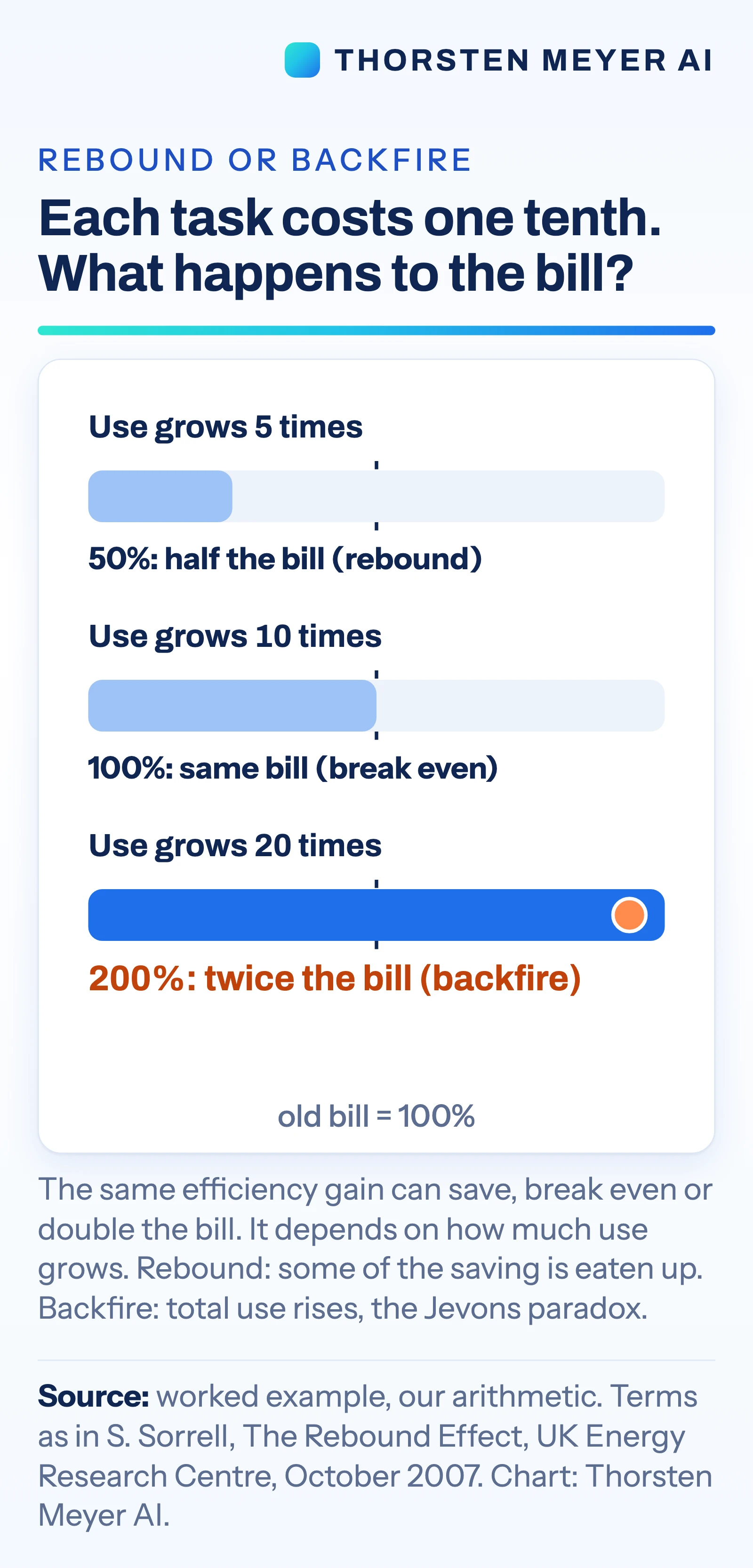
The mechanism is straightforward: when a task becomes cheaper to perform, businesses and individuals may use it more often, or adopt new applications that were previously too costly. Efficiency lowers resource use for each task, but total consumption can still rise if the number or intensity of tasks grows enough. In an illustrative example, a tenfold cut in cost per task combined with twenty times as many tasks doubles the total bill. Those figures are an example, not a measurement of AI demand.
Other figures in the source point to expanding use. Epoch AI estimates that the cost of a given level of AI performance has fallen about 13 times per year since 2023. Google’s monthly token count is reported to have risen from 9.7 trillion in May 2024 to more than 3.2 quadrillion in May 2026. The source gives those token counts without a defined comparison baseline or detail about what activity they include, so they show a reported increase in volume rather than a direct measure of energy use.
Why AI Efficiency Can Raise Demand
For companies, lower prices per token can make AI viable in more products and workflows. That may expand use enough to offset some or all of the savings per task. The practical effect can be a falling unit price alongside a growing overall bill, especially when systems handle more complex work, such as reasoning or autonomous agents, that uses more tokens.
For electricity planners, the distinction between energy per task and total demand matters. A simple text request may use little energy on its own, but demand across data centres depends on the volume and type of computing, as well as the infrastructure serving it. The IEA projects data centre electricity use will reach about 950 terawatt-hours in 2030, roughly twice the reported 2025 level. That projection concerns data centres overall, not AI alone.
The paradox is a useful way to frame this risk, but it does not establish that efficiency always increases consumption. The outcome depends on how strongly demand responds to lower costs and on other limits, including electricity supply, hardware, policy and business choices.
Products Worth Considering

Bose Smart Dolby Atmos Soundbar with Alexa, Voice Control, and Bluetooth

Bose TV Speaker Compact Soundbar with Bluetooth and HDMI-ARC, Black

DJI Mic 3 Wireless Microphone Kit (2 Transmitters, 1 Receiver, Charging Case)
As an affiliate, we earn on qualifying purchases.
Jevons’s Coal-Economy Argument
English economist William Stanley Jevons described the pattern in The Coal Question, published in 1865. He argued that more efficient industrial use of coal could increase its total consumption by making coal-powered activity more profitable and useful. In his example of iron production, lower coal use per ton could reduce costs, encourage investment, lower iron prices and increase demand enough to bring more furnaces into operation.
Jevons cited Scottish iron production, where he reported that reducing the coal needed per ton to less than one-third of its former amount was followed by a tenfold increase in total coal consumption. That historical example concerns a specific industry and period; it is not direct evidence about modern AI. The UK Energy Research Centre’s 2007 review, as summarized in the source material, found that efficiency gains usually still reduce energy use overall, though often by less than engineers expect. The term backfire describes the case where increased use fully outweighs efficiency savings.
The IEA applies the idea to AI in its discussion of energy demand, saying efficiency gains are “also fuelling broader adoption of AI services” and that total electricity use from AI is “set to increase in the near term.” This is the agency’s assessment of the current trend, not a claim that every efficiency improvement must raise energy use.
How Much AI Demand Will Grow
The figures supplied do not quantify the share of the 2025 increase in data centre electricity use caused by AI, or separate AI workloads from other computing in the overall total. They also do not provide a common measurement linking tokens, energy per task and electricity consumed at data centres. As a result, the reported growth in token volume cannot by itself establish how much electricity AI use added.
It remains unclear how far lower costs will expand demand, and whether that growth will outweigh efficiency gains over time. The source gives an annual rate for energy reductions per AI task but does not specify the measurement method or the range of tasks covered. The 2030 figure is a projection, not an observed outcome, and the supplied material does not state its assumptions or uncertainty range.
Tracking Costs, Workloads and Power
The next evidence to watch is whether new IEA data show data centre and AI-related electricity use continuing to grow, and how that compares with efficiency improvements. More detailed reporting on workload types, electricity consumed per task and the share of facility demand attributable to AI would help clarify the relationship.
Businesses can track costs per completed task alongside token prices, since more elaborate tasks may use more computing even when unit prices fall. For power planners, the relevant measures are the scale and composition of data centre demand and the pace at which electricity infrastructure can serve it. The current material points to rising use, but does not settle how large or lasting the effect will be.
Key Questions
What is the Jevons paradox?
It is the possibility that making a resource more efficient to use lowers its effective cost and increases demand enough that total consumption rises. It is a possible outcome, not a rule that applies every time.
What did the IEA report about data centre electricity use?
The figures cited in the source material say data centre electricity use rose 17% in 2025, with a 50% increase at data centres built for AI. The source says total data centre use was 485 terawatt-hours that year.
Does the reported increase prove AI caused all the growth?
No. The material does not give a breakdown showing what share of the total increase came from AI workloads. It reports a sharper increase in AI-focused data centres but does not establish that AI accounts for all data centre growth.
Does AI efficiency always increase electricity use?
No. The effect depends on how much additional use follows lower costs. A 2007 UK Energy Research Centre review, as summarized in the source, found efficiency generally still saves energy overall, though the savings can be smaller than expected.
What is the IEA’s data centre electricity projection?
The source material says the IEA projects about 950 terawatt-hours in 2030, compared with 485 terawatt-hours in 2025. This is a projection for data centres overall, not a figure for AI alone.
Source: Thorsten Meyer AI