TL;DR
Thorsten Meyer says he replaced several rented business software services with tools built using Claude and Codex. His seven-tool workflow connects project tracking, transcripts, PDFs, publishing and analytics, but he says maintenance, security and review are now his responsibility. The account describes his own practice, not an independently verified measure of broader adoption or savings.
Thorsten Meyer said Nov. 25 that he uses AI coding agents from Anthropic and OpenAI to build and connect tools for his business, replacing several software services he previously rented. His account describes how a business owner can use coding agents to create tools for specific workflows while taking responsibility for upkeep and security.

Get business pricing on tech for your team
- Business-only prices and quantity discounts
- Tax-exempt purchasing
- Multiple users, one account, clear invoices
Meyer says his tools cover web analytics, project tracking, PDFs and video recording. He pays for Claude and Codex subscriptions, and says he pays separately for AI models that generate voices, images and video clips. The article does not provide a former software budget or a direct comparison of total costs, so the size of any savings cannot be established from the account.
He describes a job moving through seven tools, from a project tracker to guides, transcripts, a PDF tool, a 3D model library, a publishing tool and analytics. In his workflow, software agents pass information between tools without a person clicking through each step. Meyer says people still set the goal and check the results.
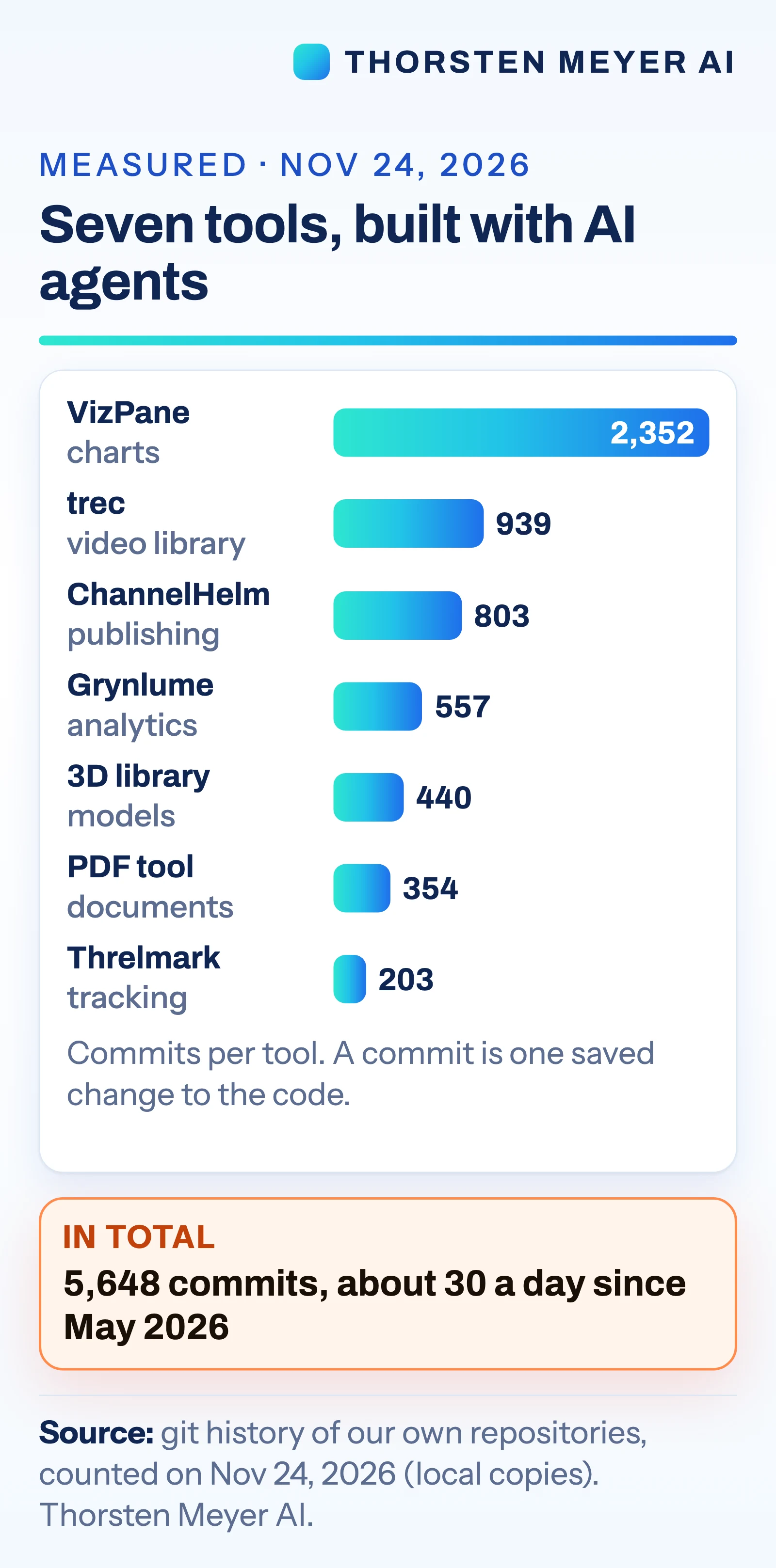
Meyer reports that seven tools in his own repositories had 5,648 commits and 2,128 test files as of Nov. 24, 2026. These are counts from his projects, not an independent assessment of quality, reliability or the effort required to maintain them. He says the coding agents can read and write project code, run tests and report their work, while he remains responsible for defining requirements and reviewing output.
Who Takes On the Software Work
Meyer describes using AI coding agents to build specialized software for his own business tasks instead of adapting general products. His account details a workflow in which tools pass information between one another, reducing manual handoffs in his work.
He says he is responsible for maintenance, security and review, and that his setup depends heavily on Anthropic and OpenAI. His account does not establish whether building tools is cheaper or more dependable for other businesses. Meyer writes that people who prefer not to maintain tools can continue renting software.
Products Worth Considering

DJI Mini 3 Drone with DJI RC and 3-Axis Gimbal

Jackery HomePower 3600 Plus Portable Power Station, 3584 Wh, 3600 W

Bose QuietComfort Wireless Noise Cancelling Headphones, Sandstone
As an affiliate, we earn on qualifying purchases.
From Rented Apps to Custom Tools
Meyer frames the change against the common model of software as a service, where a customer pays to use an application hosted by a provider. He cites the U.S. National Institute of Standards and Technology’s definition in Special Publication 800-145: users access provider applications on cloud infrastructure and do not manage the underlying servers or storage.
In Meyer’s description, AI coding agents work inside a software project: they read its code, make changes, run tests and report back. He names Claude Code and Codex as the agents he uses. He says he gives them written project rules and records because an agent needs that information to work consistently across sessions; he also says their output still requires review.
For tools to work with other software agents, Meyer says each needs a readable guide and a standard way for software to interact with it. His article uses that setup to explain how an automated job moves between his tools. The example is based on his own workflow and repositories, rather than a reported industry-wide deployment.
“The scarce part is no longer the code. It is knowing exactly what you need, and checking that you got it.”
— Thorsten Meyer
Costs and Reliability Still Unmeasured
The article gives no cost comparison between Meyer’s current subscriptions and the software services he says he stopped paying for. It also does not quantify the time spent building, reviewing, securing or maintaining the tools, or report independent audits of their reliability and security.
The repository counts are Meyer’s own measurements, and the article does not explain how commits or test files were counted or what those figures say about software quality. It remains unclear how well this approach would work for businesses with different needs, larger teams or stricter operational requirements. The account documents one person’s experience; it does not establish a general outcome.
Maintenance Will Test the Model
Meyer says he is responsible for keeping the tools secure, reliable and useful as his business needs change. His article does not announce a formal evaluation or give a timeline for measuring results. Readers assessing a similar approach would need to compare subscription and model costs with the time and resources required to build, review and maintain their own tools.
The account describes one business owner’s use of AI coding agents to build custom software. Evidence about costs, upkeep and performance across other users is not provided.
Key Questions
What did Thorsten Meyer say he built with AI coding agents?
He says he uses tools for analytics, project tracking, PDFs and video recording, among other tasks, and connects seven tools in one workflow.
Which AI coding agents does he use?
Meyer says he uses Claude Code from Anthropic and Codex from OpenAI.
Does the article show that building tools costs less?
No. Meyer says he no longer pays other vendors for the software he runs his work on, but gives no former software budget or full cost comparison, including build and maintenance time.
What does Meyer say are the main trade-offs?
He says he is responsible for maintenance, security and review, and depends heavily on Anthropic and OpenAI. The article does not report an independent security or reliability assessment.
Source: Thorsten Meyer AI