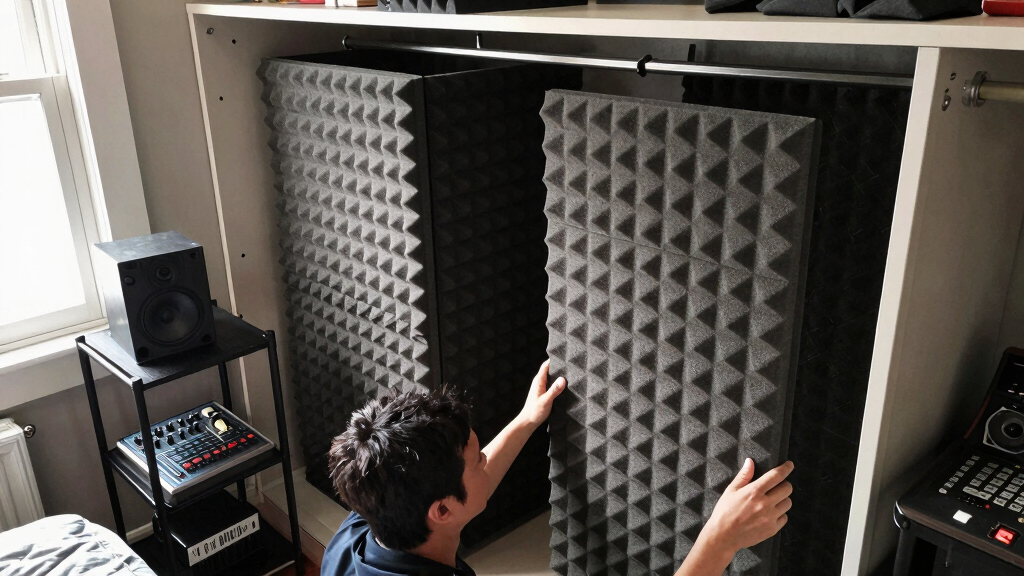

Acoustic Dampening, Placement, and the “Rig in the Closet” Setup

📊 Full opportunity report: Acoustic Dampening, Placement, and the “Rig in the Closet” Setup on ThorstenMeyerAI.com — validation score, market gap, and execution plan.

TL;DR

Moving your AI workstation into a closet or separate room can drastically reduce noise. Proper ventilation is essential to prevent heat buildup, making this a highly effective strategy for quiet, high-performance setups.

Putting a high-power AI workstation in a closet or separate room significantly reduces noise levels at the user’s workspace, according to technical experts.

Experts emphasize that the most effective way to reduce noise from powerful workstations is to move them away from the user, such as into another room or closet, especially since networked operation makes local proximity less necessary. This approach eliminates airborne and structure-borne noise at the source, with the added benefit of keeping the workspace quiet. Acoustic Dampening, Placement, and the ‘Rig in the Closet’ Setup.

However, placing a machine in an enclosed space introduces heat management challenges. A sealed closet or cabinet can trap heat generated by GPUs and CPUs, risking overheating and throttling. To mitigate this, proper ventilation—passive vents or active exhaust fans—is essential. Purpose-built soundproof cabinets with integrated cooling solutions are available but are costly. When managed correctly, this setup offers a quiet, efficient environment for continuous operation without noise disturbance.

Acoustic Dampening & Placement — Interactive Infographic
ThorstenMeyerAI.com · AI Workstation Guides
Lever 5 of 5 · Placement · Interactive
The last lever · move it out

Acoustic dampening
& the rig in the closet.

The most powerful noise fix isn’t a material — it’s a floor plan. A rig you can’t hear because it’s in another room beats any amount of foam. Tap the approaches in Part 1 to see what actually works.

1 The hierarchy people get backwards
Distance beats foam — by a lot
Acoustic treatment has a clear order of effectiveness. Most people buy foam first — it’s last. Tap a row for why.
1Distance & isolation
(another room)
most
2Reduce at the source
(levers 1–4)
high
3Block transmission
(door / barrier)
medium
4Absorb reflections
(acoustic foam)
least
#1 · Distance & isolationThe best soundproofing is a wall. Move the rig to another room and run it headless — the noise problem disappears instead of being mitigated.
2 Two kinds of noise, two fixes
Foam and pads solve different problems
Pick the wrong fix and you treat noise that was never going to respond to it.
Airborne
The whoosh of fans, the GPU hum — traveling through air.
Foam absorbs it (less echo in the room)
A barrier blocks it (stops it leaving)
×Foam alone won’t stop it passing through a wall
Structure-borne
The low hum the machine sends into the desk, floor & walls.
Anti-vibration pads / rubber feet decouple it
Soft-mount drives, or use silent SSDs
×Foam does nothing for this — it’s mechanical
3 The rig in the closet
Great noise fix — with one catch
Enclosing a hot rig works beautifully for noise. But a sealed space traps heat — the same trap as a sealed case, scaled to a room.
GPU rig cool in hot out (fan) it must breathe

Contain the noise, not the heat

Vent it — a passive path, or a quiet exhaust fan pulling hot air out.
Soundproof cabinets do both: foam lining + thermostat-controlled exhaust.
An AIO helps here — it exports CPU heat out a radiator.
⚠ Never fully seal a 24/7 rig. Trapped 600W+ of heat = the GPU breathing its own exhaust = throttling & roaring fans.
4 The few products worth it
Mostly free technique — a handful of items help
Anti-vibration pads
Best value here. Kills structure-borne hum for a few dollars.
Soundproof server cabinet
The engineered quiet + cool answer, with built-in exhaust.
Acoustic foam panels
Tames reflections in the room — not for blocking transmission.
Quiet exhaust fan
Ventilates a closet or cabinet so the heat can leave.
5 The numbers
What containment can buy
Counts animate to typical figures.
Soundproof cabinet cuts
~36%
of perceived noise — while still dissipating kilowatts.
Serious enclosures reach
30 dB
of reduction — up to 5× quieter than an open rack.
A wall between you & it
100%
of the problem, gone — the cheapest fix there is.
Acoustic principles from server-room and quiet-PC soundproofing references; cabinet figures from manufacturer specs (StarTech, SysRacks, UCoustic). Figures vary by enclosure and environment. Affiliate disclosure on page.
ThorstenMeyerAI.com

Why Moving Rigs to a Closet or Room Matters

This strategy offers a practical, often cost-effective way to achieve near-silent operation of high-performance AI rigs, improving workspace comfort and reducing noise pollution. Proper ventilation ensures hardware longevity and performance, making this approach suitable for both hobbyists and professionals relying on continuous AI inference tasks.

Sysracks Soundproof Server Rack Quiet - Acoustic Sound Proof Cabinet for Servers - Up to 36% Noise Reduction - Locking Server Enclosure - Silent Networking Cabinet - Noise Sound Dampening Box (15U)

Sysracks Soundproof Server Rack Quiet - Acoustic Sound Proof Cabinet for Servers - Up to 36% Noise Reduction - Locking Server Enclosure - Silent Networking Cabinet - Noise Sound Dampening Box (15U)

15U Sound- Proof Cabinet (26in Width x 35in Depth x 36in Height)

As an affiliate, we earn on qualifying purchases.

As an affiliate, we earn on qualifying purchases.

Placement Strategies for Noise Reduction

The hierarchy of noise mitigation prioritizes distance and isolation over acoustic treatment. Moving a rig into another room or closet is the most effective noise reduction method, especially since network-based workflows allow remote operation. Acoustic Dampening, Placement, and the 'Rig in the Closet' Setup leverages these principles, provided ventilation is carefully managed.

"The most effective noise reduction is simply moving the machine out of your immediate workspace. Once you do that, the need for acoustic foam diminishes significantly."

— Thorsten Meyer, AI Workstation Expert

180L Mobile 3D Printer Enclosure with Wheels & Dehumidifier, All-in-One Workstation with 40-Spool Sealed Dry Cabinet & Active Humidity Control (25% RH) for PLA ABS PETG Nylon

180L Mobile 3D Printer Enclosure with Wheels & Dehumidifier, All-in-One Workstation with 40-Spool Sealed Dry Cabinet & Active Humidity Control (25% RH) for PLA ABS PETG Nylon

🚛【Upgraded with 4 Lockable Swivel Casters for Ultimate Mobility & Stability】Move your entire 3D printing station effortlessly across...

As an affiliate, we earn on qualifying purchases.

As an affiliate, we earn on qualifying purchases.

Remaining Challenges in 'Rig in the Closet' Setup

While moving a rig into a closet reduces noise, the optimal ventilation solutions and their long-term reliability are still under discussion. The effectiveness of various cooling methods and cost considerations for purpose-built soundproof cabinets vary, and real-world performance can differ based on room size, ambient temperature, and hardware configuration. Further empirical data and user experiences are needed to establish best practices.

DEWENWILS 2 Pack 120V AC Fan, Waterproof Exhaust Fan 120mm, 18W 2850RPM 90CFM, DIY Cooling Fan for Refrigerator, Computer Case, Compressor Engine, Generator, UL Listed

DEWENWILS 2 Pack 120V AC Fan, Waterproof Exhaust Fan 120mm, 18W 2850RPM 90CFM, DIY Cooling Fan for Refrigerator, Computer Case, Compressor Engine, Generator, UL Listed

[Wide Application] This exhaust fan is perfect for various cooling or ventilation projects, making it an excellent choice...

As an affiliate, we earn on qualifying purchases.

As an affiliate, we earn on qualifying purchases.

Next Steps for Quiet, Efficient AI Workstations

Developers and users should focus on designing or selecting ventilation solutions tailored to enclosed spaces, such as thermostatically controlled exhaust fans and ducting. Future innovations may include integrated cooling and soundproofing units that simplify deployment. Continued testing and sharing of real-world results will refine best practices for 'rig in the closet' setups, making them more accessible and reliable.

Knightsacoustic 96 Pack Sound Proof Foam Panels for Walls, 1 X 12 X 12 Inches Acoustic Foam Panels, High Density Acoustic Panels Sound Absorbing, Black Noise Cancelling Studio Wedges(NOT Adhesive)

Knightsacoustic 96 Pack Sound Proof Foam Panels for Walls, 1 X 12 X 12 Inches Acoustic Foam Panels, High Density Acoustic Panels Sound Absorbing, Black Noise Cancelling Studio Wedges(NOT Adhesive)

PROFESSIONAL SOUND ABSORBING PROPERTIES – Our acoustic foam panels are expertly designed to reduce noise pollution by absorbing...

As an affiliate, we earn on qualifying purchases.

As an affiliate, we earn on qualifying purchases.

Key Questions

Can I put my AI rig in a closet without overheating?

Yes, if proper ventilation—passive vents or active exhaust fans—is implemented to dissipate heat effectively. Proper airflow is essential to prevent overheating and maintain performance.

Is a soundproof cabinet worth the cost?

For those needing both noise reduction and thermal management, purpose-built soundproof cabinets can be a worthwhile investment, especially in shared or noise-sensitive environments.

Does moving the rig away from my workspace affect performance?

Not if the rig is operated remotely over a network. The physical location does not impact computational performance, only noise and heat management.

What are the main risks of placing a rig in a closet?

The primary risk is inadequate ventilation leading to heat buildup, which can cause thermal throttling and hardware damage. Proper airflow solutions are necessary.

Are there alternative noise reduction methods besides moving the rig?

Yes, acoustic treatments like foam panels and barriers can reduce reflections and airborne noise, but they are less effective than physical separation. Combining methods yields best results.

Source: ThorstenMeyerAI.com

You May Also Like

Aleph Alpha. The retrospective case.

Analyzing Aleph Alpha’s strategic pivot, leadership changes, and recent acquisition to understand the costs of late structural adaptation in European AI development.

DeepSWE – The benchmark that made the models spread out again

DeepSWE, released May 26, 2026, exposes significant performance disparities among AI coding models, challenging previous benchmark claims of model equivalence.

AI Regulatory Landscape: Navigating Policies and Standards in 2026

Just as AI regulations evolve rapidly in 2026, understanding the latest policies and standards is essential to stay compliant and ahead in this dynamic landscape.

Synthetic Data: Scaling AI Training Safely and Ethically

Aiming to revolutionize AI training, synthetic data offers a safe, ethical way to generate diverse, realistic datasets—discover how it can transform your approach.