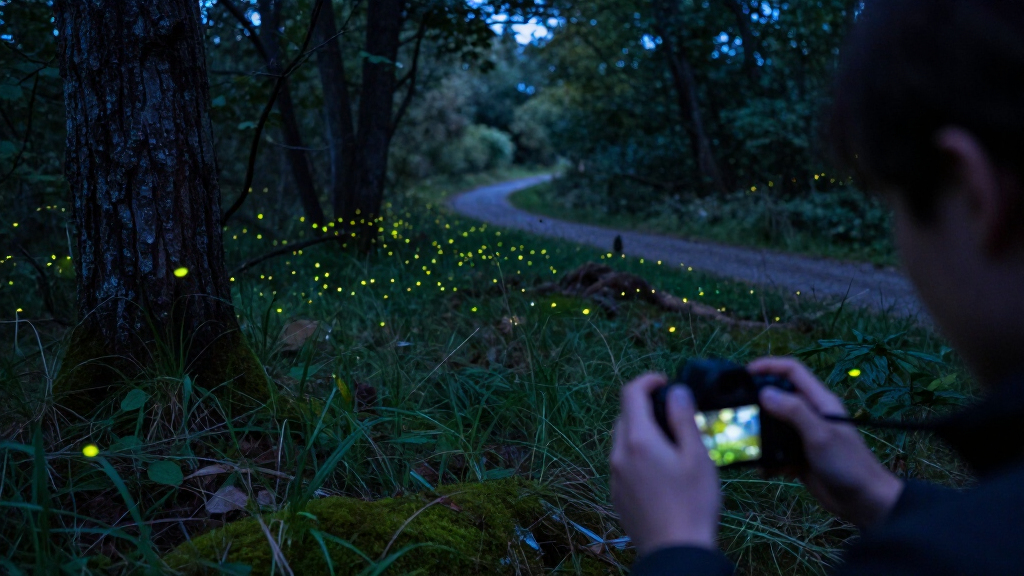

🔍 Read the full analysis: A Closer Look At The Making Of “Luciole — The Synchronous Fireflies Of Vallon Creux” on ThorstenMeyerAI.com

Get business pricing on tech for your team
- Business-only prices and quantity discounts
- Tax-exempt purchasing
- Multiple users, one account, clear invoices
TL;DR
“Luciole — The Synchronous Fireflies of Vallon Creux” is Room 155 in an AI-built exhibition series, presented as an interactive field notebook rather than a conventional explainer. Its 96 simulated fireflies gradually synchronize through a Kuramoto-style oscillator model, and visitors can disrupt the pattern and watch it recover. The fireflies, location and field-study framing are fictional; the site identifies its own AI production process as part of the work.
Room 155 of the FABLE/175 exhibition is an AI-built interactive site called “Luciole — The Synchronous Fireflies of Vallon Creux,” using a field-notebook format to demonstrate how a group of fireflies can move from scattered flashes to a shared rhythm. The exhibit says its fireflies and Vallon Creux are fictional, not a real field study, and presents the making of the site as part of the work, as detailed in the original analysis.
The live experience begins with 96 simulated fireflies flashing out of sync. Visitors can watch their rhythms converge, adjust a coupling control that changes how strongly nearby lights influence one another, or click or otherwise disturb the field. The simulation then shows the pattern recovering under the same rules. A live coherence measure, a trace of the disturbance and recovery, and a phase diagram are drawn from the simulation rather than used as decorative illustrations.
The site describes each firefly as an oscillator with an individual phase and tempo, linked to nearby neighbors. This is based on the Kuramoto synchronization model: local interactions can lead separate oscillators to align. The exhibit makes no claim that its fictional scene documents actual firefly behavior in Vallon Creux. Its stated purpose is to let visitors observe a simulated process and the effect of changing its parameters.
Its visual language is also built for the subject. The page uses a near-black green field, chartreuse flashes and muted mauve for notebook annotations. Serif text carries the main account, while handwritten-style details mark the observer’s notes. According to the supplied description, the insects and surrounding visuals are generated with HTML, CSS, SVG and canvas rather than downloaded images or a prerecorded firefly sequence.
FABLE/175 · ROOM 155 · MAKING OF
A Closer Look at the Making of Luciole
An interactive field notebook turns a fictional firefly hollow into a live demonstration of synchronization. Visitors can watch 96 simulated lights find a shared rhythm, change the rules, and see order return.
01 / THE INTERACTIVE MODEL
From scattered flashes to shared timing
The exhibit makes synchronization observable: a person can alter local influence or disrupt the field, then follow the simulation’s measures as the pattern changes.
Independent rhythms
Each simulated firefly has its own phase and tempo. At first, flashes appear out of sync across the field.
Neighbors influence neighbors
A coupling control changes how strongly nearby oscillators affect one another, based on a Kuramoto-style model.
Order can recover
Visitors can perturb the flashing pattern and watch whether the simulated group moves back toward coherence under the same rules.
What the measures follow
Live displays are described as being generated by the simulation, rather than added as decoration.
A phase diagram, in miniature
The site represents oscillator timing as a changing relationship across the group.
02 / FROM PROMPT TO FIELD
Designed as an encounter, built as a system
The source describes a single-page experience shaped by an art-direction brief and an AI production pipeline.
A fictional hollow, dark forest palette, synchronization model, and a rewarding “wait for it” moment.
The notebook framing pairs serif storytelling with handwritten-style observer annotations.
Visuals are described as generated with HTML, CSS, SVG, and canvas, without downloaded images or prerecorded footage.
Controls and live measures invite visitors to test how disturbance and coupling affect the modeled field.
THE PROMPT IS PART OF THE PIECE
The exhibit’s footer reportedly links to the original art-direction prompt, attributed to art director Claude Fable 5 and executed by the pipeline.
03 / WHAT THE WORK CLAIMS
A fictional setting, not a field study
The atmospheric notebook style can feel documentary. The exhibit’s own framing draws a clear boundary around what it represents.
Interactive explanation
Luciole offers a designed encounter with a simulated process. Its value is in making a model visible and letting visitors change its parameters.
Limits of the record
Luciole and Vallon Creux are fictional. The supplied account provides no field data, biological validation, independent accessibility audit, or device performance measurements.
04 / QUICK QUESTIONS
What visitors should know
Read the notebook as an interactive simulation with an evocative fictional setting.
Is Vallon Creux a real place?
No. The exhibit identifies both Vallon Creux and Luciole as fictional creations.
Does it document real firefly behavior?
No field observations or biological validation are supplied. The experience demonstrates a Kuramoto-style simulation.
What can visitors change?
They can adjust coupling strength and disturb the flashing field, then observe the displayed coherence, trace, and phase diagram.
Where is the creative brief?
The source says a “Prompt” link in the exhibit footer exposes the art-direction prompt.
Making Synchronization Visible
The exhibit turns an abstract idea—order emerging from local interactions—into something visitors can watch, alter and measure. Instead of simply describing synchronization, it lets a person change the coupling strength or scatter the phases, then compare the resulting light pattern with the coherence display and trace. That approach can make the model easier to grasp while showing that its apparent “behavior” follows programmed rules.
It also makes the site’s AI-assisted production part of the subject. The exhibition is not presented as a natural-history report; it is a designed, fictional encounter with a simulation. That distinction matters for readers who might otherwise mistake the evocative setting or notebook style for evidence gathered in a real forest. The piece’s value lies in its interactive explanation and art direction, not in new biological findings.
interactive firefly simulation kit
As an affiliate, we earn on qualifying purchases.
As an affiliate, we earn on qualifying purchases.
From Prompt to Interactive Field
The site is identified as Room 155 of 175 in the FABLE/175 pipeline. Its footer exposes the art-direction prompt that informed the work, attributed in the source to art director Claude Fable 5 and executed by the pipeline. The brief called for a self-contained single-page experience with a fictional hollow, a dark forest palette, a Kuramoto-based synchronization demonstration and a “wait for it” moment that rewards watching.
The brief also set technical and accessibility goals: no external requests or image assets, responsive layouts, keyboard focus styling, reduced-motion support and pausing animation when a tab is hidden. The supplied material describes these as requirements and says the live site uses generated visuals, prepared glow sprites and a pause behavior. It does not provide independent testing results, performance measurements or a documented audit confirming every target was met.
““Its signature move is to make patience visible.””
— The exhibit’s description
Kuramoto oscillator model educational kit
As an affiliate, we earn on qualifying purchases.
As an affiliate, we earn on qualifying purchases.
Limits of the Simulation Record
The supplied material does not state when the site went live, who built or reviewed each part of it, or whether the stated accessibility and performance requirements were independently tested. It also does not give technical measurements such as frame rate or confirm how the simulation behaves across specific devices. The description refers to 96 simulated fireflies, while the art-direction prompt calls for “hundreds”; the available material does not explain that difference.
There is no real study, observed firefly population or location behind Vallon Creux. The source describes the model and site design, but provides no peer-reviewed research, biological validation or external assessment of how closely the simulation represents any particular species. The live site’s behavior may be inspected directly, but the source alone does not establish those broader claims.
firefly synchronization science kit
As an affiliate, we earn on qualifying purchases.
As an affiliate, we earn on qualifying purchases.
What Visitors Can Test
The next step available to readers is to open the live site and interact with the field: watch the initial flashes, change the coupling control and disturb the rhythm to see how the displayed measures respond. The exhibit’s prompt is also available through a footer link, allowing visitors to compare the original art direction with the result.
No further release, update or evaluation is announced in the source material. Any claims about later revisions, measured accessibility, performance across devices or a more detailed account of the AI production process remain pending further information.
As an affiliate, we earn on qualifying purchases.
Key Questions
Is Vallon Creux a real place?
No. The exhibit says Vallon Creux and Luciole are fictional creations, not a real location or field study.
What does the Luciole simulation show?
It shows 96 simulated fireflies represented as oscillators. Their individual rhythms can align through local coupling, and visitors can adjust that influence or disturb the pattern.
Does the exhibit document real firefly behavior?
The source describes it as a simulation using a Kuramoto-style model, not as observations of real fireflies. It provides no field data or biological validation for the fictional setting.
How was the site’s imagery made?
The description says the visuals use HTML, CSS, SVG and canvas, including CSS-built insect shapes and generated effects, rather than downloaded image assets or prerecorded firefly footage.
Where can visitors find the original creative brief?
The source says the exhibit exposes its art-direction prompt through a “Prompt” link in the footer. The live site is listed at fable-25-830.netlify.app/sites/luciole/.
Source: ThorstenMeyerAI.com
Fall Picks
fall essentials
As an affiliate, we earn on qualifying purchases.