
📊 Full opportunity report: IEP Negotiation Skills: Rehearsal Simulators For Everyday Parents on IdeaNavigator AI — validation score, market gap, and execution plan.

Get business pricing on tech for your team
- Business-only prices and quantity discounts
- Tax-exempt purchasing
- Multiple users, one account, clear invoices
TL;DR
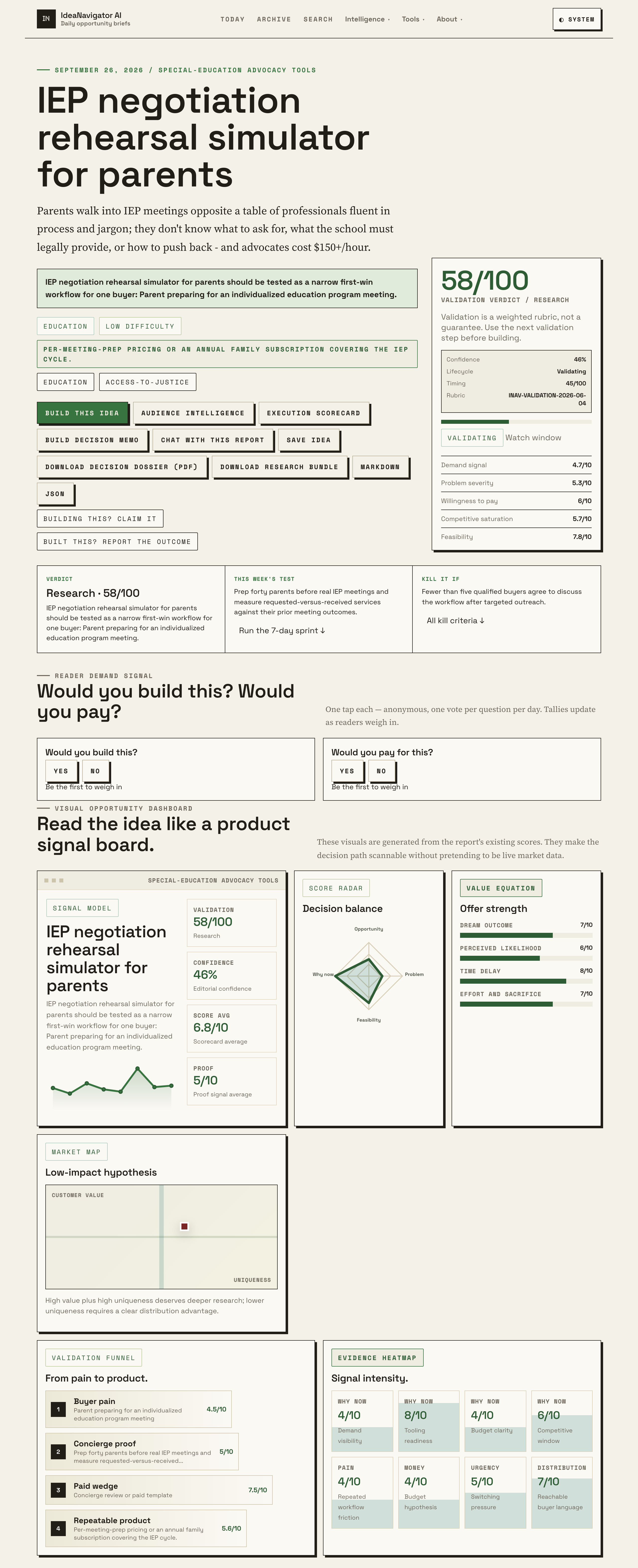
IdeaNavigator AI describes a proposed IEP meeting preparation simulator for parents, combining plain-language document review with role-play. The concept has not been shown to be a launched or tested product; its proposed first validation is to prepare 40 parents and compare outcomes with their prior meetings.
The proposed tool would let a parent upload a child’s current IEP and evaluation reports. It would explain the documents in plain language, generate a list of requests with legal grounding, and let the parent rehearse a meeting through role-play, including responses that reflect likely objections from school staff. The concept is aimed at a parent preparing for an upcoming meeting, rather than the wider market for special-education support.
IdeaNavigator AI identifies the challenge as a difference in familiarity with meeting procedures and terminology: parents may face a group of professionals who know the process well, while they may be unsure what to ask for or how to respond. It says advocates can cost $150 or more per hour, but gives no geographic scope, pricing survey or supporting data for that figure. The proposal suggests charging per preparation session or through an annual family subscription covering the IEP cycle.
The proposed validation is to prepare 40 parents before real IEP meetings, then compare the services they request with what they receive and with their outcomes in earlier meetings. No recruitment plan, comparison method, timeline or pilot results are provided. The proposal does not establish that rehearsal changes school decisions or that the tool can reliably interpret individual education records and applicable legal requirements.
A Practice Tool for IEP Meetings
If built and shown to work, the simulator could give parents a way to organize questions and practice explaining their requests before a consequential school meeting. That could be useful to families who cannot access or afford an advocate, although the concept provides no evidence yet that a simulator would fill the same role as individual advocacy.
The proposed workflow also puts legal grounding and uploaded student records at the center of the product. That makes accuracy and clear limits important: parents could rely on the explanations when deciding what services to request, while the proposal does not describe how legal references would be checked, how sensitive documents would be protected, or when a family should seek qualified human support.
The 40-parent test could offer an initial indication of whether families find the practice useful and whether request-to-receipt patterns differ from their previous meetings. By itself, that comparison would not establish that the tool caused any change. Differences between meetings, student needs and school decisions could affect outcomes.
How the Proposed Tool Would Work
An individualized education program meeting concerns a student’s special-education plan. The concept focuses on preparation for that meeting: parents would provide existing records, receive a plain-language explanation and a list of possible requests, then practice making their case in a simulated conversation.
IdeaNavigator AI presents recent improvements in large language model role-play as the reason such a simulator may now be practical. It also points to rising special-education identification rates and constrained district resources as factors that could make meetings more difficult. The proposal supplies no dates, statistics or independent evidence for those claims, so they remain rationale offered for the idea rather than verified findings in this report.
The suggested product is an early, narrow test within the broader category of special-education advocacy tools. Its initial target is not every family navigating special education, but parents preparing for one IEP meeting. The proposed commercial options are a one-time meeting-preparation fee or an annual subscription for support across the IEP cycle.
Pilot Design and Safeguards
No working product, launch schedule, operating company details or parent feedback are described. The proposal does not specify which jurisdictions its legal explanations would cover, how often those explanations would be reviewed, or how the simulator would handle conflicting or incomplete records.
It is also unclear how the suggested pilot would establish a fair comparison with parents’ previous meeting outcomes. The proposal does not state whether participants would be recruited from particular communities, how services requested and received would be defined, or whether any other factors would be tracked. No results are available to support claims that role-play improves meeting performance or service outcomes.
Privacy protections for uploaded education and evaluation records are not described. Nor does the concept explain how the tool would distinguish general preparation from legal advice, or what it would tell parents when a case requires individual professional guidance.
A 40-Parent Test Is Proposed
The next step outlined by IdeaNavigator AI is to prepare 40 parents for actual IEP meetings and compare requested and received services with each parent’s earlier meeting outcomes. The proposal does not give a start date or say that recruitment has begun.
A useful account of any pilot would need to explain how participants and prior meetings were selected, what outcomes were measured, and how the team handled privacy and legal accuracy. Until such details and results are reported, the simulator’s effectiveness and commercial viability remain untested.
Source: IdeaNavigator AI
Key Questions
Has the IEP meeting simulator launched?
No launch is reported. IdeaNavigator AI describes a proposed concept and a possible pilot, without a release date or evidence of a working product.
What would the simulator do?
The proposed tool would review a parent’s IEP and evaluation reports, explain them in plain language, suggest requests with legal grounding and provide role-play practice for a meeting.
Has it been shown to improve services for students?
No results are provided. The suggested test would compare services requested and received by 40 parents with their prior meeting outcomes, but no pilot findings are available.
How would families pay for it?
The concept proposes either a per-meeting preparation fee or an annual family subscription covering the IEP cycle. It does not specify prices.
Source: IdeaNavigator AI
Fall Picks
fall essentials
As an affiliate, we earn on qualifying purchases.