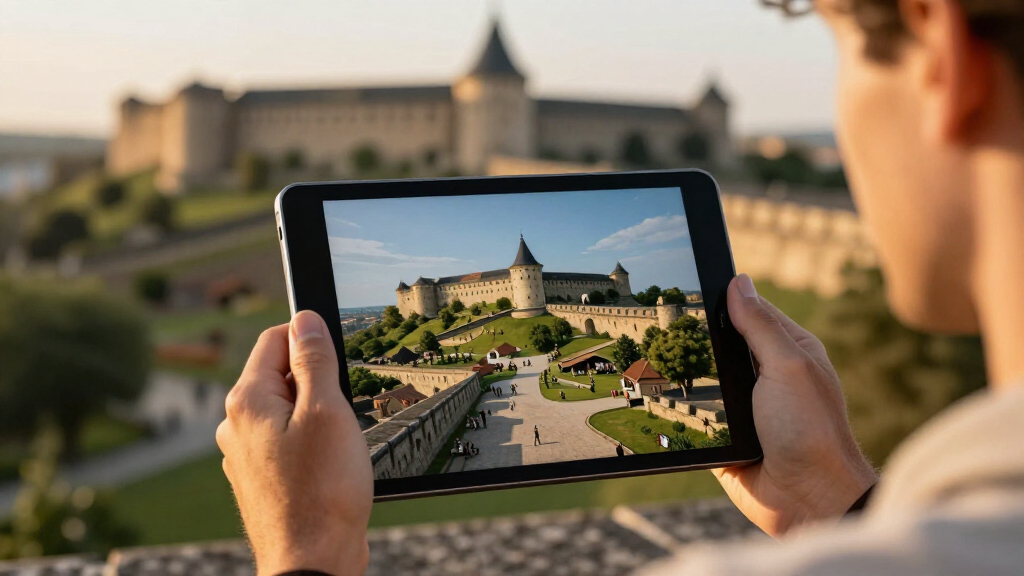

🔍 Read the full analysis: How Artificial Intelligence Creates Immersive History Of La Citadelle, 1693 on ThorstenMeyerAI.com

Get business pricing on tech for your team
- Business-only prices and quantity discounts
- Tax-exempt purchasing
- Multiple users, one account, clear invoices
TL;DR
AI-driven technology has produced a highly detailed, interactive digital exhibit depicting the 1693 siege of La Citadelle. This innovation offers a new way to experience history visually and narratively, with ongoing development and validation processes.
Artificial intelligence has generated an interactive, cinematic simulation of the 1693 siege of La Citadelle, accessible through a new digital exhibition. This project aims to blend historical fidelity with artistic storytelling, offering users an immersive experience that visualizes military movements, terrain, and siege tactics without using static images.
The exhibit, hosted on a dedicated website, employs layered SVGs, CSS, and canvas elements to create a scroll-driven, animated map of the siege, as detailed in the original analysis. It features detailed representations of earthworks, artillery trajectories, and fortifications, all orchestrated by AI-powered site logic. The project follows a three-stage development pipeline: initial construction, iterative AI-driven critique, and final approval by an art director.
According to the creators, the process emphasizes layered architecture, precise interactions, and emotional depth rooted in the fictional siege narrative. The site employs a restrained color palette inspired by archival materials—parchment, fortress ink, smoke, and red accents—and uses a combination of fonts to establish hierarchy and gravitas. The cinematic ambiance is enhanced through CSS transforms, parallax effects, and animated textures modeled after historical engravings, all created without static images, ensuring scalability and high fidelity across devices.
Thorsten Meyer, involved in the project, explained that the AI-guided workflow allows for continuous critique and refinement, balancing educational content with aesthetic restraint. The final product aims to serve as a digital monument that educates, immerses, and engages viewers in a simulated historical environment.
Innovative Use of AI in Digital Historical Reconstruction
This project demonstrates how artificial intelligence can revolutionize historical education and digital storytelling. By creating an immersive, interactive experience grounded in meticulous digital craftsmanship, it offers a new way to explore history beyond traditional texts and static images. The approach could influence future museum exhibits, educational tools, and virtual reconstructions, making history more accessible and engaging for diverse audiences.
Furthermore, the project highlights the potential of AI to balance artistic storytelling with historical accuracy, fostering a deeper understanding of complex military and architectural tactics used during sieges like that of La Citadelle in 1693. As the technology matures, it may lead to more personalized, dynamic educational experiences that adapt to user interaction and interest.
interactive history museum exhibits
As an affiliate, we earn on qualifying purchases.
As an affiliate, we earn on qualifying purchases.
Background on Digital Reconstructions and AI-Generated Exhibits
Recent advancements in digital technology have enabled the creation of highly detailed virtual environments, but integrating AI for dynamic critique and refinement remains relatively novel. The 1693 siege of La Citadelle is a historically significant event, often studied through static maps and engravings. The use of AI to generate an interactive, cinematic reconstruction marks a significant step forward in digital historiography.
Previous efforts in digital history have included virtual museums and 3D reconstructions, but these often rely on static assets or limited interactivity. The current project distinguishes itself by employing layered SVGs, CSS, and canvas elements orchestrated by AI to produce a seamless, scroll-driven narrative that adapts in real-time. This approach aligns with broader trends in AI-assisted content creation, emphasizing layered architecture, responsiveness, and artistic storytelling without static images or external assets.
“This project showcases how AI can serve as both creator and critic, enabling us to craft immersive history experiences that are both accurate and emotionally compelling.”
— Thorsten Meyer
AI-powered virtual reality history
As an affiliate, we earn on qualifying purchases.
As an affiliate, we earn on qualifying purchases.
Uncertainties in Historical Accuracy and AI Critique
While the exhibit emphasizes historical fidelity, the extent of AI’s role in ensuring accuracy remains a subject of ongoing evaluation. It is not yet clear how much of the visualization is based on verified historical data versus artistic interpretation. The critique process is designed to improve visual coherence and plausibility, but the precise standards for historical accuracy are still being refined.
Additionally, the long-term reliability of AI-driven critique and approval, especially in complex historical reconstructions, is still under review. Experts are monitoring whether the AI can consistently balance artistic storytelling with factual correctness in such projects.
digital historical reconstruction software
As an affiliate, we earn on qualifying purchases.
As an affiliate, we earn on qualifying purchases.
Future Developments and Validation of AI-Generated Exhibits
The project team plans to continue refining the AI critique process, incorporating more detailed historical data and expert feedback. Future iterations may include user interaction features, allowing viewers to explore different siege scenarios or access supplementary historical context.
Validation efforts are ongoing to compare the exhibit’s accuracy with primary sources and expert assessments. Researchers aim to establish standards for AI-assisted digital history, ensuring reliability and educational value. The exhibit remains accessible online, with updates expected as the technology and historical data integration improve.
As an affiliate, we earn on qualifying purchases.
Key Questions
How accurate is the AI reconstruction of the 1693 siege?
The reconstruction aims to balance historical detail with artistic storytelling. While it is based on available historical data, the AI critique process is still refining the standards for factual accuracy, and some artistic interpretation may be present.
Can I interact with the exhibit to learn more about the siege?
Yes, the exhibit is scroll-driven and interactive, allowing users to explore military movements, terrain, and siege tactics dynamically. Additional features or scenarios may be added in future updates.
What technologies power this AI-generated reconstruction?
The exhibit uses layered SVGs, CSS, and canvas elements orchestrated by AI logic, without relying on static images or external assets. It employs JavaScript for animations and interactions, ensuring high scalability and fidelity.
Will this approach be used for other historical events?
Potentially, yes. The successful integration of AI critique and layered digital storytelling could be adapted to reconstruct other historical battles or sites, broadening the scope of digital history education.
Source: ThorstenMeyerAI.com
Fall Picks
fall essentials
As an affiliate, we earn on qualifying purchases.