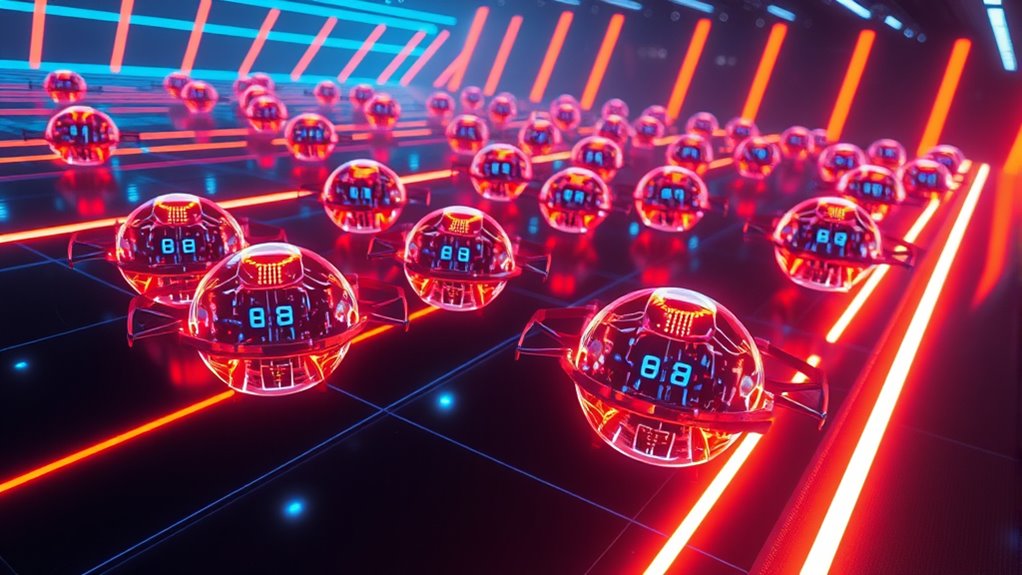

Multi-agent systems involve multiple AI agents working together or competing within shared environments to solve problems more effectively. Collaboration allows agents to share information, coordinate actions, and combine skills to optimize outcomes. Competition arises when agents have conflicting goals or limited resources, leading them to strategize and negotiate for advantage. Understanding how these dynamics function can improve system performance, and exploring further reveals how cooperation and competition shape intelligent agent interactions.

Get business pricing on tech for your team
- Business-only prices and quantity discounts
- Tax-exempt purchasing
- Multiple users, one account, clear invoices
Key Takeaways
- Multi-agent systems involve autonomous agents working together or competing to achieve individual or collective goals.
- Collaboration enables agents to share information, coordinate actions, and optimize overall system performance.
- Competition arises when agents pursue conflicting interests, often involving strategic behavior and resource contention.
- Agents learn and adapt over time, refining strategies based on interactions within dynamic environments.
- Effective communication protocols facilitate seamless cooperation and competition, enhancing MAS capabilities in complex real-world applications.

Have you ever wondered how multiple autonomous entities can work together to solve complex problems? Multi-agent systems (MAS) are designed to do just that. These systems consist of multiple AI agents that interact within a shared environment, each with individual goals, capabilities, and knowledge. Unlike a single, monolithic AI, MAS leverages the diversity and specialization of each agent to handle tasks that are too intricate or extensive for one entity alone. This setup allows for distributed problem-solving, where responsibilities are divided, and agents collaborate or compete to achieve their objectives efficiently.
Multi-agent systems enable autonomous entities to collaborate and solve complex problems efficiently.
In a multi-agent system, collaboration is often essential. You might imagine agents working together like a team of specialists, each contributing unique skills to reach a common goal. For instance, in a logistics network, one agent could handle route planning, another manages inventory, and a third tracks delivery schedules. By sharing information and coordinating actions, they optimize overall efficiency. This cooperative behavior relies on communication protocols, negotiation, and shared data, enabling agents to adapt to changing circumstances dynamically. Collaboration can markedly improve system robustness, scalability, and responsiveness, especially in complex environments where single agents might struggle.
However, multi-agent systems aren’t solely about cooperation. Competition also plays a crucial role, especially in scenarios where agents have conflicting interests or limited resources. You might see this in markets or resource allocation problems, where each agent aims to maximize its own utility. In such cases, agents act strategically, sometimes competing for the same resources or trying to outmaneuver others. This competitive aspect introduces game-theoretic considerations into MAS design. Agents must balance cooperation with competition, negotiating deals, forming alliances, or even engaging in adversarial tactics to gain advantages. This duality makes MAS versatile, capable of modeling real-world systems where cooperation and competition coexist.
Furthermore, multi-agent systems often involve learning and adaptation. As agents interact, they can refine their strategies based on experience, improving their performance over time. This adaptability enhances their ability to handle unpredictable environments and evolving tasks. Whether collaborating toward a shared goal or competing for limited resources, agents learn to predict the actions of others, adjust their strategies, and optimize outcomes. This dynamic interplay makes MAS powerful for applications like robotics, traffic management, distributed sensing, and economic modeling.
Additionally, standardized communication protocols are vital for ensuring seamless interaction among agents, enabling them to share information effectively and coordinate their efforts.
In essence, multi-agent systems harness the strengths of multiple autonomous entities, fostering collaboration and enabling strategic competition. This balance allows them to solve complex problems more effectively than isolated AI, reflecting the intricacies of real-world interactions.
multi-agent system simulation software
As an affiliate, we earn on qualifying purchases.
As an affiliate, we earn on qualifying purchases.
Frequently Asked Questions
How Do Agents Decide When to Cooperate or Compete?
You decide whether to cooperate or compete based on the goals and potential benefits or risks involved. If collaboration offers mutual advantages and aligns with your objectives, you’ll choose to work together. However, if your interests conflict or you can gain more by acting independently, you’ll opt to compete. Your decision depends on analyzing the environment, predicting others’ actions, and weighing short-term gains against long-term outcomes.
What Are the Main Challenges in Designing Multi-Agent Systems?
You face challenges like guaranteeing effective communication, managing conflicting goals, and maintaining system stability. Designing agents that adapt to dynamic environments requires balancing cooperation and competition without causing chaos. You also need to handle scalability, prevent malicious behavior, and ensure robust decision-making. These obstacles demand careful planning, advanced algorithms, and constant monitoring to create a reliable, efficient multi-agent system that meets your objectives.
How Is Trust Established Among Autonomous Agents?
You establish trust among autonomous agents by implementing secure communication protocols, ensuring information sharing is accurate and tamper-proof. You also design reinforcement learning mechanisms so agents can learn from past interactions, building reliability over time. Clear rules and shared goals help foster cooperation, while transparency and accountability make it easier for agents to rely on each other. Consistent, predictable behavior is key to maintaining and strengthening trust in multi-agent systems.
Can Multi-Agent Systems Adapt to Changing Environments?
Yes, multi-agent systems can adapt to changing environments. You program them with flexible algorithms that allow agents to learn from new data and interactions. By incorporating techniques like reinforcement learning or dynamic decision-making, they can modify their behaviors in response to environmental shifts. This adaptability guarantees they remain effective and coordinated, even when conditions evolve unexpectedly, making your system robust and capable of handling real-world complexities.
What Ethical Considerations Arise in Multi-Agent Interactions?
You should consider ethical issues like fairness, transparency, and accountability when designing multi-agent interactions. Make certain that your AI agents act responsibly, avoiding bias and discrimination. It’s important to make their decision-making processes clear, so users understand how outcomes are achieved. You also need to monitor their actions continuously, preventing harm and ensuring that collaboration and competition serve human interests ethically. Prioritizing these aspects helps build trustworthy and socially beneficial systems.
As an affiliate, we earn on qualifying purchases.
Conclusion
You might think that collaboration and competition among AI agents are just simple strategies, but research suggests they could be the key to uncovering truly intelligent systems. Some experts believe multi-agent systems mimic human teamwork and rivalry, leading to breakthroughs in problem-solving. As you explore this field, consider whether these interactions could someday surpass human capabilities or even reshape how machines learn and adapt. The future of AI collaboration and competition is more exciting—and uncertain—than you might imagine.
distributed AI problem-solving platform
As an affiliate, we earn on qualifying purchases.
As an affiliate, we earn on qualifying purchases.
multi-agent negotiation software
As an affiliate, we earn on qualifying purchases.
As an affiliate, we earn on qualifying purchases.
Halloween Picks
halloween
As an affiliate, we earn on qualifying purchases.