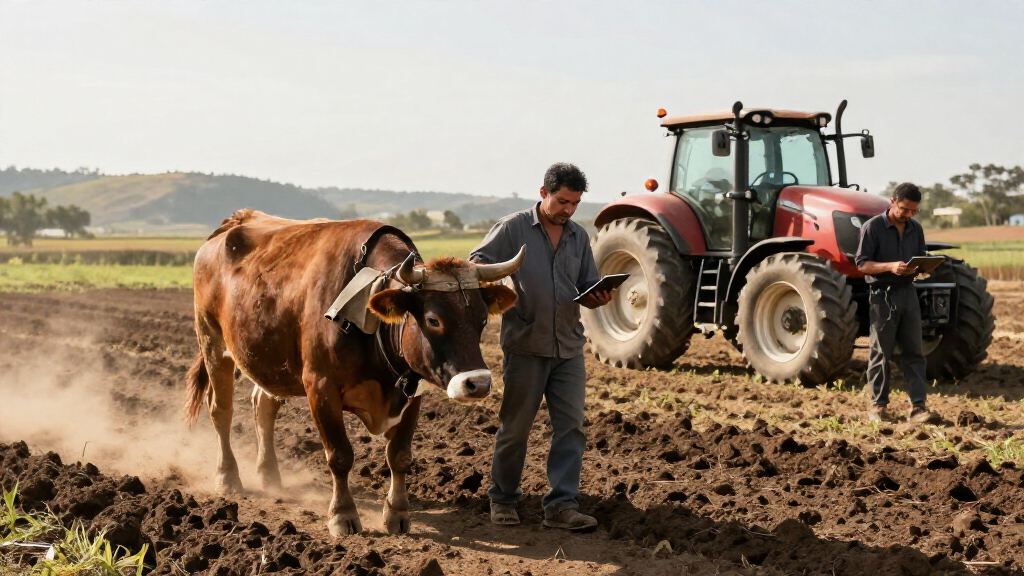

🔍 Read the full analysis: The Story Of 26.7 Million Working Animals In A Changing Farm on ThorstenMeyerAI.com

Get business pricing on tech for your team
- Business-only prices and quantity discounts
- Tax-exempt purchasing
- Multiple users, one account, clear invoices
TL;DR
U.S. farms had 26.7 million horses and mules on Jan. 1, 1918, but by 1960 the count had fallen to 3.1 million as tractors and other machinery spread. The change cut the acreage used to grow animal feed and reduced farm employment, while the broader U.S. labor force grew and work shifted toward cities. The episode presents this history as a possible analogy for automation today, not a prediction that human workers will follow the same path.
A Nov. 4 episode of ThorstenMeyerAI.com’s “Work After Work” series recounts how tractors displaced most U.S. farm horses and mules: their population peaked at 26.7 million on Jan. 1, 1918, then fell to 3.1 million by 1960. The account uses the shift to examine automation and employment, while stressing that the horse-to-tractor comparison is an analogy, not a law predicting what will happen to human workers.
The figures in the episode draw on the U.S. Census Bureau’s Historical Statistics of the United States, Colonial Times to 1970, which reprints Department of Agriculture estimates. Horses alone peaked at 21.4 million in 1915; mules continued to increase, bringing the combined total to 26.7 million three years later. The series counted animals on farms each Jan. 1.
Keeping those animals fed required substantial farmland. In 1915, about 93 million acres—more than a quarter of the country’s 340 million harvested cropland acres—grew feed for horses and mules. The source says that figure was still 90 million acres in 1920, but had fallen to about 5 million acres by 1960.
Tractors spread during the same period. The account lists about 1,000 on U.S. farms in 1910, 246,000 in 1920 and 4.69 million in 1960. Around 1955, tractors outnumbered horses and mules for the first time, according to the figures presented. Ford’s 1917 Fordson helped make tractors more accessible: The Henry Ford museum describes it as a mass-produced, inexpensive lightweight tractor aimed at small farmers.
Other machines also changed farm production. Combine harvesters rose from about 4,000 on U.S. farms in 1920 to more than one million in 1960. Department of Agriculture figures cited in the episode say one farm worker supplied 7.1 people in 1910 and 47.1 in 1970; that measure includes people abroad supplied through exports.
Land and Labor After the Tractor
The change involved more than replacing one source of power with another. When fewer animals needed feed, farmland could be used for crops for people or for sale. The account describes the shift as a hidden dividend of mechanization, alongside the rise in output per farm worker.
Employment moved as well. U.S. farm employment peaked at 13.6 million in 1916 and was down to 4.5 million by 1970, according to the source. Meanwhile, it says, the total U.S. labor force doubled. That does not mean every displaced farm worker moved directly into a new job: the episode says new work increasingly appeared in cities, requiring people to move. The numbers describe a major economic shift, but do not by themselves establish what happened to each worker or household.
That distinction matters when the episode draws a comparison with present-day automation. Machinery can eliminate or change particular tasks while new work grows elsewhere, but the historical figures alone cannot show whether displaced workers can access those jobs, where they will be, or how quickly the change will happen.
Products Worth Considering

Logitech MX Master 4 for Mac Wireless Ergonomic Mouse, Space Black

EcoFlow Delta 3 Portable Power Station – 1024 Wh, 1800 W

DJI Osmo Mobile 7P Smartphone Gimbal Stabilizer with Mic Mini Transmitter, Infinity Black
As an affiliate, we earn on qualifying purchases.
From Farm Animals to Automation Debate
The tractor’s spread was part of a wider change in farm technology, not a single-machine story. The episode points to combines, corn pickers, pickup balers and milking machines, as well as fertilizer and improved seed. Together, these changes helped farms produce more with fewer workers. The account also notes that the tractor count series excludes steam and garden tractors, and that census counts used slightly different dates in some years.
In 1983, economist Wassily Leontief compared workers to horses replaced by tractors, according to the episode. It also identifies an important limit to that comparison: horses could not vote. Human workers can participate in political decisions and seek policies to shape the effects of economic change; the historical comparison cannot account for those differences or settle what automation will do to people.
The episode connects that earlier history with current farm technology, including John Deere’s 16-camera autonomy kit, which it says was announced in February 2025 for tillage on select large tractors. It also reports China’s claim that about 74% of ploughing, sowing and harvesting was mechanized in 2023. These examples point to continued mechanization, but do not establish how many jobs newer systems will replace.
“The episode says Leontief compared workers to horses replaced by tractors and noted that horses could not vote.”
— Wassily Leontief, as summarized in the episode
What the Horse Comparison Cannot Show
The historical counts document the decline in farm horses and mules, but the source does not provide a detailed account of what happened to every animal or to each worker who left farming. It says farmers stopped breeding replacements and the existing working population aged out; it does not describe a single mass event or quantify individual outcomes.
The episode’s figures also do not establish that today’s automation will produce the same employment pattern. It offers examples of current machinery, but does not quantify jobs affected by autonomous tractors or explain how their use will spread across farms of different sizes. The China mechanization figure is presented as a claim by China, not as an independently detailed comparison in the supplied material.
Questions for Farm Automation Today
The episode’s next step is analytical rather than a reported policy or industry milestone: it examines what happened to farm workers, how mechanization unfolded in China, Germany and Japan, and where the horse analogy has limits. Its account gives no date for a follow-up episode or new data release.
For current automation, the open questions include how widely autonomous systems will be used beyond selected large tractors, which farm tasks they can handle, and how changes will affect employment and rural communities. The historical record offers a case study in the scale and speed of technological change, but current evidence will be needed to answer those questions.
Key Questions
When did U.S. farm horses and mules reach their peak?
The combined count peaked at 26.7 million on Jan. 1, 1918, according to the historical estimates cited in the episode. Horses alone peaked earlier, at 21.4 million in 1915.
How many farm horses and mules remained by 1960?
The count had fallen to 3.1 million by 1960, almost 90% below the 1918 peak, according to the figures presented.
When did tractors outnumber horses and mules?
The episode says the crossover happened around 1955: it lists 4.35 million tractors and 4.31 million horses and mules.
Does the history prove that automation will replace human workers in the same way?
No. The episode presents the horse comparison as an analogy, not a law. The past shows that machinery transformed farm work, but does not establish how current automation will affect people, jobs or wages.
Source: ThorstenMeyerAI.com