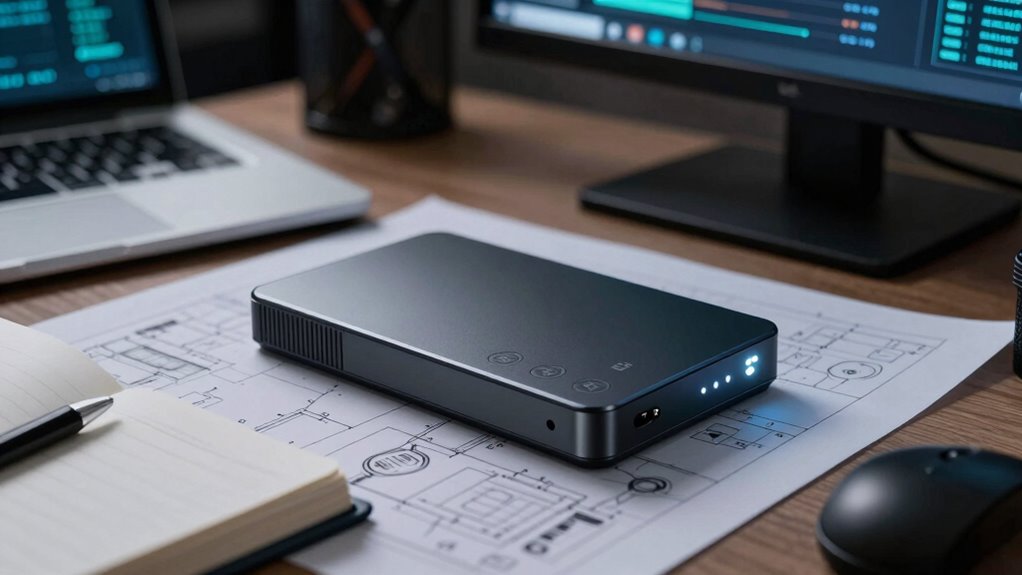

If you’re searching for a hardware encrypted SSD for compliance, you’re likely balancing security, performance, and ease of use. The best options protect sensitive data with hardware-level encryption, meeting strict regulations like GDPR, HIPAA, or PCI DSS. Among these, the BUSlink CipherShield stands out for high capacity and robust encryption, while the Kingston IronKey Vault Privacy 80 offers a compact design with enterprise-grade security. However, tradeoffs include higher costs or reduced portability depending on the model. Continue reading for a full breakdown of the top choices and what makes each unique.
Key Takeaways
- High-capacity drives like the BUSlink CipherShield excel for enterprise use, but come with a higher price tag.
- Compact encrypted USBs like the Kingston IronKey Vault Privacy 50 are ideal for quick, portable security but may lack large storage capacity.
- Durability features such as rugged enclosures and shock resistance are common in drives suited for field or mobile work.
- Encryption standards like AES-256 are standard, but additional security features like PIN or biometric authentication vary widely.
- Pricing often correlates with feature set; the most secure models tend to cost more but offer greater compliance assurance.
| BUSlink CipherShield CSE16TSDSU3M1 16TB Encrypted External Desktop SSD Drive |  | Best Overall for Large-Scale Secure Data Storage | Capacity: 16TB | Encryption: 256-bit AES hardware encryption | Standards: FIPS 140-2 Level 2 | VIEW ON AMAZON | See Our Full Breakdown |
| Kingston IronKey Vault Privacy 80 1.92TB External SSD |  | Best for User-Friendly Security with Multi-Password Management | Capacity: 1.92TB | Encryption: XTS-AES 256-bit | Certification: FIPS 197 | VIEW ON AMAZON | See Our Full Breakdown |
| Kingston IronKey Vault Privacy 50 256GB Encrypted USB |  | Best for Secure Data Transfer in Compact Form | Storage Capacity: 256GB | Encryption: XTS-AES 256-bit | Compliance: TAA | VIEW ON AMAZON | See Our Full Breakdown |
| Apricorn 1TB Aegis Padlock Fortress USB 3.0 Hard Drive with PIN Access |  | Best for Cross-Platform Secure Storage with PIN Entry | Storage Capacity: 1TB | Encryption: 256-bit AES XTS | Connection: USB 3.0 | VIEW ON AMAZON | See Our Full Breakdown |
| SanDisk Professional 1TB G-DRIVE ArmorLock SSD – Encrypted NVMe Solid State Drive, USB-C, Rugged Security |  | Best for High-Speed Portable Security in Rugged Conditions | Capacity: 1TB | Speed: 1000MB/s read/write | Connectivity: USB-C | VIEW ON AMAZON | See Our Full Breakdown |
| iStorage diskAshur PRO3 SSD 1TB – Secure Portable Solid State Drive |  | Best Overall for High-Security Portable Storage | Storage Capacity: 1TB | Encryption: AES-XTS 256-bit hardware encryption | Certification: FIPS 140-3 Level 3 (pending) | VIEW ON AMAZON | See Our Full Breakdown |
| SecureData SecureDrive KP 2TB SSD External Encrypted USB 3.0 Drive |  | Best for Multi-Method Biometric Security and Durability | Storage Capacity: 2TB | Connection: USB 3.2, USB-C, USB-A | Encryption: Hardware encrypted | VIEW ON AMAZON | See Our Full Breakdown |
| DataLocker DL4 FE 2TB USB-C / -A External Hard Drive with AES-256 Encryption |  | Best for User-Friendly Management and Multiple Platforms | Capacity: 2TB | Connectivity: USB-C / USB-A | Encryption: AES-256-bit hardware encryption | VIEW ON AMAZON | See Our Full Breakdown |
| iStorage diskAshur PRO2 1TB Portable Secure Hard Drive |  | Best Rugged FIPS 140-2 Certified HDD for Durability and Security | Capacity: 1TB | Encryption: AES-XTS 256-bit hardware encryption | Certification: FIPS 140-2 Level 3 | VIEW ON AMAZON | See Our Full Breakdown |
| iStorage diskAshur M2 1TB PIN-Authenticated Hardware Encrypted Portable SSD |  | Best for Rugged, Fast, and Secure Data on the Go | Storage Capacity: 1TB | Hard Disk Interface: USB 3.2 | Connectivity Technology: USB | VIEW ON AMAZON | See Our Full Breakdown |
| hardware encrypted ssd for compliance | Encryption | Capacity | Storage Capacity |
|---|---|---|---|
| BUSlink CipherShield CSE16TSDS | 256-bit AES hardware encryption | 16TB | — |
| Kingston IronKey Vault Privacy | XTS-AES 256-bit | 1.92TB | — |
| Kingston IronKey Vault Privacy | XTS-AES 256-bit | — | 256GB |
| Apricorn 1TB Aegis Padlock For | 256-bit AES XTS | — | 1TB |
| SanDisk Professional 1TB G-DRI | — | 1TB | — |
| iStorage diskAshur PRO3 SSD 1T | AES-XTS 256-bit hardware encryption | — | 1TB |
| SecureData SecureDrive KP 2TB | Hardware encrypted | — | 2TB |
| DataLocker DL4 FE 2TB USB-C / | AES-256-bit hardware encryption | 2TB | — |
| iStorage diskAshur PRO2 1TB Po | AES-XTS 256-bit hardware encryption | 1TB | — |
| iStorage diskAshur M2 1TB PIN- | — | — | 1TB |
More Details on Our Top Picks
BUSlink CipherShield CSE16TSDSU3M1 16TB Encrypted External Desktop SSD Drive
This model is ideal for organizations needing massive storage with hardware encryption that doesn’t compromise performance. Compared with the SanDisk ArmorLock, the BUSlink offers significantly larger capacity—16TB versus 1TB—and TAA compliance, making it suitable for government and regulated environments. However, it lacks detailed encryption key management features, which could be a concern for highly sensitive data. Its shock-resistant design and fast transfer options via USB 3.0 and eSATA make it versatile for secure, on-the-go use. The main tradeoff is the higher cost due to its extensive security and capacity features, which might be overkill for smaller operations.
Pros:- Massive 16TB storage capacity for extensive data needs
- Hardware-based 256-bit AES encryption ensures data protection
- TAA-compliant, suitable for government procurement
- Shock-resistant solid-state design for durability
Cons:- Higher price point due to security and capacity features
- Lacks detailed encryption key management options
Best for: Large government agencies or enterprises requiring high-capacity, compliant storage solutions.
Not ideal for: Small businesses or individual users with limited budgets and less complex security needs.
- Capacity:16TB
- Encryption:256-bit AES hardware encryption
- Standards:FIPS 140-2 Level 2
- Interfaces:USB 3.0, eSATA
- Compliance:HIPAA, HITECH, FERPA, TAA
Our verdict“This external SSD suits large organizations seeking high-capacity, compliant encryption without compromising speed.”
Kingston IronKey Vault Privacy 80 1.92TB External SSD
This pick makes the most sense for security-conscious professionals who value ease of use. It features a built-in touch-screen for straightforward password management, unlike the Kingston IronKey Vault Privacy 50 USB, which relies solely on software. The 1.92TB capacity strikes a good balance between portability and storage needs, though its price can be high for the size, and setup might be complex for less tech-savvy users. Compared to the SanDisk ArmorLock, it offers enhanced security features like multi-password support and attack protection, but its larger size and touchscreen may be less portable than rugged drives. The tradeoff lies in its premium price versus ease of user control.
Pros:- Large 1.92TB capacity for portable encrypted storage
- Touch-screen interface simplifies password management
- Supports multiple password modes and attack protection
- FIPS 197 certification ensures compliance
Cons:- Setup can be complex for non-technical users
- Premium cost may be prohibitive for some
Best for: IT professionals and security teams who need manageable, encrypted storage with multi-layered password options.
Not ideal for: Casual users or those seeking an affordable, simple encrypted drive without advanced security features.
- Capacity:1.92TB
- Encryption:XTS-AES 256-bit
- Certification:FIPS 197
- Features:Touch-screen, Multi-password, Dual read-only modes
Our verdict“This drive is best suited for security-focused professionals who prioritize ease of password management and compliance.”
Kingston IronKey Vault Privacy 50 256GB Encrypted USB
Compared with larger encrypted drives like the IronKey Vault Privacy 80, this 256GB USB provides a portable solution focused on secure, quick data transfers. Its hardware-based XTS-AES 256-bit encryption and write-protect features make it suitable for users needing to move sensitive data securely across different environments. The limited capacity, however, restricts use to smaller datasets, making it less ideal for bulk storage needs. While it’s simple to carry and offers multiple password options, it lacks detailed performance specs like transfer speeds, which could impact workflow efficiency. The main tradeoff is between portability and storage capacity, making it perfect for secure transfer but not large-scale storage.
Pros:- High-level hardware encryption for secure transfers
- Multiple password and passphrase options
- Write-protect feature prevents accidental data loss
- TAA compliance supports government use
Cons:- Limited to 256GB capacity, less suitable for large datasets
- Lack of detailed transfer speed specifications
Best for: Mobile professionals who need encrypted data transfer with high security on the go.
Not ideal for: Users requiring large capacity or constant heavy-duty data storage, where size limits could be restrictive.
- Storage Capacity:256GB
- Encryption:XTS-AES 256-bit
- Compliance:TAA
- Features:Multiple passwords, attack protection, write-protect
Our verdict“This encrypted USB is ideal for secure, portable data transfer where size is a priority over capacity.”
Apricorn 1TB Aegis Padlock Fortress USB 3.0 Hard Drive with PIN Access
This 1TB encrypted drive excels for users needing compatibility across Windows, Mac, and Linux, unlike many encrypted drives that are limited to specific OS. Its PIN keypad provides direct hardware access control, reducing reliance on software and making it more resilient against malware. The 256-bit AES encryption and water/dust resistance add to its durability and security. However, its reliance on a USB port and lack of advanced encryption key management might be a concern for highly sensitive or enterprise-level security. Compared to the Kingston IronKey Vault Privacy 50, it offers broader OS compatibility but may lack the same level of security customization. The main tradeoff is ease of use versus advanced security features.
Pros:- Hardware-based 256-bit AES encryption
- PIN keypad for direct hardware security
- Water and dust resistant design
- Compatible with Windows, Mac, and Linux
Cons:- Requires USB port, limiting flexibility
- No advanced encryption key management features
Best for: Mixed-OS environments requiring secure, portable, hardware-encrypted storage with physical access control.
Not ideal for: Users looking for cloud integration or high-capacity storage, as it is limited to 1TB and local use only.
- Storage Capacity:1TB
- Encryption:256-bit AES XTS
- Connection:USB 3.0
- Security:PIN keypad, water/dust resistance
Our verdict“This drive is well-suited for users needing cross-platform, hardware-encrypted storage with simple PIN access.”
SanDisk Professional 1TB G-DRIVE ArmorLock SSD – Encrypted NVMe Solid State Drive, USB-C, Rugged Security
Compared to traditional encrypted drives like the Apricorn Aegis Padlock, the SanDisk ArmorLock offers blazing-fast transfer speeds up to 1000MB/s, making it ideal for professionals transferring large files quickly. Its ArmorLock technology includes quick unlocking via smartphone, simplifying access without sacrificing security. The rugged construction ensures durability in harsh environments, unlike some less durable drives. However, performance may vary depending on device compatibility and environmental conditions, and the 1TB capacity might be limiting for high-volume data needs. The tradeoff here lies in balancing speed, ruggedness, and convenience against capacity and potential environmental performance limitations.
Pros:- Fast transfer speeds up to 1000MB/s
- Secure ArmorLock encryption technology
- Easy phone-based unlocking for quick access
- Ultra-rugged, durable design
Cons:- Performance can depend heavily on device and conditions
- Limited to 1TB capacity
Best for: Creative professionals and field workers needing rapid, secure data transfers with rugged protection.
Not ideal for: Users who require multi-terabyte storage or primarily stationary use where speed and ruggedness are less critical.
- Capacity:1TB
- Speed:1000MB/s read/write
- Connectivity:USB-C
- Security:ArmorLock encryption
- Design:Ultra rugged
Our verdict“This SSD is perfect for mobile professionals demanding fast, rugged, and encrypted storage with simple access via smartphone.”
iStorage diskAshur PRO3 SSD 1TB – Secure Portable Solid State Drive
The diskAshur PRO3 stands out for its robust hardware encryption and compliance readiness, making it ideal for users who need portable security with the highest standards. Compared with the iStorage diskAshur PRO2, it offers faster transfer speeds and a more modern interface, though it comes at a higher price. The FIPS 140-3 Level 3 certification, still pending, hints at future compliance assurances but isn’t guaranteed yet. Its auto-lock feature and alphanumeric keypad add layers of security, but the lack of included management software means setup can be more manual. This drive is best suited for security-conscious professionals who prioritize compliance and portability, accepting a premium price for peace of mind.
Pros:- High-level hardware encryption (AES-XTS 256-bit) for secure data protection
- FIPS 140-3 Level 3 certification (pending) for compliance readiness
- Auto-lock feature and alphanumeric keypad for enhanced security
- Supports multiple operating systems and devices
Cons:- No included management software, requiring manual configuration
- Premium price point may be prohibitive for some users
- Pending certification status may cause uncertainty for compliance deadlines
Best for: IT security managers and compliance officers needing portable encryption with future-proof certifications
Not ideal for: Budget-conscious users or those preferring plug-and-play simplicity without manual setup
- Storage Capacity:1TB
- Encryption:AES-XTS 256-bit hardware encryption
- Certification:FIPS 140-3 Level 3 (pending)
- Read Speed:up to 448 MB/s
- Write Speed:up to 444 MB/s
- Connectivity:USB
Our verdict“This drive is best for security teams needing portable encryption that aligns with rigorous compliance standards, despite the higher cost and setup effort.”
SecureData SecureDrive KP 2TB SSD External Encrypted USB 3.0 Drive
The SecureDrive KP excels in offering multiple unlocking options, including face ID, fingerprint, keypad, and password, making it ideal for users who want flexible biometric security. While its 2TB capacity surpasses many competitors like the diskAshur PRO2, its listed transfer speeds of up to 5MB/s seem unusually slow, likely a typo or misprint, which could disappoint users expecting fast workflows. Its water-resistant and shockproof design adds durability for mobile environments, but the variety of unlocking methods can complicate setup and maintenance. This product makes sense for field personnel or executives needing versatile access and rugged protection, even if raw speed is not its strongest suit.
Pros:- Multiple unlocking options including biometric face ID, fingerprint, keypad, and password
- Water-resistant, shockproof, and splash-proof design for durability
- Large 2TB capacity suitable for extensive data storage
- Supports various operating systems
Cons:- Reported speeds of up to 5MB/s are slow and may hinder productivity
- Complex unlocking options might complicate daily use
- First-year antivirus subscription required for full security features
Best for: Mobile professionals and security-conscious users needing multi-factor biometric unlocking in a rugged, portable drive
Not ideal for: Users requiring high-speed data transfer or streamlined, simple setup processes
- Storage Capacity:2TB
- Connection:USB 3.2, USB-C, USB-A
- Encryption:Hardware encrypted
- Compliance:TAA, CJIS, HIPAA, CMMC, GDPR
- Security Features:Keypad unlock, face ID, fingerprint, password
- Additional Features:Water-resistant, shockproof
Our verdict“Best suited for users valuing flexible biometric security and rugged durability over raw speed or simplicity.”
DataLocker DL4 FE 2TB USB-C / -A External Hard Drive with AES-256 Encryption
The DataLocker DL4 FE offers a compelling mix of high security and ease of use, with a touchscreen interface that simplifies password management and remote control capabilities. Compared with the SecureData SecureDrive KP, it provides more straightforward management, though it lacks the ruggedness and water resistance that make the KP ideal for fieldwork. Its AES-256 hardware encryption and FIPS 140-3 validation meet stringent compliance requirements, making it suitable for government agencies and regulated industries. However, the need for separate licenses for remote management and limited info on physical durability might be drawbacks for some buyers. This drive makes the most sense for organizations seeking secure, manageable storage that spans multiple platforms, especially in office environments.
Pros:- AES-256 hardware encryption with FIPS validation for high security
- User-friendly touchscreen interface for easy password management
- Remotely manageable with SafeConsole (license sold separately)
- Supports Windows, Mac, and Linux
Cons:- Additional license needed for remote management features
- Limited physical durability details provided
- Potential complexity for users unfamiliar with management tools
Best for: IT administrators and compliance officers managing secure data across diverse platforms with remote control needs
Not ideal for: Field workers or users who need ruggedized hardware or water resistance for outdoor use
- Capacity:2TB
- Connectivity:USB-C / USB-A
- Encryption:AES-256-bit hardware encryption
- Validation:FIPS 140-3
- Compliance:TAA
- Platform Compatibility:Windows, Mac, Linux
Our verdict“Ideal for enterprise environments requiring manageable, multi-platform encryption with a focus on ease of administration.”
iStorage diskAshur PRO2 1TB Portable Secure Hard Drive
The diskAshur PRO2 combines ruggedness with high-security standards, offering a FIPS 140-2 Level 3 certification and a dust/water-resistant design. While its hardware encryption ensures data security without reliance on software, the PIN entry method might be less convenient than biometric options. Its 1TB capacity could limit users with larger data needs, but it’s well-suited for field deployment where durability and compliance are priorities. Compared to the diskAshur PRO3, it lacks the latest certification pending status but provides proven ruggedness and high security for demanding environments. This drive appeals to users who need a durable, compliant solution that can withstand tough conditions, accepting some tradeoffs in ease of access and capacity.
Pros:- FIPS 140-2 Level 3 certification for high security
- Dust and water-resistant (IP56 rated) for durability
- Hardware encryption ensures security without software dependencies
- Wide compatibility with multiple device types
Cons:- PIN-based access may be less convenient than biometric options
- Limited 1TB capacity may not suffice for all users
- Requires manual PIN entry for each use
Best for: Field personnel and security teams requiring rugged, certified portable drives for demanding environments
Not ideal for: Users prioritizing large storage capacity or quick, biometric access in office settings
- Capacity:1TB
- Encryption:AES-XTS 256-bit hardware encryption
- Certification:FIPS 140-2 Level 3
- Speed:Up to 160MB/s read, 143MB/s write
- Water Resistance:IP56
- Compatibility:Windows, macOS, Linux, Chrome, Android
Our verdict“Best for users needing a rugged, certified drive for field security, accepting some inconvenience with PIN access and capacity limitations.”
iStorage diskAshur M2 1TB PIN-Authenticated Hardware Encrypted Portable SSD
The diskAshur M2 provides a rugged, fast, and secure portable SSD option, with AES-XTS 256-bit hardware encryption and PIN authentication. Its shockproof, crushproof, and water-resistant design make it suitable for outdoor or high-mobility environments. Compared with the diskAshur PRO3, it offers higher transfer speeds up to 370MB/s, making it better suited for demanding workflows. Nonetheless, the need to set up PIN authentication may be less convenient than biometric options, and its 1TB capacity might limit some users. The inclusion of rugged features makes it a standout for those who prioritize durability and speed, though it sacrifices some ease of use and capacity flexibility.
Pros:- Rugged design resistant to drops, water, and dust
- Fast transfer speeds up to 370MB/s
- Hardware encryption with PIN authentication for security
- Lightweight and portable
Cons:- PIN setup required, which may be inconvenient for some users
- Limited to 1TB capacity in this model
- No included management software for advanced features
Best for: Travelers and field workers needing fast, durable, and secure storage with rugged features
Not ideal for: Users seeking large capacity or simple, software-based security solutions for office use
- Storage Capacity:1TB
- Hard Disk Interface:USB 3.2
- Connectivity Technology:USB
- Read Speed:370 MB/s
- Write Speed:370 MB/s
- Water Resistance:IP68
Our verdict“This drive is ideal for mobile professionals demanding rugged durability and high-speed data transfer in secure environments, despite capacity constraints.”
How We Picked
This lineup was selected based on a combination of security features, performance, build quality, and usability. Each product was evaluated for compliance standards such as FIPS 140-2 certification and AES-256 encryption, which are critical for regulatory adherence. We also considered user-friendly features like ease of setup, authentication methods, and durability for real-world environments. The ranking reflects a balance between security, value, and practical deployment scenarios, with top picks providing robust encryption while remaining accessible for both enterprise and individual users.Factors to Consider When Choosing Hardware Encrypted Ssd For Compliance
Choosing the right hardware encrypted SSD for compliance involves understanding several key factors. Beyond basic security features, you’ll want to consider ease of use, compatibility with your systems, durability, and certification standards. Making the wrong choice can lead to vulnerabilities or operational inefficiencies, so weighing these considerations carefully helps ensure your data remains protected without unnecessary complications.Security Certifications and Standards
Look for drives that meet recognized standards like FIPS 140-2 or FIPS 140-3, which indicate compliance with government and industry security protocols. These certifications verify that the encryption algorithms and hardware implementations are thoroughly tested and reliable. Failing to choose a certified device may result in non-compliance issues or exposure to vulnerabilities.
Encryption Method and Authentication
Most encrypted SSDs utilize AES-256 encryption, which is widely regarded as secure and compliant. However, authentication methods vary—some models offer PIN, password, or biometric options, which can significantly improve security. Consider your operational environment—if remote access or field use is common, multi-factor authentication can provide extra assurance against unauthorized access.
Build Quality and Durability
Devices designed for mobile or harsh environments often feature rugged enclosures, shock resistance, and water resistance. These features are essential if your data must be protected outside controlled office settings. Conversely, for stationary setups, lighter, more compact drives may suffice, but ensure they still meet your security requirements.
Compatibility and Ease of Use
Verify that the SSD is compatible with your operating systems and hardware interfaces (USB-C, Thunderbolt, etc.). User-friendly authentication and straightforward setup are also vital, especially for non-technical users. A complex or unreliable system can introduce risks or cause delays in critical situations.
Cost and Total Value
Higher security standards and certifications usually come with increased costs. Balance your budget against your compliance needs—paying more for a certified, rugged, and easy-to-manage device can prevent costly data breaches or regulatory penalties. Often, investing in a proven, certified device reduces long-term risks and operational headaches.
Frequently Asked Questions
Is FIPS certification necessary for compliance?
FIPS certification is often a requirement for government agencies or organizations handling sensitive data subject to strict regulations. It ensures that the encryption hardware and algorithms meet rigorous security standards. If your compliance obligations specify FIPS standards, choosing a certified device is essential to avoid legal or regulatory issues.
Can I use a hardware encrypted SSD for everyday data backup?
Yes, hardware encrypted SSDs are suitable for daily backups, especially if sensitive data is involved. Their built-in encryption provides an extra layer of security, reducing the risk of data theft if the device is lost or stolen. However, ensure that the device’s authentication process is convenient enough for regular use to prevent compromising security through workaround methods.
Are there any downsides to hardware encryption in SSDs?
While hardware encryption offers strong security, it can introduce some limitations, such as increased cost and potential performance overhead. Additionally, if the encryption key is lost or the device becomes damaged, data recovery can be difficult or impossible. Selecting devices with reliable key management and recovery options helps mitigate these risks.
How does ruggedness impact compliance suitability?
Rugged features like shock resistance and water-proofing are valuable if the device will be used in field environments or transported frequently. While these features don’t directly influence compliance, they help ensure the device remains functional and secure under adverse conditions, supporting ongoing data protection efforts.
Is it better to buy a dedicated encrypted SSD or encrypt an ordinary drive?
Dedicated encrypted SSDs provide hardware-level encryption, which generally offers better security and performance compared to software encryption. They also tend to meet compliance standards more reliably. Software encryption can be more flexible but may introduce vulnerabilities or performance issues, making dedicated hardware a preferable choice for sensitive or regulated data.
Conclusion
For organizations requiring the highest compliance assurance, the BUSlink CipherShield stands out for its extensive capacity and robust security features, making it ideal for enterprise use. The Kingston IronKey Vault Privacy 80 offers a compact, highly secure option suited for mobile professionals. Beginners or smaller teams might prefer the Apricorn Aegis Padlock Fortress for its straightforward PIN access and reliable encryption. For those prioritizing rugged durability, the SanDisk ArmorLock SSD provides both security and physical protection. Overall, your choice should align with your specific security needs, environment, and regulatory obligations.