
🔍 Read the full analysis: 10 Best NVMe SSD Options For AI And HPC Systems In 2027 on ThorstenMeyerAI.com

Get business pricing on tech for your team
- Business-only prices and quantity discounts
- Tax-exempt purchasing
- Multiple users, one account, clear invoices
TL;DR
The supplied source is a buying guide, not a report of a new product launch or independently verified AI and HPC evaluation. It names 10 SSD options and highlights tradeoffs in sustained writes, cooling, capacity and cost, but provides limited product specifications and no workload-specific benchmark data.
A buying guide framed for AI and high-performance computing (HPC) systems in 2027 names 10 NVMe SSD options, including Samsung’s 990 PRO and 9100 PRO, Kingston’s NV3 and SanDisk’s Optimus 5100. The supplied material describes consumer and general computing tradeoffs, but does not provide AI- or HPC-specific benchmark results, so its selections should be treated as a preliminary shortlist rather than a verified ranking for those workloads.
The guide’s central point is that choosing a drive involves more than its advertised peak speed. It emphasizes sustained write performance, thermal behavior, capacity, endurance and cost, noting that burst speeds can fall after a drive’s cache is exhausted. It names the Samsung 990 PRO 2TB as its best overall option and the Kingston NV3 1TB as a budget choice, but supplies no test tables, dates, or measured results to substantiate those judgments.
The other named options are the Samsung 9100 PRO, SanDisk Optimus 5100, and Bestoss 1TB, alongside five products not identified in the supplied source excerpt. The guide says the 9100 PRO is a more power-efficient choice for laptops, describes the Optimus 5100 as a DRAM-less option, and says the Bestoss drive has an integrated heatsink. Those are source characterizations; model configurations and supporting measurements are not included.
The methodology described in the source considers sequential throughput, random IOPS, thermal throttling, endurance ratings and warranty terms. It also distinguishes drives with onboard DRAM from models that use a Host Memory Buffer. However, the material does not report the actual benchmark procedures, comparison set, firmware versions, temperatures, or results. It therefore does not allow readers to compare the candidates on a consistent, independently checkable basis.
The 10 picks
- 1
 Samsung 990 PRO 4TB PCIe 4.0 NVMe M.2 2280 SSDView on Amazon →
- 2
 Gigastone Game Turbo 4TB M.2 NVMe PCIe 4.0 Internal SSDView on Amazon →
- 3
 Gigastone 1TB Game Turbo PCIe Gen4x4 M.2 NVMe SSD (2-Pack)View on Amazon →
- 4
 Samsung 9100 PRO 2TB Internal SSDView on Amazon →
- 5
 Samsung 990 PRO 2TB PCIe 4.0 M.2 2280 NVMe SSDView on Amazon →
- 6
 Bestoss 1TB PCIe 4.0 NVMe M.2 2280 SSD with HeatsinkView on Amazon →
- 7
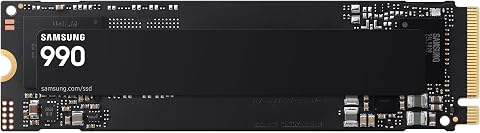 Samsung 990 1TB PCIe 4.0 NVMe Internal SSDView on Amazon →
- 8
 SanDisk Optimus 5100 1TB NVMe SSD, PCIe 4.0, M.2 2280View on Amazon →
- 9
 Kingston NV3 1TB M.2 2280 PCIe 4.0 NVMe SSDView on Amazon →
- 10
 SanDisk Optimus 5100 500GB NVMe SSD, PCIe 4.0, M.2 2280View on Amazon →
Storage Needs for AI and HPC
Storage can affect how quickly systems load datasets, checkpoints and application files, and sustained transfers may matter more than short bursts in repeated workloads. For AI and HPC buyers, though, the right choice depends on the system’s storage design and workload: a single consumer M.2 drive may not represent the performance, capacity or reliability needs of a shared compute environment.
The guide’s focus on cooling, endurance and capacity offers useful questions for buyers to investigate. Its stated product preferences are not enough to establish suitability for data-intensive servers or AI training, because no enterprise workload tests, sustained-load figures or system-level results are supplied. Readers should not interpret the consumer-oriented labels as proof of HPC performance.
Products Worth Considering

LG 27GS60QC-B Ultragear 27-inch Curved Gaming Monitor (QHD, 180Hz, 1ms, 1000R)

Samsung 32 Odyssey G5 QHD Gaming Monitor

Apple MacBook Air 13-inch with M5 Chip, 16GB Memory, 512GB SSD, Midnight
As an affiliate, we earn on qualifying purchases.
What the Guide Actually Tests
The source describes a selection process based on everyday computing criteria, including large-file transfers, application responsiveness, heat management and rated write endurance. It also points out that PCIe generation and motherboard support can limit performance: a newer drive installed in an older compatible slot may run at the slot’s lower supported speed. The guide presents PCIe 4.0 as a practical choice for many users and says PCIe 5.0 models can require more cooling, but it supplies no comparative measurements for the named products.
Its advice on DRAM, HMB and drive capacity is relevant to interpreting specifications. DRAM can assist with address mapping, while some DRAM-less drives use system memory through HMB; smaller-capacity versions may also have less room for cache and show weaker consistency during long writes. These are general considerations in the source, not evidence that each named drive will perform a particular way in an AI or HPC system.
“Sustained write performance diverges sharply from peak burst speeds, especially in entry-level drives like the Kingston NV3 when the SLC cache is exhausted.”
— ThorstenMeyerAI.com guide
Missing Workload Test Evidence
The supplied text does not identify all 10 selections: only five product names appear in the excerpt. It also gives no publication date, test date, full ranking, prices, capacities for most models, benchmark results, or links to test procedures. The specific claim that these are among the best options for AI and HPC in 2027 cannot be checked from the material provided.
It is also unclear whether the named drives were tested in the same system, under sustained writes, or with AI and HPC workloads. No information is supplied on server qualification, power-loss protection, workload-specific endurance, drive availability in 2027, or firmware revisions. Product descriptions and comparative judgments should therefore be read as claims made by the guide, not independently confirmed findings.
Verify Models Before Buying
Before using the list to plan a system, readers need the complete 10-drive lineup and the guide’s dated test results. Buyers should check each drive’s current specifications, supported PCIe interface, capacity-specific endurance and warranty, along with the host platform’s cooling and slot support. For AI or HPC deployments, the next useful evidence would be workload-matched testing under sustained load and confirmation that the drives meet the system’s operational requirements.
Until those details are available, the list is best used as a set of models to investigate, not as a settled 2027 ranking. Product availability, pricing and specifications can change, and the source does not say when its comparisons were conducted.
Key Questions
Does the source verify these SSDs for AI or HPC workloads?
No. It discusses general storage-selection criteria but provides no AI- or HPC-specific benchmark results in the supplied material.
Which models are named in the supplied source?
The excerpt names the Samsung 990 PRO 2TB, Kingston NV3 1TB, Samsung 9100 PRO, SanDisk Optimus 5100 and Bestoss 1TB. It refers to 10 options overall, but does not identify the other five in the text provided.
Why does sustained write performance matter?
A drive’s short burst speed may not hold during a long transfer, particularly after its cache is used. The guide says this can affect large-file transfers, but does not supply measured results for the named drives.
What should buyers verify before choosing a drive?
Check the exact model and capacity, host PCIe support, cooling, endurance rating, warranty and current price. For AI or HPC use, seek tests that match the intended workload rather than relying on consumer-oriented rankings alone.
Source: ThorstenMeyerAI.com