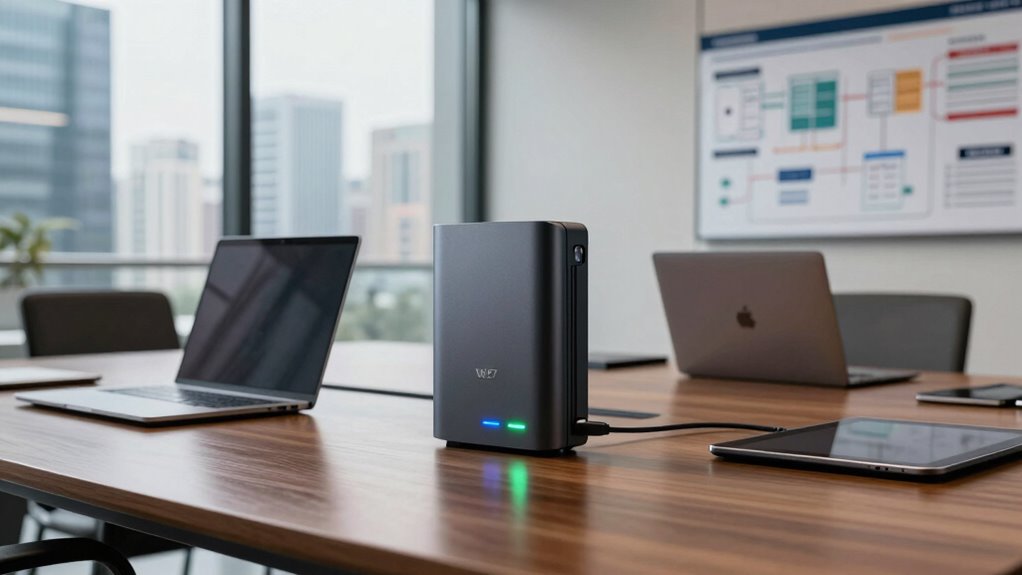

To get the most out of a WiFi 7 access point in your office, you need real planning. You should check device compatibility, optimize access point placement, and reduce interference from other electronics. It’s also crucial to take into account future growth by adding more access points as needed. Proper planning ensures reliable, high-speed connections today and long-term scalability. Keep exploring these factors, and you’ll discover how to make your network both powerful and future-proof.
Key Takeaways
- Proper planning ensures optimal access point placement for comprehensive coverage and minimal dead zones.
- Assessing device compatibility prevents bottlenecks caused by outdated hardware limitations.
- Managing interference and optimizing signal settings maintains high network reliability and performance.
- Scalability planning accommodates future growth without costly infrastructure overhauls.
- Deployment strategies tailored to office layouts maximize WiFi 7 features and ensure seamless connectivity.
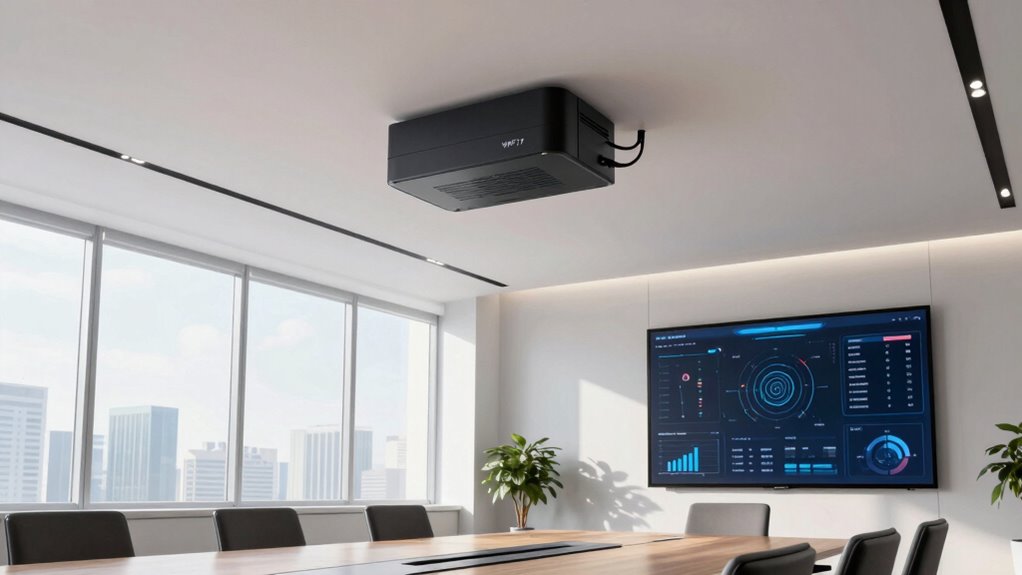
As offices increasingly rely on seamless, high-speed internet connectivity, WiFi 7 access points emerge as a game-changer. But deploying these advanced devices isn’t as simple as just installing the latest hardware. To truly harness their potential, you need to plan carefully, especially considering device compatibility and signal optimization. Without proper preparation, you risk underperforming or facing connectivity issues that disrupt daily operations.
First, understanding device compatibility is vital. Not every device on your network will automatically support WiFi 7. Many existing laptops, smartphones, and IoT gadgets may still rely on older WiFi standards. If your new access points aren’t compatible with these devices, you’ll create bottlenecks, forcing some devices to operate at lower speeds or drop connections altogether. To avoid this, you should conduct an inventory of your current hardware and assess which devices will benefit from WiFi 7’s capabilities. You might need to upgrade certain devices or implement dual-band solutions that support both old and new standards. Proper planning ensures a smooth shift, maximizing your investment and avoiding frustrating connectivity gaps.
Ensure device compatibility and plan upgrades to maximize WiFi 7 performance and avoid connectivity bottlenecks.
Signal optimization is another critical aspect. WiFi 7 offers impressive speed and capacity, but these benefits depend heavily on how well you manage signal coverage across your office space. Without strategic placement, you could end up with dead zones or interference issues that limit performance. Consider mapping your office layout to identify ideal locations for access points, ensuring they’re placed where signals can reach all areas without obstruction. Also, leverage WiFi 7’s advanced features, such as multi-user MIMO and beamforming, to direct signals efficiently and improve overall network reliability. Signal optimization isn’t just about placement; it involves configuring settings to minimize interference from other electronic devices and neighboring networks, which can degrade performance. Additionally, understanding network standards helps in aligning hardware capabilities and ensuring compatibility across your infrastructure. Taking into account interference mitigation strategies can further enhance network stability and speed.
Planning for WiFi 7 deployment means thinking about future scalability too. As your office grows or adopts new technology, your network should be ready to accommodate increased traffic and device density. This might involve deploying additional access points or adjusting configurations to ensure consistent, high-quality connectivity. The more you plan upfront, the better prepared you’ll be to adapt and expand without costly overhauls.

Omada EAP720, WiFi 7 BE5000 Dual Band Wireless Access Point
- Centralized Remote Management: Manage network via Omada Cloud platform
- WiFi 7 Dual-Band Speed: Up to 5.0 Gbps with Wi-Fi 7 tech
- High-Speed 2.5G Ethernet Port: Supports future broadband upgrades
As an affiliate, we earn on qualifying purchases.
As an affiliate, we earn on qualifying purchases.
Frequently Asked Questions
How Does Wifi 7 Improve Office Network Security?
WiFi 7 enhances office network security by utilizing advanced encryption protocols, making data transmission more secure against eavesdropping and breaches. It also incorporates improved threat detection features that identify and respond to suspicious activities in real time. By deploying WiFi 7, you can better protect sensitive information and maintain a safer network environment, reducing vulnerabilities and ensuring your office stays resilient against cyber threats.
What Is the Typical ROI for Upgrading to Wifi 7?
You’ll see a typical ROI of around 20-30% after upgrading to WiFi 7, despite initial costs and upgrade challenges. While the cost analysis highlights higher upfront expenses, increased productivity, enhanced security, and smoother device integration quickly offset these investments. The emotional payoff comes from worry-free connectivity and future-proofed networks that keep your office competitive—making the upgrade not just a cost, but a strategic advantage.
Can Existing Infrastructure Support Wifi 7 Seamlessly?
Your existing infrastructure may not support WiFi 7 seamlessly due to legacy compatibility issues. You’ll likely need hardware upgrades, especially for older access points and networking equipment, to fully leverage WiFi 7’s advanced features. It’s essential to assess your current setup and plan for compatibility upgrades, ensuring smooth integration and peak performance. Without these updates, you risk limited benefits and potential network bottlenecks.
How Does Wifi 7 Handle Interference in Busy Office Environments?
Imagine a busy office as a crowded city street. WiFi 7 handles interference by actively mitigating it through advanced interference mitigation techniques, ensuring signals don’t clash like traffic jams. It also optimizes signals for clarity, much like traffic lights directing cars smoothly. This means your network remains strong and reliable even amid many devices, providing seamless connectivity. With WiFi 7, you’ll experience a smarter, more resilient office network.
What Training Is Needed for Staff to Manage Wifi 7 Networks?
You need to provide staff with training in network troubleshooting to manage WiFi 7 networks effectively. They should understand how to diagnose and resolve common connectivity issues, which minimizes downtime. Additionally, pursuing staff certification in wireless networking guarantees they stay updated on the latest WiFi 7 features and security protocols. This combination helps your team confidently maintain a reliable, high-performance office WiFi network.

TP-Link BE6500 Dual-Band WiFi 7 Router (BE400)
- Wi-Fi 7 Technology: Latest Wi-Fi 7 with MLO and 4K-QAM
- High-Speed Dual-Band: Up to 5764 Mbps on 5GHz, 688 Mbps on 2.4GHz
- Wide Coverage: Covers up to 2,400 sq. ft. for 90 devices
As an affiliate, we earn on qualifying purchases.
As an affiliate, we earn on qualifying purchases.
Conclusion
Choosing the best WiFi 7 access point for your office isn’t just about the latest tech; it’s about strategic planning. You need to assess your current needs and future growth to avoid bottlenecks and guarantee seamless connectivity. Remember, “A stitch in time saves nine.” Proper planning now means fewer headaches later, so invest time in selecting and deploying the right access point. It’s the difference between a smooth-running office and one plagued by connectivity issues.

Deco 7 Pro Tri-Band WiFi 7 BE10000 Whole Home Mesh System 6-Stream 10 Gbps
- Whole Home Coverage: Covers up to 7,600 sq.ft.
- High-Speed Wi-Fi 7: Up to 5,188 Mbps on 6 GHz
- Future-Ready 10G Port: Supports 10G WAN/LAN connections
As an affiliate, we earn on qualifying purchases.
As an affiliate, we earn on qualifying purchases.

Ubiquiti UniFi E7 Audience Enterprise Access Point WiFi 7 Access Point (E7-Audience-US)
- Indoor/Outdoor Enterprise Access Point: High-density WiFi 7 performance
- High-Speed Uplink: 10 GbE and redundant GbE ports
- Coverage Area: Up to 465 m² (5,000 ft²)
As an affiliate, we earn on qualifying purchases.
As an affiliate, we earn on qualifying purchases.