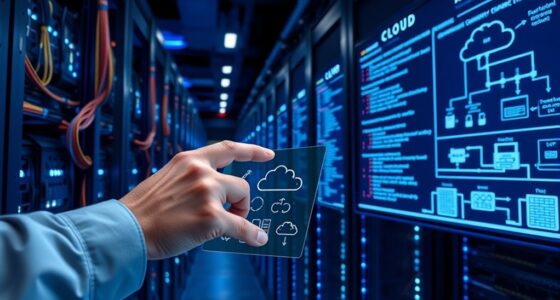

Monitoring and observability are key to maintaining your infrastructure’s health. By tracking metrics like CPU, memory, and network traffic, and setting up alerts, you can quickly catch issues before they cause outages. Instrumenting applications for logs and traces helps you understand root causes and optimize performance. Continuous review and automation keep your system resilient. Keep exploring to discover how to build a robust monitoring strategy that ensures reliable, scalable infrastructure.
Key Takeaways
- Implement tailored monitoring tools to collect key metrics like CPU, memory, disk, and network traffic for infrastructure health.
- Use dashboards and alerts to detect anomalies and thresholds breaches for proactive issue resolution.
- Instrument applications to generate logs, traces, and metrics, providing context for root cause analysis.
- Define and regularly update performance baselines, leveraging automation for health checks and auto-scaling.
- Continuously review and refine monitoring strategies to adapt to infrastructure changes and ensure system reliability.

Effective monitoring and observability are essential for maintaining the health of your infrastructure. When you have a clear view of your systems, you can quickly identify issues before they escalate into outages or performance bottlenecks. Monitoring involves collecting data on system performance, resource utilization, and application behavior, giving you real-time insights into how your infrastructure is functioning. Observability takes this a step further by providing context, enabling you to understand why problems occur and how different components interact. Together, they form a thorough approach that helps you ensure stability, optimize performance, and plan for growth.
You should start by implementing the right monitoring tools tailored to your infrastructure’s needs. These tools gather metrics such as CPU usage, memory consumption, disk I/O, network traffic, and application-specific data. Visual dashboards allow you to spot trends and anomalies at a glance, so you can act swiftly when something doesn’t look right. But don’t just stop at collecting data; set up alerts that notify you immediately when thresholds are breached. This proactive approach minimizes downtime and reduces manual effort in troubleshooting.
Observability enhances your ability to diagnose issues effectively. Instead of just knowing that something went wrong, you gain insight into the root cause. This involves instrumenting your applications and systems to generate logs, traces, and metrics that tell a story about how your infrastructure behaves under different conditions. When a problem occurs, you can drill down into detailed logs or trace data to pinpoint the exact point of failure. This reduces guesswork and accelerates your response time. To maximize observability, ensure your data is centralized and easily accessible, so you can correlate signals across multiple systems and layers.
Another key aspect is establishing baseline performance metrics. Knowing what normal operation looks like allows you to detect deviations early. Regularly review and update these baselines to adapt to changing workloads or infrastructure updates. Additionally, leverage automation where possible. Automated health checks and auto-scaling can respond to alerts automatically, maintaining thorough performance without manual intervention. This continuous feedback loop helps you keep the infrastructure resilient and responsive.
Finally, remember that monitoring and observability aren’t one-time tasks. They require ongoing effort and refinement. As your infrastructure evolves, so should your monitoring strategies. Regularly review your metrics, update your alert thresholds, and incorporate new data sources to stay ahead of potential issues. Developing a comprehensive monitoring strategy ensures your infrastructure remains healthy, reliable, and capable of supporting your business needs effectively.
Frequently Asked Questions
How Do I Choose the Right Monitoring Tools for My Infrastructure?
You should start by evaluating your infrastructure’s specific needs, like the types of systems, applications, and performance metrics you need to track. Consider compatibility with your existing tools, ease of use, scalability, and whether the tool offers real-time alerts and detailed insights. Test a few options through trial periods, gather feedback from your team, and choose the one that best fits your operational requirements and budget.
What Are Common Pitfalls in Implementing Observability Strategies?
Like Icarus flying too close to the sun, you might overreach with complex observability strategies. Common pitfalls include relying solely on metrics without logs or traces, which leaves blind spots. You may also neglect to set clear goals, causing disorganized data collection. Additionally, ignoring the human factor—failing to train teams—can hinder effective use. Keep it simple, aligned with your goals, and guarantee your team is well-equipped.
How Can I Balance Monitoring Depth With System Performance?
To balance monitoring depth with system performance, prioritize critical metrics that directly impact user experience and system stability. Use sampling and adaptive monitoring to reduce overhead during low-traffic periods. Implement lightweight agents and limit data collection to essential information. Regularly review your monitoring setup, removing unnecessary checks. This approach guarantees you gather valuable insights without degrading system performance, keeping your infrastructure healthy and responsive.
What Are Emerging Trends in Infrastructure Monitoring Technologies?
Emerging trends in infrastructure monitoring include AI-driven analytics that enable proactive issue detection, and the adoption of open-source tools for greater customization. You’ll also notice a shift toward edge monitoring, allowing you to track distributed systems in real-time. These innovations help you improve reliability without adding significant overhead, ensuring your infrastructure remains resilient as complexity grows. Staying updated with these trends empowers you to optimize performance efficiently.
How Do I Ensure Security and Privacy in Monitoring Data?
To guarantee security and privacy in monitoring data, you should encrypt data both in transit and at rest, use strong access controls, and regularly update your security protocols. Implement role-based access to limit data exposure, monitor for suspicious activity, and conduct security audits. Additionally, anonymize sensitive information where possible and ensure compliance with relevant privacy regulations. These steps help safeguard your data and maintain trust.
Conclusion
By implementing effective monitoring and observability, you can detect issues early and make certain your infrastructure stays healthy. Did you know that companies with strong observability practices reduce downtime by up to 30%? Staying proactive not only minimizes disruptions but also boosts overall performance. Keep a close eye on your systems, leverage the right tools, and continuously improve your strategies. This way, you’ll maintain a resilient, reliable infrastructure that supports your goals seamlessly.