
Kubernetes networking still confuses teams because its layered architecture and abstractions differ a lot from traditional networks. You have to understand service discovery, network policies, and how plugins influence connectivity, all while managing dynamic changes in pods and services. These complexities can make troubleshooting and predicting behavior tricky. If you keep exploring, you’ll uncover how these components interact and learn strategies to master Kubernetes networking smoothly.
Key Takeaways
- Kubernetes introduces an abstracted networking layer that differs from traditional models, making it harder to understand and troubleshoot.
- Service discovery mechanisms are dynamic, requiring teams to grasp how endpoints and DNS updates occur during scaling or pod movement.
- Complex network policies and layered plugins can unintentionally block services, complicating diagnosis and security management.
- The multitude of network components and configurations necessitate deep architectural knowledge for effective troubleshooting.
- The steep learning curve and need for continuous experimentation make mastering Kubernetes networking a challenging and ongoing process.
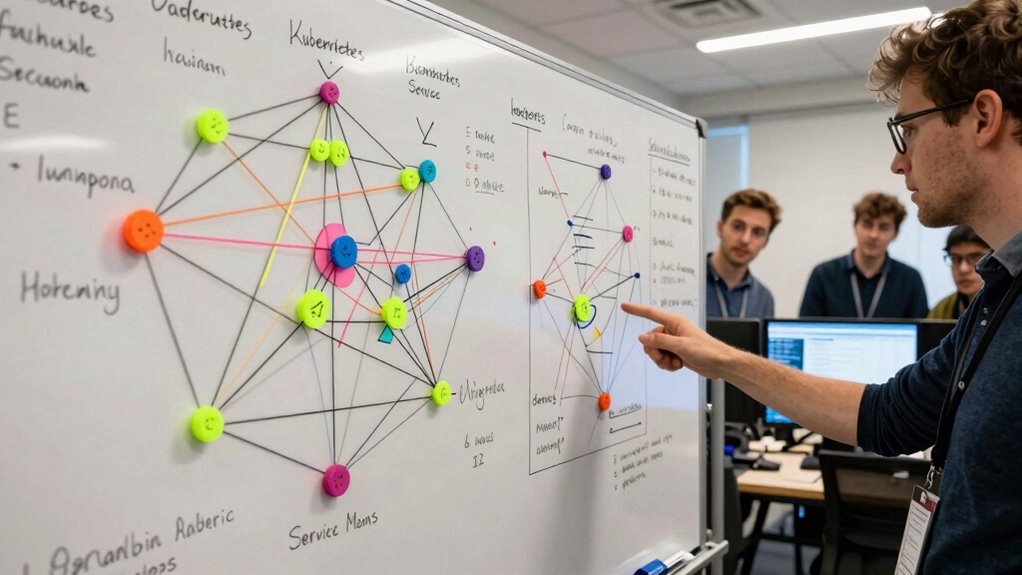
Are you confused by how networking works in Kubernetes? You’re not alone. Kubernetes networking can seem complex because it introduces a layer of abstraction that differs significantly from traditional networking models. Kubernetes aims to make application deployment seamless, but understanding how services communicate across the cluster can be tricky. One of the key concepts that often confuses teams is Service Discovery. Unlike conventional systems where you manually configure IP addresses and DNS, Kubernetes automates service registration and discovery through built-in mechanisms. When you deploy a service, Kubernetes assigns it a stable IP address and a DNS name, ensuring that other components can reliably connect to it, regardless of where the pod runs within the cluster. This automated service discovery helps maintain application availability, but grasping how it dynamically updates as pods scale or move can be challenging. Additionally, understanding the role of affiliate relationships and how they influence documentation and support can help clarify some of the operational aspects. Adding to the confusion are Network Policies, which control how pods communicate with each other and with external resources. While these policies are crucial for securing your cluster, they introduce another layer of complexity. Network Policies let you define rules about which pods can talk to each other, effectively segmenting your network and reducing potential attack surfaces. However, until you understand the default behavior—where, by default, all pods can communicate—you might mistakenly assume that restrictions are in place. Learning how to craft specific policies, interpret their effects, and troubleshoot connectivity issues takes time and experience. Many teams struggle to visualize the network flows, especially in larger clusters with multiple policies layered on top of each other. The challenge with Kubernetes networking is that it combines multiple moving parts—services, ingress controllers, network policies, and the underlying network plugin—each with its own configuration nuances. This complexity makes it difficult to pinpoint issues or predict how changes will ripple through the system. For example, implementing a new network policy without fully understanding how it interacts with existing rules can lead to unexpected outages or blocked services. Similarly, troubleshooting service discovery problems often involves checking DNS, service endpoints, and pod labels—all of which can be overwhelming if you’re unfamiliar with the cluster’s architecture. Recognizing the importance of network plugins and their configurations can help troubleshoot these issues more effectively. An understanding of cluster architecture in relation to networking can also aid in diagnosing and resolving issues more efficiently. Moreover, being familiar with network segmentation concepts can assist in designing more secure and manageable cluster environments. Furthermore, it’s beneficial to understand how security policies impact the overall network security and communication within your cluster. In essence, Kubernetes networking is a powerful but intricate system. It’s designed to provide scalable, flexible, and secure communication, but that comes at the cost of a steep learning curve. Grasping how Service Discovery works and mastering Network Policies are vital steps in demystifying this environment. The more you experiment, read, and troubleshoot, the more confident you’ll become in managing Kubernetes networking effectively.

Kubernetes Security and Observability: A Holistic Approach to Securing Containers and Cloud Native Applications
As an affiliate, we earn on qualifying purchases.
As an affiliate, we earn on qualifying purchases.
Frequently Asked Questions
How Does Kubernetes Networking Differ From Traditional Networking?
Kubernetes networking differs from traditional networking by abstracting container overlays, allowing containers across nodes to communicate seamlessly without relying on IP addresses. It automates service discovery, so you don’t manually configure connections between services. Instead, Kubernetes manages dynamic IPs and routing, which can be confusing if you’re used to static setups. This dynamic, overlay-based approach simplifies scaling but makes understanding network flows more complex initially.
What Are the Common Pitfalls in Kubernetes Network Configuration?
Imagine building a city where streets (networks) must connect countless neighborhoods (containers). Your common pitfalls include misconfiguring container segmentation, causing traffic jams or security breaches, and overlooking service discovery, making it hard for containers to find each other. These issues lead to communication failures and downtime. Ensuring proper network policies, clear segmentation, and reliable service discovery are essential to keep your Kubernetes city running smoothly.
How Do Network Policies Impact Cluster Security?
Network policies boost your cluster security by enabling network segmentation, which isolates sensitive workloads from others. They enforce rules that control traffic flow, preventing unauthorized access and reducing attack surfaces. By applying policy enforcement, you guarantee only approved communication occurs between pods, strengthening overall security. This proactive approach helps you manage risks and maintain a secure, well-controlled environment within your Kubernetes cluster.
What Tools Can Simplify Kubernetes Network Troubleshooting?
To simplify Kubernetes network troubleshooting, you can use tools like Calico or Cilium for container segmentation, which help isolate network issues. Additionally, leveraging DNS management tools like CoreDNS allows you to quickly identify name resolution problems. These tools give you clear insights into network behavior, making it easier to pinpoint and resolve issues efficiently. They streamline troubleshooting by providing visibility into container segmentation and DNS configurations.
How Scalable Is Kubernetes Networking for Large Deployments?
Imagine your network as a vast, intricate city with countless roads and neighborhoods. Kubernetes networking scales well for large deployments when you use a service mesh to manage traffic efficiently and implement network segmentation for security. This setup guarantees smooth communication between thousands of pods, much like a well-planned city handles traffic flow. With proper tools, you can confidently expand, knowing your network can grow without chaos or bottlenecks.

Kubernetes – Open-Source Container Management Solution Zip Hoodie
- Open-source container management: Automates deployment and scaling
- Ideal for large-scale deployments: Supports cloud architects and engineers
- Comfortable classic fit: 8.5 oz twill-taped neck hoodie
As an affiliate, we earn on qualifying purchases.
As an affiliate, we earn on qualifying purchases.
Conclusion
Think of Kubernetes networking as a vast, intricate city’s subway system—seemingly simple but full of hidden tunnels and secret passages. As you navigate, each connection and protocol becomes a train route, guiding data through complex tunnels. Though it may seem confusing at first, understanding these routes helps you move smoothly through the network maze. With patience, you’ll master this subway map, turning chaos into clarity and making your team’s journey seamless and efficient.
Kubernetes – An Enterprise Guide: Master containerized application deployments, integrate enterprise systems, and achieve scalability
As an affiliate, we earn on qualifying purchases.
As an affiliate, we earn on qualifying purchases.

ADVANCED KUBERNETES SCHEDULING: Custom Schedulers, Scheduler Plugins, and Performance Optimization. Dynamic Resource Allocation, Topology-Aware Scheduling, and Production Best Practices
As an affiliate, we earn on qualifying purchases.
As an affiliate, we earn on qualifying purchases.