This checklist is for people connecting AI tools and automation across a home office, small team, or equipment rack. It covers the network and power pieces that help a setup fit together, from wireless access to shared storage. Start with your current setup: note the devices, connections, and workloads you need to support.

Get business pricing on tech for your team
- Business-only prices and quantity discounts
- Tax-exempt purchasing
- Multiple users, one account, clear invoices
The sections follow a practical path through connectivity: wireless routing, wired switching, fiber links, a computer’s Ethernet connection, shared storage, and backup power. Some slots include a named product pick; fiber transceivers and UPS units are advice-only because no specific products were provided. Check the actual ports and requirements for your devices before choosing parts.
Use each section to identify the job the component must do, then compare its requirements with the rest of your setup. Pay attention to port types, link speeds, physical fit, and compatibility with existing equipment. Plan the connections first so you can avoid buying a component that cannot connect where you need it.
Wi-Fi 7 Router
A router is the central wireless connection point in this checklist, so its fit depends on the spaces and devices you need to connect. The named pick is the NETGEAR Orbi 970 Series WiFi 7 Mesh System (3-Pack). Before choosing a mesh system, consider where each unit can sit, how the units will connect, and whether your devices can use the wireless features you expect. A three-pack also calls for a placement plan: identify likely locations and available power before setting it up.
A common mistake is treating the router’s headline wireless generation as a guarantee that every device or application will benefit from it. Check device compatibility, the internet service connection, and any wired ports needed for your local network. Consider whether your intended layout leaves a clear path for the mesh units to communicate. Verify device support and the system’s documented port capabilities rather than assuming all connections operate at the same speed. Match the router choice to the rooms, clients, and wired equipment in your actual setup.
What to look for:
- Confirm client devices support the wireless features you intend to use.
- Check the documented WAN and LAN port types and capabilities.
- Plan locations for all three mesh units and nearby power.
- Consider how the router will connect to your modem or service equipment.
- Check whether wired devices can reach the router or a compatible switch.
NETGEAR Orbi 970 Series WiFi 7 Mesh System (3-Pack)
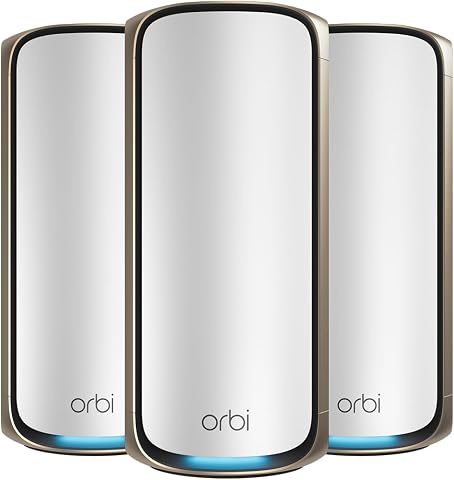
The NETGEAR Orbi 970 Series is a 3-pack WiFi 7 mesh system (router plus 2 satellites) providing up to 10,000 sq ft of coverage and support for up to 200 connected devices. It delivers speeds up to 27 Gbps using patented Quad-Band technology with a dedicated backhaul, and includes 10 Gig and 2.5 Gig wired ports for high-performance connections.
Pros:
- Massive whole-home coverage up to 10,000 sq ft with no dead zones
- Very fast WiFi 7 speeds up to 27 Gbps with dedicated backhaul
- High-speed wired options including 10 Gig ports
- Easy guided setup and remote management via the Orbi app
Cons:
- NETGEAR Armor security requires a paid subscription after 30-day trial
- Real-world speeds vary with devices and internet plan
- Only for use in the US
Best for: Teams planning wireless coverage across multiple spaces
Not ideal for: Setups that need only a single access point
Bottom line: Choose the Orbi 970 three-pack only after checking device support, port needs, and placement.
10GbE Network Switch
A switch connects wired devices on the same local network, and this slot is for setups considering faster Ethernet links. The named pick is the YuanLey 8-Port 10GbE PoE Unmanaged Switch. Before selecting it, map the devices that need wired connections and confirm which ones can use the port types and speeds specified by the manufacturer. The product name identifies eight ports and PoE, but the exact power capabilities and compatibility details should be checked in its documentation.
A frequent buying mistake is assuming that a 10GbE switch makes every connected device communicate at 10GbE. Each endpoint, cable, and upstream connection needs to support the required link; otherwise, the link will operate according to its compatible capabilities. Check the switch’s PoE specifications against any devices you intend to power, and confirm physical placement, ventilation, and cable reach. Count the required ports with room for planned additions, and verify that the switch’s management style suits your needs. Since this is an unmanaged model, review the available configuration options before relying on features that require managed switching.
What to look for:
- Count current wired devices and leave capacity for planned additions.
- Confirm each endpoint supports the intended Ethernet link speed.
- Check the switch’s documented PoE standards and power budget.
- Verify cable types, lengths, and connector compatibility.
- Review whether unmanaged switching supports the network features you need.
YuanLey 8-Port 10GbE PoE Unmanaged Switch

This unmanaged switch has eight 10GbE PoE ports that support 10G, 5G, 2.5G, 1G, and 100Mbps connections, with plug-and-play setup. It provides 110W total PoE power, up to 30W per port, and 160Gbps switching capacity in a metal case designed for rack or wall mounting.
Pros:
- Supports multi-gig speeds up to 10GbE
- Plug-and-play setup requires no configuration
- Provides PoE power for multiple devices
- Rackmount and wall-mount placement options
Cons:
- Unmanaged design does not provide configuration options
- Total PoE budget is limited to 110W
Best for: Setups connecting compatible wired devices without switch management
Not ideal for: Networks needing managed configuration features
Bottom line: Match the switch’s ports and PoE specifications to every device you plan to connect.
Fiber Optic Transceiver
A fiber optic transceiver connects a network device to a fiber link, but there is no named product pick for this slot. Choose one only after confirming the exact transceiver type supported by both ends of the connection. Start with the device documentation: check supported form factors, fiber type, wavelength, and link speed. These details determine whether the transceiver can fit and communicate with the switch, router, or other equipment.
A common mistake is buying by connector appearance alone. Matching connectors does not establish compatibility: the transceiver and fiber path also need to support the same signaling and link requirements. Consider the distance between endpoints and whether the fiber cable and transceiver are intended for that reach. Check for vendor compatibility guidance, especially when connecting equipment from different manufacturers. Verify both endpoints and the cable route before ordering, and confirm whether the link requires a matched pair or specific optical characteristics. If documentation is unclear, consult the equipment vendor or network integrator before purchasing.
What to look for:
- Match the transceiver form factor to the equipment slot.
- Confirm supported speed and device compatibility at both ends.
- Match fiber type, wavelength, and connector specifications.
- Check that the transceiver supports the required link distance.
- Verify whether the connection needs matched transceivers.
USB-C Ethernet Adapter
A USB-C Ethernet adapter can give a compatible computer a wired network connection, and the named pick is the Acer USB-C Hub 6-in-1 Adapter with Ethernet, 10Gbps Data Transfer and. The supplied product name ends after “and,” so check the complete listing and manufacturer documentation before relying on any additional feature claims. Confirm that your computer has a USB-C port that supports the adapter’s connection requirements, and that the adapter’s Ethernet capability matches the network you intend to use.
A common mistake is assuming every USB-C port supports the same functions or that the adapter’s data-transfer wording describes Ethernet speed. Check those specifications separately. Consider how the hub will fit alongside other connected cables and whether it blocks neighboring ports. Confirm the computer’s operating system support and whether any drivers or setup steps are required. Separate USB and Ethernet specs when comparing the adapter with your needs, and check which other hub connections are actually included in the complete model description. If you need a particular link speed, verify it in the manufacturer’s documentation rather than inferring it from the product name.
What to look for:
- Confirm the computer supports the adapter through its USB-C port.
- Check the adapter’s documented Ethernet link speed and connector.
- Review the complete product name and included hub connections.
- Confirm operating system compatibility and any setup requirements.
- Check spacing and cable fit around neighboring computer ports.
Acer USB-C Hub 6-in-1 Adapter with Ethernet, 10Gbps Data Transfer and 100W PD Ch

A compact 6-in-1 USB-C hub that expands a single port into 2×USB-C 3.2, 1×USB-A 3.2, 1×USB-A 3.0, Gigabit Ethernet, and 100W PD charging. It supports transfer speeds up to 10Gbps, stable 1000Mbps wired networking, and up to 90W charging output for the host laptop.
Pros:
- Six connection options from a single USB-C port
- Fast data transfer speeds up to 10Gbps
- 100W PD passthrough charging keeps laptop powered
- Plug and play with no drivers needed across major operating systems
Cons:
- Does not support video output or monitor connections
- Full 10Gbps speed requires compatible ports and devices
- Gigabit speeds require CAT6 or higher Ethernet cable
Best for: Compatible computers that need a USB-C-connected Ethernet port
Not ideal for: Devices without a suitable USB-C connection
Bottom line: Verify the complete model details and Ethernet specifications before choosing this Acer hub.
Network Attached Storage
Network attached storage can provide shared storage on a local network, and the named pick is the QNAP TS-1273AU-RP-8G-US 12-Bay Rackmount NAS with 2x 2.5GbE Ports and. The supplied name ends after “and,” so confirm the complete model listing and included specifications before making a decision. Its rackmount form makes physical fit a key part of selection: check rack space, mounting requirements, depth, and available power in the intended location.
A common mistake is choosing a NAS based on bay count alone. Confirm which drives are supported, whether drives are included, and how much usable capacity your storage plan requires. Also check the documented network ports and whether they fit your switch and workflow. Plan storage and network needs together: account for the devices that will access files, the connection speeds they support, and how you will protect important data. Review setup, backup, and maintenance requirements in the manufacturer’s documentation. If you expect several users or automated jobs to access data at once, ensure the complete system configuration meets those demands.
What to look for:
- Confirm rack dimensions, mounting needs, and available power.
- Check drive compatibility and whether drives are included.
- Estimate usable capacity for the storage plan and redundancy approach.
- Verify network port capabilities and switch compatibility.
- Review backup, maintenance, and multi-user requirements.
QNAP TS-1273AU-RP-8G-US 12-Bay Rackmount NAS with 2x 2.5GbE Ports and Redundant

The QNAP TS-1273AU-RP-8G-US is a high-performance 12-bay rackmount NAS powered by an AMD Ryzen Embedded V1500B quad-core 2.2 GHz processor. It ships with 8GB UDIMM DDR4 memory (expandable to 32GB) and includes two 2.5GbE ports plus two PCIe Gen3 x4 slots for expansion.
Pros:
- Powerful AMD Ryzen V1500B quad-core processor
- Dual 2.5GbE ports for fast networking
- Redundant PSU improves uptime and reliability
- Two PCIe Gen3 x4 slots allow flexible expansion
Cons:
- Ships diskless, drives must be purchased separately
- Memory limited to 32GB maximum
- Rackmount form factor may not suit home users
Best for: Setups needing a rackmount NAS with multiple drive bays
Not ideal for: Installations without suitable rack space
Bottom line: Check the full QNAP model specifications, drive plan, and network fit before purchase.
Uninterruptible Power Supply
A UPS can provide backup power for connected equipment, but there is no named pick for this slot. Begin by listing which devices need to stay powered during an outage, such as network equipment or storage. Check each device’s power requirements and identify which UPS outlets provide battery backup versus surge protection only. Size for the connected load and the runtime you need, using manufacturer specifications rather than assumptions.
A common mistake is choosing a unit based only on outlet count or the word “backup.” Confirm its supported load, expected runtime at that load, plug types, and physical placement. Consider whether the UPS offers the status monitoring or automatic shutdown features needed by your equipment, and check compatibility with the devices you want to protect. Leave room for cable access and safe ventilation. Prioritize essential devices if the runtime target is difficult to meet, and confirm the battery replacement and maintenance guidance. A suitable choice depends on the actual equipment load and how long it needs to remain available.
What to look for:
- Add up the power requirements of equipment to be backed up.
- Check runtime estimates at the intended connected load.
- Confirm which outlets provide battery backup.
- Match plug types and monitoring features to connected devices.
- Review battery replacement guidance and placement requirements.
Buy in order of dependency: first identify the connection and power needs of your current devices, then choose the router and switch, followed by any fiber or USB-C links, shared storage, and backup power. Compatibility comes first: confirm ports, speeds, physical fit, and power requirements before filling gaps in the setup.
You do not need to purchase every category at once. Start with the component that resolves your most immediate connection or storage need, then revisit the remaining sections as your setup grows. A clear plan makes the checklist useful: record what each device connects to and verify the details against manufacturer documentation before ordering.
Evergreen bestsellers Picks

KitchenAid Artisan Series 5-Quart Tilt-Head Stand Mixer, Juniper (KSM150PS)

Shark PowerPro Reveal Plus Cordless Stick Vacuum, Charcoal (IZ376H)

Roborock Q7 M5+ Robot Vacuum and Mop
As an affiliate, we earn on qualifying purchases.