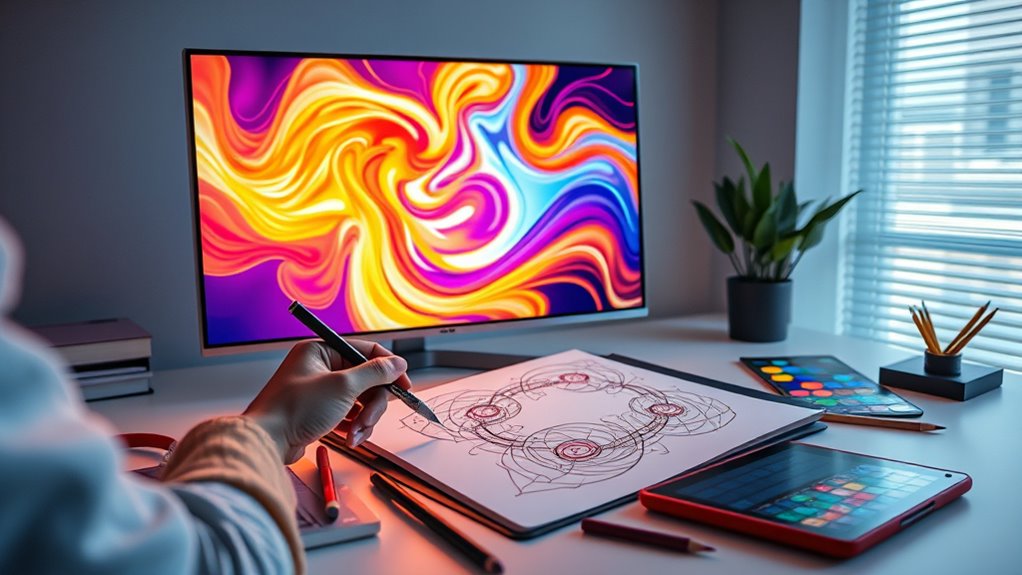

Using generative AI as a collaboration partner can substantially boost your creativity. It acts as a brainstorming teammate, offering new ideas, variations, and inspiration that expand your possibilities. AI tools help you refine your work through iterative feedback and quick adjustments, making your creative process more fluid and enjoyable. By combining your intuition with AI suggestions, you can develop skills and explore uncharted ideas. Keep exploring to discover how this partnership can transform your creative projects even further.
Key Takeaways
- Generative AI acts as a brainstorming partner, expanding ideas and inspiring new creative directions.
- It accelerates workflows by handling repetitive tasks and generating multiple variations for decision-making.
- AI tools help refine and develop ideas through iterative feedback, enhancing creative skills over time.
- Active collaboration with AI allows for customization, steering outputs to better align with artistic vision.
- Using AI as a partner boosts confidence, encourages experimentation, and fosters continuous innovation in creative projects.

Generative AI is transforming the way we approach creativity by providing new tools that inspire and enhance human imagination. Instead of replacing your creative process, these algorithms act as collaborators, opening up possibilities you might not have considered on your own. When you work with generative AI, you’re tapping into a vast reservoir of ideas, styles, and concepts that can spark new directions for your projects. Whether you’re designing art, crafting stories, or developing music, AI can serve as a brainstorming partner that pushes your boundaries and helps you explore uncharted territory.
Generative AI acts as a creative partner, expanding your ideas and inspiring new directions in art, storytelling, and music.
Imagine feeding an AI system a rough sketch of your idea, and then watching as it refines, expands, or even reimagines it in ways you hadn’t thought of. This collaboration allows you to focus on your strengths—your vision, your unique voice—while the AI handles the more tedious or repetitive tasks. For example, if you’re a writer experiencing writer’s block, you can input a paragraph or a prompt and receive multiple variations or continuations. This process not only accelerates your workflow but also introduces fresh perspectives, encouraging you to think outside the box. Similarly, artists can generate multiple iterations of a concept, helping them decide which direction resonates most before investing time into the final piece.
Generative AI can also serve as a source of inspiration for complex projects. Instead of staring at a blank canvas or a blank page, you can collaborate with AI to generate starting points or themes. This synergy helps you overcome creative hurdles, making the process more fluid and enjoyable. As you engage with AI-generated content, you learn to refine your ideas, combining your intuition with machine-driven suggestions. Over time, this partnership enhances your creative skills, as you develop an understanding of how to guide AI to produce outputs that align with your artistic vision.
Furthermore, working with generative AI is an active dialogue. You can give feedback, tweak parameters, and steer the output toward your desired outcome. This iterative process makes you an active participant, shaping the AI’s contributions rather than passively accepting its suggestions. It’s like having a creative assistant that learns your preferences and adapts accordingly. This dynamic interaction fosters a deeper engagement with your work, leading to richer, more nuanced results. Ultimately, integrating generative AI into your workflow isn’t about replacing your creativity but amplifying it, giving you more tools, more ideas, and more confidence to push your projects forward.
Additionally, understanding the importance of drivetrain components such as gears, derailleurs, and tires can help you optimize your bike for better performance and longevity, especially when collaborating on creative projects or exploring new terrains.

Adobe Firefly 2026 for Beginners: Master AI Image Creation, Generative Fill, Prompt Design, and Creative Workflows with Step-by-Step Projects
As an affiliate, we earn on qualifying purchases.
As an affiliate, we earn on qualifying purchases.
Frequently Asked Questions
Can Generative AI Fully Replace Human Creativity?
No, generative AI can’t fully replace human creativity. You bring unique experiences, emotions, and intuition that AI can’t replicate. While AI can generate ideas and enhance your creative process, it lacks genuine understanding and personal insight. Your ability to interpret, adapt, and add depth remains essential. Think of AI as a tool that amplifies your creativity, not a substitute for the human touch that makes art, stories, and innovations truly meaningful.
How Do I Ensure Ai-Generated Ideas Align With My Vision?
Ever stumble upon an AI suggestion that perfectly echoes your vision? To guarantee AI ideas align with your goals, clearly communicate your objectives and provide detailed prompts. Regularly review and refine the outputs, guiding the AI with specific feedback. Trust your intuition, and don’t hesitate to tweak the AI’s input or mix in your personal touch. This collaborative process keeps your vision front and center, blending human insight with AI creativity seamlessly.
What Are the Ethical Considerations When Using AI in Creative Work?
When using AI in your creative work, you should consider transparency about AI’s role, ensuring you credit its contributions appropriately. Respect intellectual property rights by avoiding plagiarism and unauthorized use of data. Be mindful of biases embedded in AI models that might skew your work. Additionally, consider the societal impact of your creations, promoting ethical use, and avoiding harm or perpetuating stereotypes through AI-generated content.
How Does AI Influence Originality and Authenticity in Art?
AI influences originality and authenticity in art like a mirror reflecting your unique style, blending it with new possibilities. It can spark fresh ideas and expand your creative boundaries, but it might also challenge traditional notions of authenticity. You control how much AI shapes your work, ensuring it remains true to your vision. By embracing AI thoughtfully, you preserve your originality while exploring innovative avenues, making your art both genuine and exciting.
What Skills Are Needed to Effectively Collaborate With AI Tools?
To effectively collaborate with AI tools, you need a mix of technical and creative skills. You should understand how the AI works, enabling you to guide its outputs effectively. Creativity is essential for framing prompts and interpreting results. Additionally, critical thinking helps you evaluate AI-generated ideas, and adaptability allows you to experiment with new methods. Developing these skills ensures you can harness AI’s potential while maintaining your unique creative voice.

AI For Students: Your Academic Writing Assistant: Ethical Tools, Prompts & Workflows to Write Stronger Papers in High School, College & Beyond (AI for Academic Success)
As an affiliate, we earn on qualifying purchases.
As an affiliate, we earn on qualifying purchases.
Conclusion
By embracing generative AI as your creative partner, you open new possibilities and challenge traditional boundaries. This collaboration isn’t about replacing your ideas but enhancing them, pushing you to explore uncharted territory. The truth is, innovation often comes from merging human intuition with machine intelligence. When you trust this partnership, you’ll discover that creativity isn’t a solo journey—it’s a shared adventure that transforms your vision into something truly extraordinary.
Claude AI for Work and Automation: Building Smarter Workflows, Automating Repetitive Tasks, and Creating AI-Powered Systems (The Claude AI Mastery Series)
As an affiliate, we earn on qualifying purchases.
As an affiliate, we earn on qualifying purchases.

AI Music Mastery: A Beginner’s Guide to Creating and Selling Songs with Artificial Intelligence
As an affiliate, we earn on qualifying purchases.
As an affiliate, we earn on qualifying purchases.