📊 Full opportunity report: A Vendor’s Guide To Consent Workflows In Youth Services on IdeaNavigator AI — validation score, market gap, and execution plan.

Get business pricing on tech for your team
- Business-only prices and quantity discounts
- Tax-exempt purchasing
- Multiple users, one account, clear invoices
TL;DR
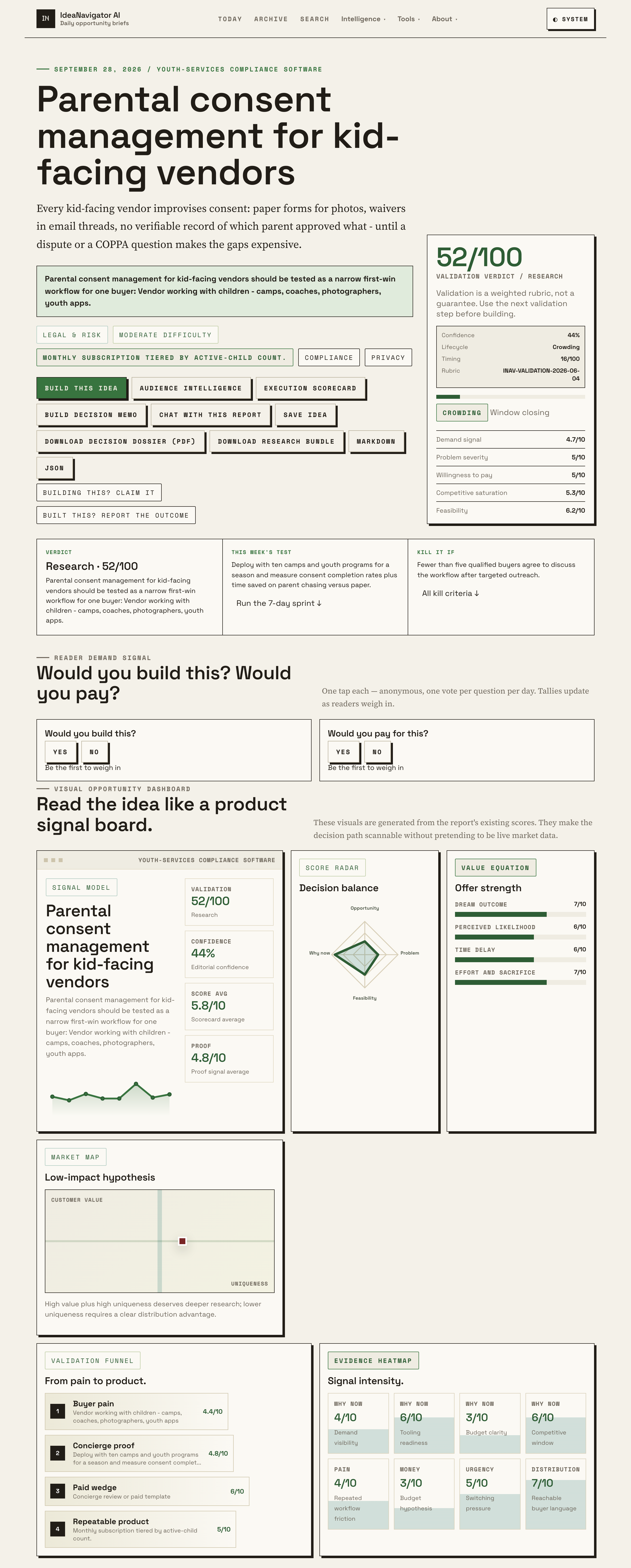
A proposal published by IdeaNavigator AI for youth-service vendors outlines a phone-based system for collecting and tracking parental consent for photos, data, medical information and liability waivers. It is a product concept, not a reported launch or tested result; the proposal suggests a pilot involving ten camps and youth programs for one season.
An IdeaNavigator AI product proposal for parental consent management would give camps, coaches, photographers and youth-focused apps a phone-based way to collect and track approvals for children. The concept calls for records organized by child, expiry tracking and audit exports, but no product launch, pilot results or adoption figures are reported in the proposal.
According to the IdeaNavigator AI proposal, vendors would present parents with branded forms on their phones. The listed consent areas include photo use, data collection, medical information and liability. The system would keep a record of which parent approved which item for each child, with consent expiry dates and an option to export records for an audit.
The proposal also calls for identity checks matched to the risk level of a consent request. It does not specify which verification methods vendors would use, how they would set risk tiers, or how the system would address changes in custody or who is authorized to approve on a child’s behalf.
The proposed business model is a monthly subscription tiered by active-child count. To assess demand, IdeaNavigator AI suggests a season-long deployment with ten camps and youth programs, measuring consent completion rates and time saved on following up with parents compared with paper processes. The proposal identifies no participating organizations, schedule or measurement results.
A Record for Each Child
For organizations that collect many kinds of permissions, putting approvals in one place could make it easier to check what a parent authorized and when that approval expires. It could also reduce the manual work of sending reminders and searching through paper forms or email threads. These are intended benefits described in the IdeaNavigator AI proposal; no measurements show that the system has achieved them.
Accurate records can matter when a parent questions how a photo or a child’s information was used, or when an organization needs to show that it received permission. A digital ledger may help document that history, but its value would depend on reliable identity checks, clear permission language and secure record handling. A stored approval alone would not resolve every dispute about who could consent or whether a particular use fell within the permission granted.
The proposal frames the product as a way to help small youth-service vendors handle consent more consistently as privacy requirements and parent expectations change. It does not cite specific enforcement actions, legal advice or a finding that the proposed tool would satisfy any particular law. Vendors would still need to determine which rules apply to their services and the information they collect.
Paper Forms and Digital Records
IdeaNavigator AI describes current consent practices among kid-facing vendors as a mix of paper photo forms, waivers in email and informal recordkeeping. It argues that this can leave organizations without a clear record of which parent approved which activity. The proposal provides no survey or independent research to establish how common those practices are.
The proposal presents expanding children’s privacy enforcement, including updates to the federal Children’s Online Privacy Protection Rule (COPPA) and state laws, as reasons vendors may seek more defensible records. It provides no legal analysis of how those requirements apply to camps, coaches, photographers or particular youth apps. Requirements vary by service and data use, so the suggested workflow should be understood as a product concept rather than a compliance determination.
The suggested first market is youth-services compliance software, with camps and youth programs as potential early testers. The focus on one buyer group and a limited pilot would allow a product team to measure completion rates and staff follow-up time before making broader claims about demand or results.
Pilot and Legal Questions
No pilot has been reported in the IdeaNavigator AI proposal, which identifies no vendor, launch date, participating camps or price. It is also unclear what counts as a completed consent, how the suggested time savings would be calculated, or what comparison period would be used. Without those details and results, claims about efficiency or market demand remain untested.
Technical and operational questions also remain open: how parent identities would be verified at each risk tier; how a vendor would handle conflicting guardians, revoked approvals or corrected records; and how long records would be retained. The proposal does not describe data security, access controls, privacy practices or procedures for parents who cannot use a phone-based form.
The proposal’s reference to COPPA updates and state laws does not establish that one workflow would meet every vendor’s legal obligations. The applicable rules can depend on the organization, the service and the data involved. No legal assessment is supplied.
A Season-Long Trial
The next step set out in the IdeaNavigator AI proposal is to deploy the workflow with ten camps and youth programs for one season. The suggested measures are parent consent completion rates and staff time spent chasing approvals compared with paper processes. The proposal does not say that a trial has begun or give a date for one.
If a pilot proceeds, its results could show whether parents complete phone-based forms and whether staff follow-up time changes. Details about participating organizations, measurement methods, privacy safeguards and the definition of a successful trial would be needed to interpret those results. Until such evidence is available, the concept remains an unvalidated proposal for a subscription product.
Source: IdeaNavigator AI, “Parental Consent Platform” proposal
Key Questions
What is being proposed?
An IdeaNavigator AI proposal describes a phone-based consent workflow for vendors working with children, including camps, coaches, photographers and youth apps. It would organize parent approvals by child and track expiry dates.
Has the system been launched or tested?
No launch or test results are reported in the IdeaNavigator AI proposal. It suggests a one-season pilot with ten camps and youth programs, but does not say that the pilot has started.
What kinds of permission would it cover?
The proposal lists forms covering photo use, data collection, medical information and liability. The specific form language and how vendors would handle different consent needs are not described.
Would using it guarantee legal compliance?
No such guarantee is established by the proposal. It offers no legal analysis, and the rules that apply can depend on the vendor’s service and data practices. It presents the product as a way to keep records, not as proof of compliance.
Source: IdeaNavigator AI
Fall Picks
fall essentials
As an affiliate, we earn on qualifying purchases.