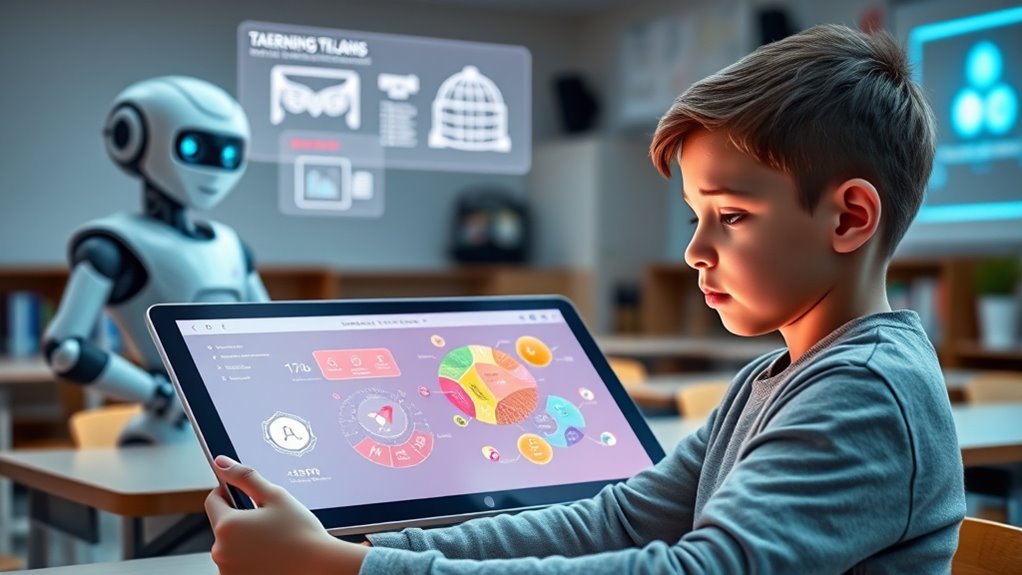

Generative AI transforms education by offering personalized learning experiences tailored to your unique needs. It adapts content based on your progress, strengths, and weaknesses, making learning more engaging and effective. Plus, it provides instant, detailed feedback on your work, highlighting errors and offering suggestions for improvement. With dynamic content creation and real-world scenario simulations, AI helps you develop critical thinking and problem-solving skills. Keep exploring to discover how AI can reshape your learning journey even further.
Key Takeaways
- AI personalizes learning by adapting content to individual student needs, styles, and progress.
- Provides instant, detailed feedback on assignments, highlighting errors and offering targeted suggestions.
- Enables dynamic creation of customized quizzes, tests, and discussion prompts to suit curriculum and learner levels.
- Facilitates critical thinking through scenario generation and real-world application of knowledge.
- Ensures secure handling of learner data, addressing ethical and privacy considerations in AI-driven education.

Generative AI is transforming education by providing personalized learning experiences and automating routine tasks. As a student or educator, you’ll notice how AI-powered tools can adapt to individual needs, making learning more engaging and effective. Instead of a one-size-fits-all approach, AI analyzes your progress, strengths, and weaknesses, tailoring content to fit your unique learning style. Whether you’re tackling complex math problems or exploring new languages, AI can generate customized exercises, hints, and explanations that match your current level. This personalization helps you stay motivated, reduces frustration, and accelerates your understanding of challenging concepts.
Moreover, generative AI offers immediate, detailed feedback that guides you through your learning journey. Traditional methods often involve waiting for teachers or tutors to review your work, which can slow down your progress. AI, however, provides instant responses to your submissions, highlighting errors and suggesting improvements right away. For instance, if you’re writing an essay, the AI can analyze your grammar, coherence, and argument structure, then offer specific suggestions for enhancement. This real-time feedback not only sharpens your skills but also encourages a growth mindset, as you learn from mistakes without feeling judged or discouraged. You gain clarity on what to improve, which helps you focus your efforts efficiently.
In addition to personalized exercises and feedback, generative AI enables dynamic content creation. Teachers can leverage AI to generate practice tests, quizzes, or discussion prompts tailored to the curriculum and your current learning phase. This reduces the burden on educators, allowing them to spend more time engaging directly with students rather than preparing materials. For you, it means access to diverse and relevant resources that keep the learning experience fresh and aligned with your needs. AI can also simulate real-world scenarios or generate case studies, making abstract concepts more concrete and applicable. This practical approach enhances your critical thinking and problem-solving skills, preparing you for real-life situations. Additionally, advances in AI in Education are addressing challenges related to data privacy and ethical considerations, ensuring that personalized learning remains secure and respectful of your privacy.

LeapFrog My First Learning Tablet, Scout
Just like a grown-up’s, this kid-tough toddler tablet features a home button, 20 app icons and introduces letters,…
As an affiliate, we earn on qualifying purchases.
As an affiliate, we earn on qualifying purchases.
Frequently Asked Questions
How Do Generative AI Models Adapt to Diverse Learning Styles?
Generative AI models adapt to your diverse learning styles by analyzing your interactions and preferences. They tailor content, feedback, and pacing based on your responses, ensuring a customized experience. As you engage, the AI adjusts its approach, offering visual, auditory, or hands-on materials that suit how you learn best. This dynamic personalization helps you stay motivated and understand concepts more effectively, making your learning journey more efficient and enjoyable.
What Are the Privacy Concerns With Ai-Generated Student Data?
You should be aware that AI-generated student data raises privacy concerns because it involves collecting and analyzing sensitive information, which could be misused or accessed without permission. You might worry about data breaches, unauthorized sharing, or how your data is stored and protected. To stay safe, make certain that institutions follow strict privacy policies, use encryption, and obtain clear consent before gathering or sharing any personal information.
How Can Teachers Effectively Integrate AI Tools Into Their Curriculum?
You can effectively integrate AI tools into your curriculum by starting with clear objectives and selecting platforms that align with your teaching goals. Use AI to personalize assignments, provide instant feedback, and analyze student progress. Incorporate training sessions to familiarize yourself with the tools, and encourage student engagement through interactive activities. Always monitor and adapt your approach based on student responses to ensure AI enhances learning without replacing your teaching presence.
What Measures Ensure the Accuracy of Ai-Generated Feedback?
Think of AI-generated feedback as a seasoned navigator guiding you through rough waters; its accuracy depends on clear maps and steady hands. To guarantee correctness, you should regularly update the AI’s data, cross-check feedback with human oversight, and implement calibration protocols. By doing so, you turn this digital compass into a reliable guide, helping students stay on course and achieve their learning goals confidently.
How Does AI Personalize Learning for Students With Disabilities?
You can use AI to tailor learning experiences for students with disabilities by adjusting content to fit their needs, such as simplifying language or providing alternative formats. AI analyzes individual progress and adapts activities accordingly, offering personalized support. It also identifies specific challenges, enabling you to modify instructions or resources, ensuring each student receives appropriate assistance. This personalized approach helps students engage more effectively and achieve their learning goals.

Music Software Bundle for Recording, Editing, Beat Making & Production – DAW, VST Audio Plugins, Sounds for Mac & Windows PC
No Demos, No Subscriptions, it's All Yours for Life. Music Creator has all the tools you need to…
As an affiliate, we earn on qualifying purchases.
As an affiliate, we earn on qualifying purchases.
Conclusion
As you explore the potential of generative AI in education, remember it’s a gentle nudge towards more personalized learning experiences. While it offers remarkable opportunities, it’s wise to approach its integration with a cautious optimism, ensuring human guidance remains central. Embracing these tools thoughtfully can enhance your teaching and learning journey, helping you unseal new possibilities without overshadowing the invaluable human connection that truly fosters growth and understanding.
customized quiz generator tools
As an affiliate, we earn on qualifying purchases.
As an affiliate, we earn on qualifying purchases.

ANVOSED Translation Earbuds Real Time – 156 Languages Translator Earbuds, Free App with AI Assisrant & 4 Smart Modes, Ultra-Light Open Earbud for Travel, Business, Language Learning (Ink Black)
[156 languages Translation Earbuds Real Time] 156 languages translation earbuds and accents with 0.1s response, Works as earbuds…
As an affiliate, we earn on qualifying purchases.
As an affiliate, we earn on qualifying purchases.