Generative AI for software development helps you write code faster by offering real-time suggestions and predicting your next steps. It automates repetitive tasks, reduces errors, and streamlines design ideas, allowing you to focus on higher-level problem solving. AI can generate entire modules, maintain consistency, and suggest optimized solutions. This boosts your productivity and confidence, making development more efficient. Keep exploring to discover how AI can become your powerful coding partner.
Key Takeaways
- Generative AI enhances code completion by analyzing context and providing real-time, accurate suggestions to speed up development.
- It aids in designing software by generating sketches, pseudocode, and alternative approaches based on functional descriptions.
- AI-driven tools help identify potential issues early, improving code quality and robustness during the design phase.
- They support creating larger code structures and maintaining consistency across modules and teams.
- Overall, generative AI boosts productivity, creativity, and efficiency in both coding and software architecture tasks.
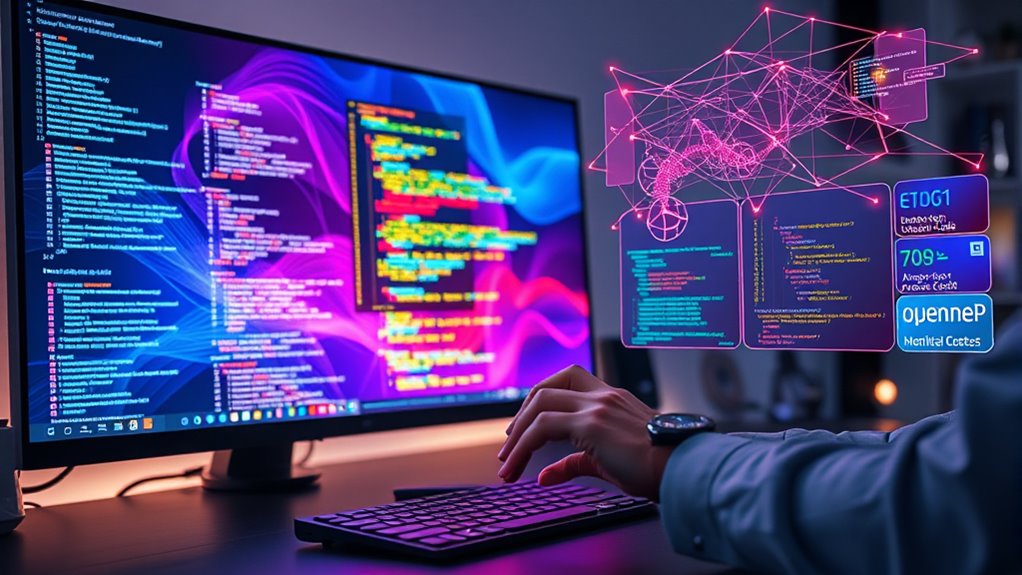
Generative AI is transforming the way software is developed by automating complex tasks and enhancing productivity. It acts as a powerful assistant, helping you write code faster, more accurately, and with fewer errors. Instead of spending hours searching for the right syntax or debugging, you can rely on AI tools to generate code snippets, suggest improvements, or even complete entire functions based on contextual cues. This shift allows you to focus more on high-level problem-solving and design, rather than getting bogged down in routine coding tasks. Additionally, AI-driven code generation can learn from various coding styles and adapt its suggestions accordingly, further streamlining your workflow.
When it comes to code completion, generative AI models analyze the code you’ve already written and predict what comes next. As you type, they provide real-time suggestions that can range from simple variable names to complex code blocks. This instant support accelerates your workflow, reduces typos, and helps you stick to best practices. Plus, these tools learn from a vast array of coding examples, so their suggestions often include efficient, idiomatic solutions you might not have considered. Over time, this can markedly boost your coding speed and make you more confident in your work.
Beyond just completing lines of code, generative AI also plays an essential role in designing software architecture. You can describe the functionality or the problem you’re trying to solve, and the AI can generate initial design sketches or pseudocode. This gives you a solid starting point, saving you the mental energy of drafting from scratch. As you refine your ideas, the AI can suggest alternative approaches, optimize algorithms, or highlight potential issues before you even run the code. This collaborative process helps you iterate faster, catch errors early, and develop more robust solutions.
Moreover, AI-driven code generation isn’t limited to individual functions or components. It can assist in generating entire modules or even scaffolding larger systems, ensuring consistency across your project. This consistency helps prevent integration issues down the line and maintains a clean, organized codebase. It also makes onboarding new team members easier, as the AI can help standardize coding styles and project structures.
In essence, generative AI empowers you to be more creative and efficient. It acts as a virtual partner that complements your skills, handles repetitive tasks, and offers insightful suggestions. By integrating these tools into your workflow, you can accelerate development cycles, improve code quality, and focus more on innovative solutions rather than mundane coding chores.
Frequently Asked Questions
How Does Generative AI Handle Complex or Niche Programming Languages?
Generative AI handles complex or niche programming languages by leveraging extensive training data and sophisticated models to understand unique syntax and patterns. You’ll find that it adapts quickly, offering relevant code suggestions even for less common languages. However, its effectiveness depends on the availability of high-quality examples. When data is limited, you may need to fine-tune or supplement AI outputs with your expertise to guarantee accuracy and efficiency.
What Are the Best Practices for Integrating AI Tools Into Existing Workflows?
You should start by clearly identifying the tasks AI can enhance, then integrate tools gradually to avoid disrupting your workflow. Train your team on how to use AI effectively, and establish feedback channels for continuous improvement. Automate repetitive tasks with AI, but maintain human oversight to catch errors. Regularly evaluate AI performance, update tools as needed, and document best practices to guarantee seamless adoption and maximize productivity.
How Secure Is Code Generated by AI in Terms of Vulnerabilities?
AI-generated code can introduce vulnerabilities if not carefully examined, so you should always test it thoroughly before deployment. While AI tools aim to produce secure code, they might overlook best practices or recent security updates. You need to stay vigilant, conduct security audits, and incorporate manual reviews to catch potential flaws. Relying solely on AI for security isn’t advisable—you must combine it with your expertise to ensure safety.
Can Generative AI Adapt to Evolving Coding Standards Over Time?
Yes, generative AI can adapt to evolving coding standards like a chameleon shifting colors. As you feed it new guidelines and updates, it learns from these signals, blending them into its creations. Over time, it becomes more attuned to current practices, much like a river carving new paths. This continuous learning guarantees your AI stays relevant, flexible, and aligned with the latest standards, guiding your development process forward smoothly.
What Are the Limitations of Current AI Models in Understanding Project Context?
You might find that current AI models struggle to fully grasp your project’s unique context because they lack deep understanding of your specific goals, architecture, and domain nuances. They often rely on patterns from training data, which can lead to generic suggestions that don’t align perfectly with your needs. As a result, you need to verify and adapt AI outputs carefully, since these models can’t yet replace human insight in complex project scenarios.
Conclusion
As you harness generative AI for code completion and design, you’ll see your productivity soar. Some might worry about losing creativity or control, but think of AI as your collaborative partner, sparking new ideas and handling repetitive tasks. Imagine spending more time on innovative solutions instead of tedious coding. Embrace this technology, and you’ll transform your development process into a more efficient, inspired journey, where human ingenuity and AI work hand in hand seamlessly.