Multimodal Generative AI combines text, images, and audio to help machines understand and create complex content across different formats. It uses advanced neural networks to fuse visual, verbal, and audio data, enabling more natural interactions and richer outputs like stories, art, or music. This technology pushes the boundaries of automation and creativity, making AI more intuitive and versatile. Keep exploring to discover how this evolving field can transform various industries and experiences.

Get business pricing on tech for your team
- Business-only prices and quantity discounts
- Tax-exempt purchasing
- Multiple users, one account, clear invoices
Key Takeaways
- Multimodal Generative AI integrates text, images, and audio to create richer, context-aware outputs.
- It uses advanced neural networks to fuse diverse data types, enabling comprehensive understanding.
- Applications include virtual assistants, creative content, and multimedia storytelling.
- Benefits include improved engagement, accessibility, and human-like AI interactions.
- Future developments focus on deeper contextual awareness and immersive multimedia experiences.
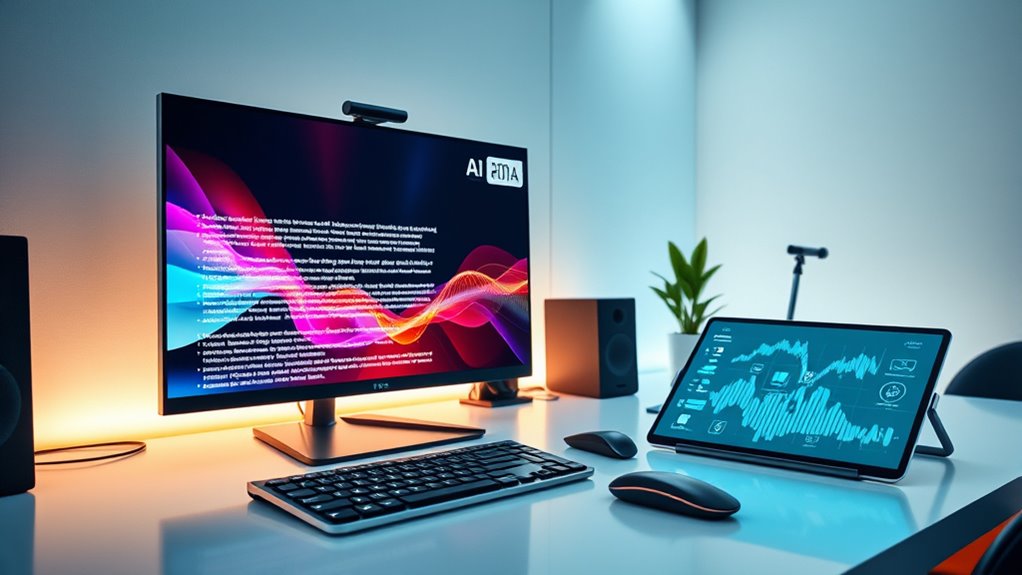
Multimodal Generative AI is transforming how machines understand and create content by integrating multiple types of data such as images, text, and audio. Instead of processing each data type separately, this technology combines them to produce richer, more nuanced outputs. Imagine giving an AI a photo, a snippet of text, and a sound clip, and then watching it generate a detailed story, a realistic video, or a compelling audio narration. That’s the power of multimodal AI—it enables machines to interpret the context more holistically, much like humans do. This integration allows for more natural interactions, as the AI can understand complex inputs and respond in ways that feel intuitive and human-like.
Multimodal AI combines images, text, and audio for richer, more human-like understanding and responses.
You might notice that multimodal AI is especially useful in applications like virtual assistants, where understanding multiple data formats enhances communication. For example, if you show a virtual assistant an image of a new product, speak a description, and play a related sound, the AI can combine these inputs to provide detailed information, answer questions, or suggest related items. This capability markedly improves the user experience because the AI isn’t limited to just text or images but can leverage all available data to deliver thorough responses. It also enables more creative applications such as AI-generated artwork, music videos, or immersive virtual environments, where different media types blend seamlessly.
As you explore multimodal AI, you’ll see how it pushes the boundaries of automation and creativity. It uses advanced neural networks and fusion techniques to align features from different data sources, creating a unified understanding. For instance, when analyzing a video that contains visual scenes, spoken dialogue, and background music, the AI can generate a detailed transcript or create a summary that captures the essence of all elements. This multi-layered comprehension opens new possibilities in education, entertainment, healthcare, and marketing, making content more engaging and accessible. Additionally, continuous improvements in fusion techniques enhance the accuracy and relevance of the generated outputs, further expanding the potential of multimodal AI.
Moreover, multimodal AI is continuously evolving. Researchers are developing models that learn from even more complex data combinations, improving accuracy and contextual awareness. As a user, you benefit from these advancements because the technology becomes smarter, more responsive, and better at understanding subtle cues. Whether you’re designing a multimedia project, creating interactive experiences, or simply seeking more personalized digital interactions, multimodal AI offers a versatile toolset to bridge different formats effortlessly. It essentially mimics human perception and cognition, helping machines become more intuitive partners in your creative and practical pursuits.
multimodal AI content creation tools
As an affiliate, we earn on qualifying purchases.
As an affiliate, we earn on qualifying purchases.
Frequently Asked Questions
How Do Multimodal Models Handle Conflicting Information Across Modalities?
When you encounter conflicting information across modalities, multimodal models analyze the context and weight the reliability of each source. They often use attention mechanisms to focus on the most relevant or trustworthy data, integrating signals to resolve discrepancies. By balancing the inputs dynamically, these models generate coherent outputs, ensuring that conflicting signals are managed effectively, leading to more accurate and consistent responses despite the disagreements across different modalities.
What Are the Best Practices for Training Multimodal AI Systems?
Think of training multimodal AI systems as orchestrating a symphony—you need harmony among diverse data types. To do this, you should curate high-quality, balanced datasets, align data formats, and use advanced fusion techniques. Incorporate cross-modal loss functions and regularization to enhance consistency. Continuously validate with real-world scenarios, and fine-tune models iteratively. This approach guarantees your AI learns to integrate modalities seamlessly, producing reliable, cohesive outputs.
How Do Multimodal Models Ensure Data Privacy and Security?
You can guarantee data privacy and security in multimodal models by implementing strict access controls, encrypting data both at rest and in transit, and anonymizing sensitive information. Regular audits and monitoring help detect unauthorized access, while federated learning allows training without sharing raw data. Additionally, adopting privacy-preserving techniques like differential privacy ensures user data remains protected, giving you confidence that your system maintains confidentiality and adheres to regulations.
Can Multimodal AI Generate Personalized Content Effectively?
Yes, multimodal AI can generate personalized content effectively. It analyzes your input data across text, images, and audio to understand your preferences and context. This allows it to create tailored responses, images, or audio that match your style and needs. As you interact more, the system learns and refines its outputs, making your experience more relevant and engaging every time.
What Are the Limitations of Current Multimodal Generative AI?
You face limitations with current multimodal AI, like a ship battling an endless storm. It struggles with understanding nuanced human emotions, often producing inconsistent or biased content. It can’t perfectly grasp context across different media types, leading to errors. Additionally, computational demands are enormous, making real-time, high-quality results challenging. These hurdles mean you can’t fully rely on it for complex, sensitive, or highly personalized tasks yet.
AI virtual assistant with image and audio recognition
As an affiliate, we earn on qualifying purchases.
As an affiliate, we earn on qualifying purchases.
Conclusion
As you step into the world of multimodal generative AI, imagine it as a vibrant tapestry woven from threads of text, images, and sound. This technology paints vivid stories and crafts immersive experiences, blending senses like a master artist. With each innovation, you’re opening new domains of creativity, where ideas leap off the page and dance in your mind’s eye. Embrace this symphony of modalities, and watch your imagination come alive in dazzling, unexpected ways.
AI-generated multimedia storytelling software
As an affiliate, we earn on qualifying purchases.
As an affiliate, we earn on qualifying purchases.
neural network AI for creative projects
As an affiliate, we earn on qualifying purchases.
As an affiliate, we earn on qualifying purchases.
Evergreen bestsellers Picks
bestsellers
As an affiliate, we earn on qualifying purchases.