
TL;DR

Get business pricing on tech for your team
- Business-only prices and quantity discounts
- Tax-exempt purchasing
- Multiple users, one account, clear invoices
A developer has created a guitar tuner app that uses a phone’s accelerometer to detect vibrations when pressed against guitar strings. The app works best on Android devices with high-rate IMU sensors and requires motion permission. This innovation offers a new approach to tuning, leveraging existing smartphone hardware.
A new guitar tuning method has been developed that uses a smartphone’s accelerometer to detect string vibrations when pressed against the guitar body, offering an alternative to traditional microphone-based tuners.
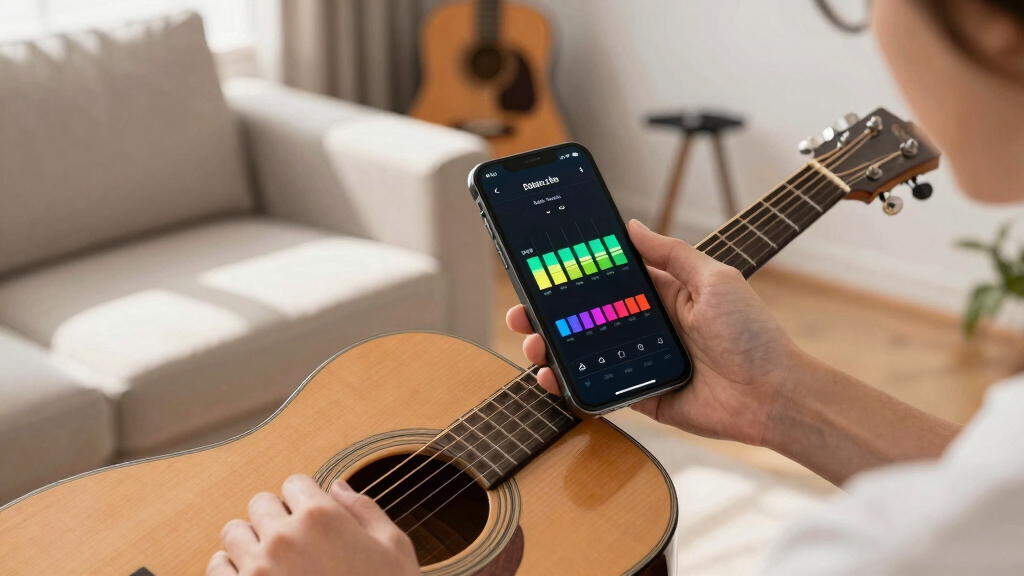
The app requires users to press their phone firmly against the guitar string or body and pluck the string. It then uses the phone’s accelerometer to trace vibration signals across its axes, with the strongest axis used to determine pitch. The app is currently optimized for Android devices with high-rate inertial measurement units (IMUs) and requires motion permission to operate.
According to the developer, the app analyzes raw vibration data captured by the accelerometer, calculating the combined magnitude from all axes and identifying the string’s frequency by correcting for aliasing effects. The method has been demonstrated on a prototype and is accessible via a web interface hosted on GitHub, with open-source code available for review and development.
Why It Matters
This development introduces a new approach for musicians to tune their instruments without relying on microphones, which can be affected by ambient noise. It leverages existing hardware in smartphones, potentially broadening access to tuning tools and inspiring further innovations in mobile music applications.
While traditional tuners use audio input, this accelerometer-based method could offer more precise detection in noisy environments and reduce the need for external hardware, making tuning more convenient and portable. However, its efficacy compared to standard methods remains to be validated through broader testing and user feedback.
As an affiliate, we earn on qualifying purchases.
Background
Existing guitar tuners typically rely on microphone input to detect string vibrations and determine pitch. Recent advances in mobile hardware, especially high-rate IMUs, have opened possibilities for alternative detection methods. The concept of using accelerometers for tuning has been discussed in technical circles but has not been widely implemented commercially.
This project, hosted on GitHub, demonstrates a practical application of these ideas, showing that smartphones can serve as vibration sensors with appropriate software. The approach aligns with broader trends in mobile sensor utilization for musical and scientific purposes.
“Pressing the phone firmly against the guitar string and plucking it allows the accelerometer to detect vibrations accurately, enabling pitch detection without a microphone.”
— Developer of the app
“High-rate IMUs in recent Android devices provide the necessary sensitivity for vibration detection, making this approach feasible on consumer smartphones.”
— Android hardware expert
accelerometer-based guitar tuner
As an affiliate, we earn on qualifying purchases.
As an affiliate, we earn on qualifying purchases.
What Remains Unclear
It is not yet clear how the app’s accuracy compares to traditional microphone-based tuners across different devices and environments. Broader testing and user feedback are still needed to validate its effectiveness and reliability.
smartphone vibration guitar tuner
As an affiliate, we earn on qualifying purchases.
As an affiliate, we earn on qualifying purchases.
What’s Next
The developer plans to refine the app, improve user interface, and conduct broader testing with musicians. Future updates may include compatibility with more devices and enhanced vibration analysis algorithms. Further validation studies are expected to assess its accuracy against standard tuning methods.
As an affiliate, we earn on qualifying purchases.
Key Questions
How does the accelerometer-based tuner work?
The user presses their phone firmly against a guitar string or body and plucks the string. The app analyzes vibration data captured by the accelerometer to determine the string’s pitch, using the strongest axis of movement for detection.
What devices are compatible with this app?
The app works best on Android devices equipped with high-rate IMUs that can accurately detect vibrations. Compatibility with other platforms or lower-end devices has not yet been confirmed.
Can this method replace traditional tuners?
While promising, it remains to be seen how the accuracy and reliability compare to standard microphone-based tuners. Users should consider it as an alternative, especially in noisy environments, but further validation is needed.
Is the app available for download?
The project is hosted on GitHub with open-source code, but a user-friendly app interface has not yet been officially released. Interested users can review the code and try the prototype.
Halloween Picks
halloween
As an affiliate, we earn on qualifying purchases.