📊 Full opportunity report: Liquid vs Air Cooling for 24/7 Inference Rigs on ThorstenMeyerAI.com — validation score, market gap, and execution plan.
TL;DR
For 24/7 AI inference rigs, air cooling generally offers greater reliability, lower cost, and quieter operation than liquid cooling. Liquid cooling may be necessary for extreme thermal headroom but introduces complexity and potential failure points.
For continuous AI inference systems operating 24/7, air cooling is typically the preferred choice over liquid cooling due to its simplicity, reliability, and lower total cost of ownership, according to industry experts and recent testing.
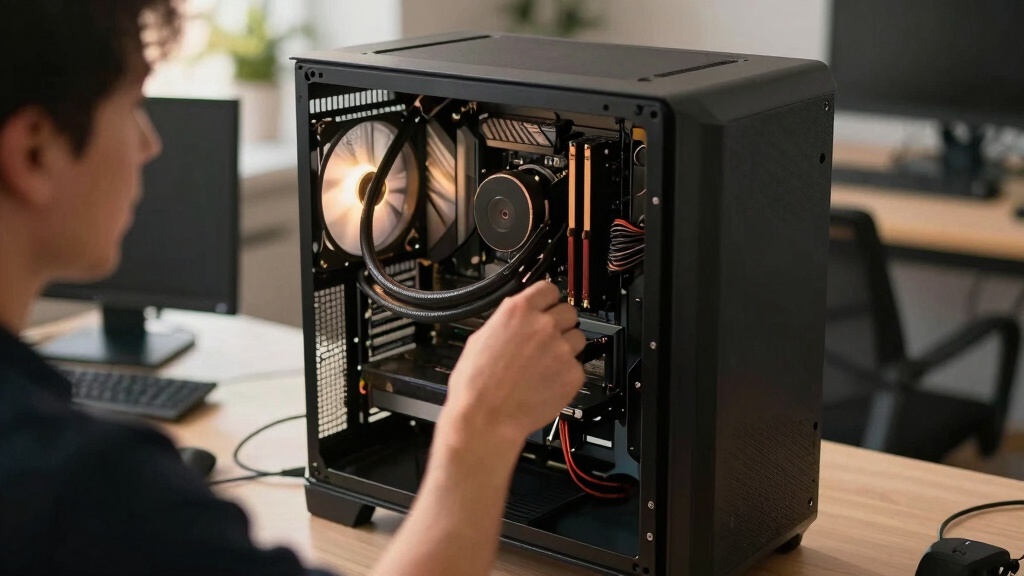
Most AI inference rigs run unattended for extended periods, making reliability a critical factor. Air coolers, especially high-end dual-tower models like the Noctua NH-D15, have no moving parts beyond the fan, which can be replaced easily and cheaply. They are designed to last for many years without failure, and their performance rivals that of smaller liquid coolers under sustained loads. In contrast, all-in-one (AIO) liquid coolers contain a pump, seals, and tubing, each with a finite lifespan. The pump is a single point of failure, typically lasting 5–7 years, and the coolant can permeate through rubber components over time, reducing efficiency. Leaks, although rare, pose risks of damage to other components. While modern AIOs are reliable, their lifespan and maintenance requirements make them less ideal for always-on systems. Cost-wise, air coolers are more economical upfront and over the machine’s lifespan, as they do not require replacement of the pump or coolant. Noise levels are often lower with high-quality air coolers, which produce less constant hum than the pump noise of AIOs. Maintenance is straightforward—dust removal and thermal paste reapplication—whereas AIOs require monitoring for pump failure and potential leaks.Liquid vs air
for a 24/7 inference rig.
For an always-on machine the question isn’t “which cools better” — it’s which one still works in three years without you thinking about it. That reframing makes air the default for most rigs. Answer three questions in Part 2 to find yours.
- Nothing to fail — fan swaps in minutes
- Lasts a decade+; lower total cost
- Quieter floor — no pump hum (~40–45 dBA)
- Trivial maintenance — wipe & repaste
- Tall — can block RAM, dumps heat in case
- Best headroom — ~360W TDP sustained
- Compact block — fits tight cases, clears RAM
- Exports heat out the radiator & room
- Pump fails at 5–7 yrs; replace whole unit
- Costs 2–3× more over its life; pump hum
- You run it 24/7 and want set-and-forget.
- Your CPU is mainstream-to-high-end (or power-capped).
- A big tower fits your case.
- You value lower cost and a quieter floor.
- Your CPU is too hot for air under sustained all-core load.
- A big tower won’t fit (compact / multi-GPU case).
- You need to export heat out of a warm room.
- RAM clearance is tight.
Reliability and Cost Are Critical for Continuous AI Operations
Choosing the right cooling method impacts the longevity, maintenance, and overall cost of AI inference rigs. Air cooling’s simplicity and durability make it the best option for systems that run continuously without frequent intervention. Liquid cooling, while offering higher thermal headroom, introduces potential failure points that can compromise system uptime. For organizations deploying large-scale AI workloads, these factors influence total cost of ownership and operational stability.
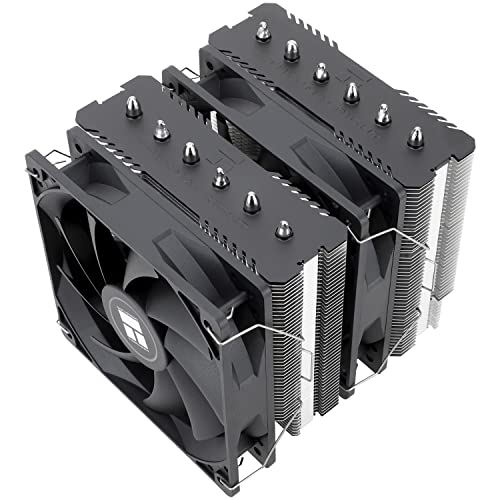
Thermalright Peerless Assassin 120 SE CPU Cooler, 6 Heat Pipes AGHP Technology, Dual 120mm PWM Fans, 1550RPM Speed, for AMD:AM4 AM5/Intel LGA 1700/1150/1151/1200/1851,PC Cooler
- Brand Origin: Taiwan-based with 20+ years experience
- Product Dimensions: 125x135x155mm
- Material: Aluminum heat sink
As an affiliate, we earn on qualifying purchases.
As an affiliate, we earn on qualifying purchases.
Cooling Choices in AI Workstation Design
Traditionally, gamers and overclockers favored liquid cooling for its superior thermal performance. However, AI inference rigs differ because they prioritize reliability and long-term stability over peak performance. Recent testing shows high-end air coolers can dissipate enough heat for most CPUs under sustained loads, making them suitable for 24/7 operation. The market’s shift toward larger, more efficient air coolers and the increasing lifespan of modern AIOs reflect this evolving understanding. Industry experts emphasize that for unattended, continuous workloads, the risk of pump failure and coolant degradation in liquid coolers outweighs their thermal advantages in typical scenarios.
"For a set-and-forget inference rig, the simplicity and durability of air cooling make it the smarter choice over liquid cooling."
— Thorsten Meyer, AI hardware specialist
24/7 AI inference cooling solution
As an affiliate, we earn on qualifying purchases.
As an affiliate, we earn on qualifying purchases.
Long-Term Performance and Failure Risks of Liquid Cooling
While modern AIO liquid coolers are generally reliable, their long-term performance in continuous operation remains less certain. Data on failure rates over 5–10 years is limited, and the impact of coolant permeation, seal degradation, and pump wear in real-world, unattended systems needs further study. It is also unclear whether future advancements will mitigate these issues significantly.
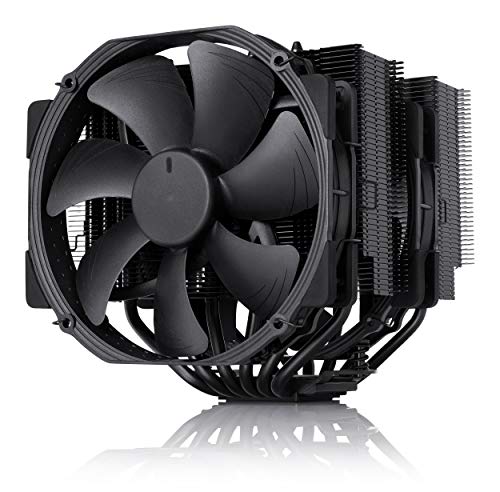
Noctua NH-D15 chromax.Black, Dual-Tower CPU Cooler (140mm, Black)
- Premium heatsink with awards: Over 300 awards and recommendations
- All-black design: Matches various color schemes
- Wide dual-tower structure: 140mm with 6 heatpipes
As an affiliate, we earn on qualifying purchases.
As an affiliate, we earn on qualifying purchases.
Monitoring and Future Developments in Cooling Technologies
Expect ongoing evaluation of cooling solutions as manufacturers improve pump durability and seal longevity. System builders may adopt hybrid approaches, combining high-quality air coolers with auxiliary cooling methods for specific workloads. Further research into long-term reliability data and new materials could shift recommendations in favor of liquid cooling if failure risks are minimized.
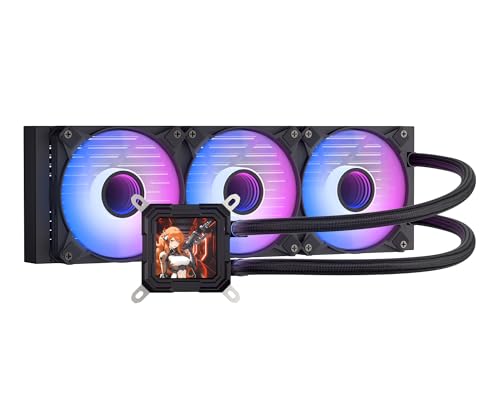
darkFlash DV360S All-in-one Liquid CPU Cooler, 3.2” LCD Screen with 320 * 320 Resolution, ARGB Sync, PWM Fans 360mm Radiator, CPU PC Aio Cooler Compatible with Intel 1851/1700, AMD AM4/AM5 (Black)
- 3.2-inch IPS LCD Display: Vivid visuals with customizable info
- Magnetic 270° Installation: Easy to install and personalize
- Silent Efficient Pump: High-performance, stable cooling
As an affiliate, we earn on qualifying purchases.
As an affiliate, we earn on qualifying purchases.
Key Questions
Is liquid cooling worth it for a 24/7 AI inference rig?
Generally, no. For most continuous workloads, air cooling offers comparable performance with higher reliability, lower cost, and less maintenance.
How often do AIO liquid coolers need maintenance or replacement?
Typically, pumps last 5–7 years, but coolant permeation and seal degradation can reduce effectiveness over 3–5 years, potentially requiring replacement.
Can high-end air coolers handle the thermal load of overclocked CPUs in inference rigs?
Yes, many high-quality dual-tower air coolers can dissipate 200–250W, sufficient for most CPUs under sustained load in AI workloads.
What are the main failure points of liquid coolers?
The pump, seals, and tubing are the primary failure points, with pumps being the most common source of breakdown over time.
Will future cooling tech eliminate the reliability concerns of liquid cooling?
Potentially, but current data suggests that reliability and maintenance remain key considerations, favoring air cooling for most continuous, unattended systems.
Source: ThorstenMeyerAI.com