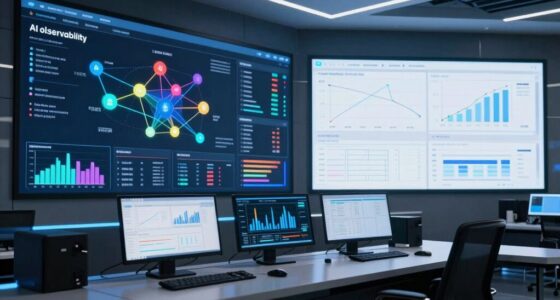
Self-healing AI systems automatically detect, diagnose, and fix model failures in real time, so your applications stay reliable without manual intervention. They monitor performance proactively, identify anomalies, and isolate faulty components quickly. These systems adjust parameters and reroute tasks to guarantee continuous operation, reducing downtime and boosting resilience. By learning from incidents, they improve over time, handling new challenges effectively. Keep exploring to discover how these advanced mechanisms can revolutionize your AI deployments.
Key Takeaways
- Self-healing AI systems detect and diagnose model failures in real time without human intervention.
- They automatically isolate faulty components and reroute tasks to maintain continuous operation.
- Dynamic adjustments of model parameters help correct errors and adapt to changing conditions.
- Continuous monitoring and learning enable these systems to improve fault detection accuracy over time.
- They are ideal for high-stakes environments requiring reliable, autonomous correction of model issues.

Self-healing AI systems are revolutionizing the way machines maintain their functionality by automatically detecting, diagnosing, and repairing faults without human intervention. When you deploy these systems, you empower your models to operate more reliably and efficiently, even in unpredictable environments. Instead of waiting for errors to cause failures or for manual troubleshooting, these AI systems proactively monitor their own performance, spotting anomalies as soon as they occur. This capability is essential because it minimizes downtime and keeps your applications running smoothly, ensuring consistent user experiences and safeguarding critical operations.
Self-healing AI automatically detects and repairs faults, ensuring reliable, efficient operation with minimal downtime.
As you implement self-healing AI, you’ll find that these systems leverage sophisticated algorithms to analyze vast amounts of data in real time. They continuously assess various metrics, such as prediction accuracy, response times, or resource utilization, to identify signs of degradation or faults. When a problem emerges, the system doesn’t just flag it—it acts. It can automatically isolate the faulty component, reroute tasks, or even adjust model parameters to compensate for issues. This dynamic response reduces the need for manual intervention and accelerates recovery times, which is especially indispensable in high-stakes applications like autonomous vehicles, financial trading, or healthcare diagnostics.
Moreover, these systems learn from their own experiences. Over time, they build a knowledge base of common failure patterns and successful corrective actions. This self-improving aspect means the system gets better at diagnosing and repairing itself with each incident, reducing the likelihood of recurring problems. You can think of it as having an AI that not only maintains your models but also evolves to handle future challenges more effectively. This continuous learning process helps you optimize your infrastructure, reducing maintenance costs and increasing overall system resilience.
Another benefit you’ll notice is that self-healing AI systems enable you to implement more complex and sensitive applications confidently. Since the system can adapt on the fly to faults—whether caused by data drift, hardware issues, or software bugs—you can push the boundaries of automation without fearing catastrophic failures. This flexibility is especially valuable in environments where manual oversight is limited or impractical, such as edge computing devices or large-scale IoT networks. Incorporating inspired techniques from other fields can further enhance their robustness and adaptability over time.

THE FUTURE OF AI IN SITE RELIABILITY: Predictive Analytics and Self-Healing Systems
As an affiliate, we earn on qualifying purchases.
As an affiliate, we earn on qualifying purchases.
Frequently Asked Questions
How Do Self-Healing AI Systems Detect Their Own Failures?
You can detect failures in self-healing AI systems by monitoring their performance metrics and comparing real-time outputs with expected results. These systems analyze data patterns and look for anomalies or deviations that signal issues. When they spot inconsistencies, they flag potential failures. This proactive approach lets you quickly identify problems, ensuring the system can initiate corrective actions without human intervention, maintaining peak functionality and reliability.
What Are the Limitations of Current Self-Healing Techniques?
You face limitations in current self-healing techniques, like a fragile glass that shatters under pressure. They often struggle with complex, unforeseen failures, like a boat steering stormy waters without a compass. These systems can be slow to adapt or misinterpret signals, leading to incomplete fixes. Without human oversight, they might miss subtle issues or cause unintended consequences, highlighting the need for more resilient, context-aware solutions to truly keep your AI stable.
How Do Self-Healing Systems Impact User Privacy and Data Security?
You might worry that self-healing systems could compromise your privacy or data security because they often require access to sensitive information to identify and fix issues. While they aim to improve reliability, they could inadvertently expose data if not properly secured. To protect your privacy, these systems should implement strict access controls, encryption, and regular security audits, ensuring your data remains confidential and safe throughout their self-healing processes.
Can Self-Healing AI Systems Adapt to Completely New Failure Types?
Yes, self-healing AI systems can adapt to completely new failure types, but it’s not automatic. You need to design them with flexibility and foresight, enabling them to recognize unfamiliar issues and learn from new data. By leveraging machine learning and continuous monitoring, you empower your system to evolve and address unforeseen failures swiftly. This proactive approach helps you stay resilient, reliable, and ready for whatever challenges come next.
What Are the Ethical Considerations of Autonomous Model Corrections?
You should consider that autonomous model corrections raise ethical concerns like transparency, accountability, and bias. When AI adjusts itself without human oversight, it can become opaque, making it difficult to understand decisions or identify errors. You need to guarantee safeguards are in place so that corrections don’t reinforce biases or cause unintended harm. Balancing automation with human oversight helps maintain trust, fairness, and responsibility in AI systems.

Automotive Fault Detection Device, Read/Erase Codes, View Freeze Frame, 4.8 in Display
Comprehensive Diagnostics: This automotive fault detection device allows you to read and erase diagnostic trouble codes, view freeze…
As an affiliate, we earn on qualifying purchases.
As an affiliate, we earn on qualifying purchases.
Conclusion
By implementing self-healing AI systems, you create a technology that’s like a vigilant guardian, always ready to repair itself when failures occur. This proactive approach guarantees your models stay reliable and efficient, even in unpredictable environments. As if your AI has an invisible safety net, it catches and corrects errors before they cause problems. Embracing self-healing capabilities means you’re building smarter, more resilient systems that adapt seamlessly—keeping your operations smooth like a well-oiled machine.

Observability in the AI-Native Era: Leveraging AIOps to build, observe, and operate resilient systems
As an affiliate, we earn on qualifying purchases.
As an affiliate, we earn on qualifying purchases.

Edge AI on Embedded Devices Running Machine Learning on Microcontrollers and Low-Power Hardware
As an affiliate, we earn on qualifying purchases.
As an affiliate, we earn on qualifying purchases.