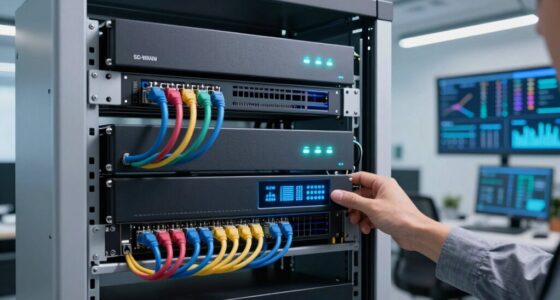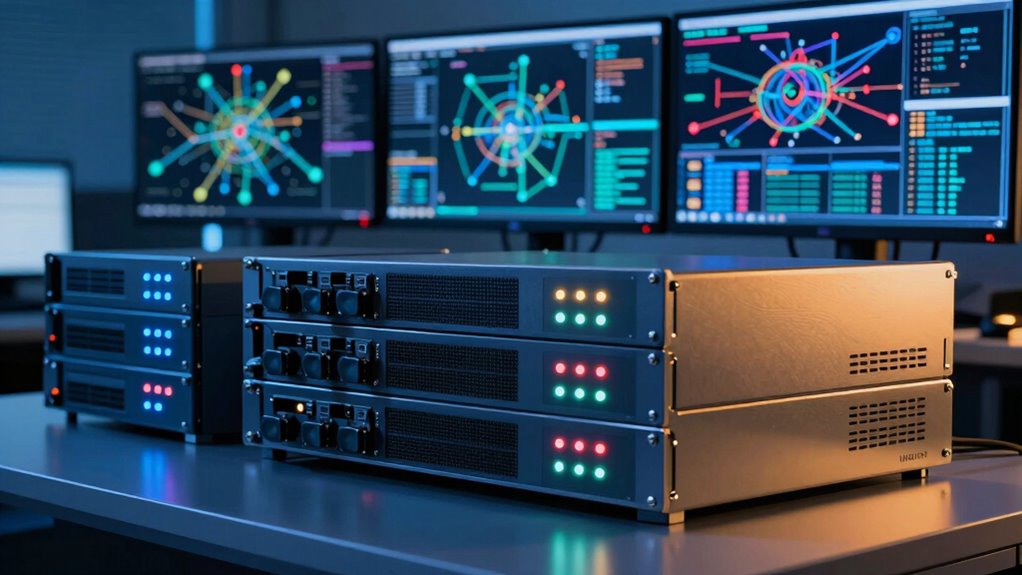

Network packet broker appliances still matter because they help you efficiently manage complex data flows by aggregating, filtering, and normalizing diverse traffic before it reaches security and monitoring tools. They guarantee you get high-quality, relevant data, reducing noise and preventing overload. This enhances your system’s performance and accuracy in threat detection. If you want to understand how these devices keep your visibility stack effective, there’s more to explore below.
Key Takeaways
- They aggregate and filter high-volume data, ensuring only relevant traffic reaches security tools, reducing overload.
- They normalize diverse data formats, enabling accurate analysis and faster threat detection.
- They provide scalable, automated traffic management adaptable to evolving network complexities.
- They serve as centralized points for efficient data distribution, improving overall visibility and monitoring effectiveness.
- They enable precise traffic shaping and prioritization, enhancing security response and operational efficiency.
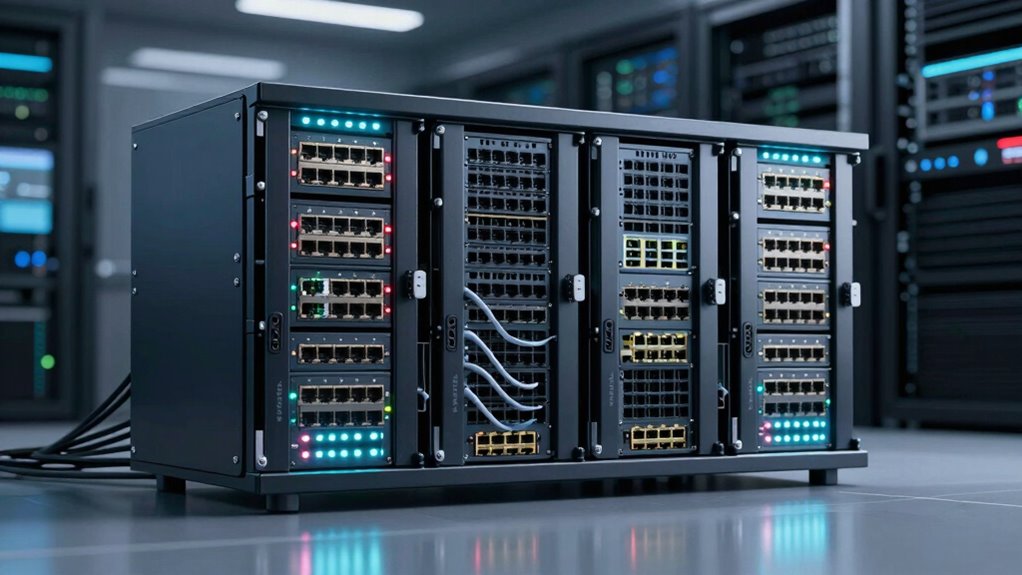
Network packet broker (NPB) appliances play an essential role in visibility stacks by efficiently aggregating, filtering, and directing network traffic to security and monitoring tools. In complex network environments, where data flows are vast and varied, NPBs help you manage this traffic effectively. They serve as central points that streamline visibility, guaranteeing your tools receive only relevant, high-quality data. This is where traffic filtering becomes fundamental. By implementing precise filtering rules, NPBs allow you to eliminate unnecessary or redundant packets, reducing noise and focusing your monitoring efforts on the most critical information. This targeted approach not only enhances performance but also helps prevent overload on security appliances, which can be overwhelmed by excessive data.
Data normalization is another key function of NPB appliances that keeps your visibility stack efficient. When data from multiple sources enters your network, it often arrives in different formats, protocols, or encapsulations. Without normalization, analyzing this data becomes a challenge, as inconsistencies can lead to missed alerts or false positives. NPBs perform data normalization by converting diverse data streams into a unified format, making it easier for your security and monitoring tools to interpret and correlate information across the network. This process guarantees that your tools work with clean, consistent data, improving detection accuracy and enabling faster responses to threats. Additionally, automation capabilities within NPB appliances further enhance operational efficiency by allowing dynamic adjustments to traffic management based on real-time conditions. Incorporating advanced filtering techniques can further optimize the effectiveness of traffic management and ensure the most relevant data reaches your security tools.
Even in highly complex visibility architectures, NPB appliances remain indispensable. They act as intelligent traffic managers that not only filter out irrelevant data but also shape and distribute traffic based on your specific needs. You can configure them to prioritize critical data flows, ensuring that your security tools focus on the most pressing issues. Their ability to perform traffic filtering and normalization at the edge minimizes the processing burden on downstream tools, which often have limited capacity. This separation of concerns keeps your entire security stack running smoothly, reducing latency and boosting overall effectiveness.
You might wonder if traditional monitoring methods can suffice, but in today’s dynamic network landscape, NPBs provide a level of control and flexibility that’s hard to match. They adapt quickly to changing threats and network configurations, giving you continuous visibility without sacrificing performance. As networks grow more complex, the importance of intelligent traffic filtering and data normalization only increases. NPB appliances help you keep pace, ensuring your security and monitoring efforts remain accurate, efficient, and scalable. That’s why, despite evolving technology, NPBs continue to matter in sophisticated visibility stacks.
As an affiliate, we earn on qualifying purchases.
Frequently Asked Questions
How Do Packet Brokers Differ From Traditional Network Switches?
Packet brokers differ from traditional network switches by focusing on packet filtering and traffic segmentation. While switches primarily direct data based on MAC addresses, packet brokers selectively filter packets and segment traffic to optimize visibility and security. This allows you to better manage and analyze network data, ensuring you see only what you need for performance monitoring or security, making complex visibility stacks more efficient and effective.
What Are the Cost Implications of Deploying Packet Broker Appliances?
Deploying packet broker appliances impacts your budget planning by offering cost efficiency through optimized traffic management. While the initial investment might seem high, these appliances reduce the need for multiple specialized tools, lowering ongoing operational costs. They streamline your network visibility, helping you allocate resources more effectively and avoid unnecessary expenses, ultimately making your overall network infrastructure more cost-effective.
How Scalable Are Network Packet Broker Appliances in Large Networks?
You’ll find that network packet broker appliances are quite scalable in large networks, especially when handling traffic aggregation. They’re designed to address scalability challenges by efficiently managing high volumes of data and ensuring your visibility tools receive relevant traffic. As your network grows, these appliances adapt, providing flexible, centralized control that helps you maintain performance without overloading your monitoring infrastructure. This makes them essential for complex, expanding network environments.
Can Packet Brokers Integrate With Cloud-Based Visibility Solutions?
Think of packet brokers as skilled conductors guiding an orchestra; they seamlessly sync with cloud-based visibility solutions. You can integrate packet brokers with cloud platforms through flexible APIs and cloud-native features, boosting your visibility enhancement efforts. This integration simplifies data management, guarantees real-time insights, and strengthens your network’s performance. By doing so, you maintain thorough, scalable visibility, even across complex, hybrid environments.
What Are Common Challenges When Implementing Packet Broker Appliances?
When implementing packet broker appliances, you often face challenges like managing traffic filtering and protocol aggregation effectively. You need to guarantee that the device correctly filters unnecessary data, preventing overloads, and aggregates protocols seamlessly for thorough visibility. Additionally, configuring these features across complex networks can be tricky, requiring careful planning and expertise. Overcoming these challenges is vital to optimize network monitoring and maintain high performance.
Network Traffic Filtering Device
As an affiliate, we earn on qualifying purchases.
As an affiliate, we earn on qualifying purchases.
Conclusion
In today’s intricate visibility stacks, network packet broker appliances are your secret weapon—an absolute game-changer. They streamline data, eliminate chaos, and guarantee you don’t drown in a sea of information. Without them, your network’s complexity could become an insurmountable mountain. Trust me, these appliances are more essential than ever, standing as the ultimate fortress for your network’s clarity and security. Embrace them, or risk being overwhelmed by the chaos of modern networks!
Data Normalization Network Appliance
As an affiliate, we earn on qualifying purchases.
As an affiliate, we earn on qualifying purchases.
Network Visibility and Monitoring Tool
As an affiliate, we earn on qualifying purchases.
As an affiliate, we earn on qualifying purchases.