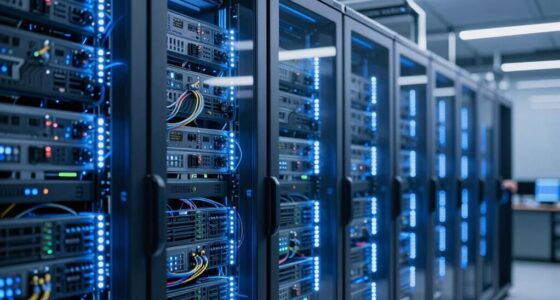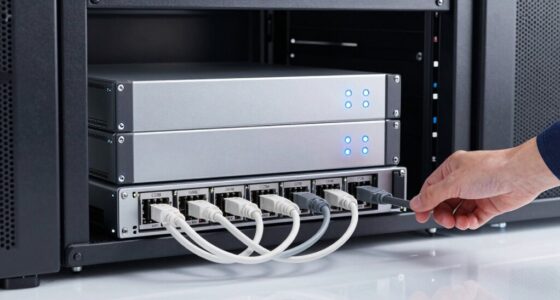

Private AI infrastructure gives you more control over data, security, and compliance, making it ideal if you need strict data sovereignty and tailored security measures. It helps reduce risks of breaches and keeps sensitive data within specific jurisdictions. Public cloud AI offers unmatched scalability and flexible resources, perfect for handling fluctuating workloads. If you want to explore how these options balance control and performance, you’ll find valuable insights ahead.
Key Takeaways
- Private AI infrastructure offers greater control over data location, security, and compliance, unlike public cloud which relies on shared resources.
- Public cloud provides superior scalability and flexibility for fluctuating workloads, whereas private setups may have limited scalability.
- Private infrastructure enhances data sovereignty and security for sensitive industries, while public cloud solutions depend on provider security measures.
- Edge computing integrated with private infrastructure reduces latency and improves real-time processing, unlike traditional public cloud setups.
- Public cloud typically involves lower upfront costs and faster deployment, while private infrastructure requires capital investment but offers long-term value.
As artificial intelligence continues to transform industries, understanding the strengths and weaknesses of different AI infrastructure options becomes crucial. When comparing private AI infrastructure to public cloud AI, you need to take into account key factors like control, security, performance, and compliance. Private AI infrastructure offers a level of control that’s hard to match. With private setups, you manage everything on your terms, which is especially important if data sovereignty is a concern. Data sovereignty refers to your ability to keep data within specific jurisdictions, ensuring compliance with local laws and regulations. When you deploy AI models on private infrastructure, you retain full control over where data resides, reducing the risk of data breaches or unauthorized access. This control is critical for industries handling sensitive information, such as healthcare or finance, where privacy violations can have serious consequences.
Private AI infrastructure ensures control and compliance, safeguarding sensitive data within specific jurisdictions for industries like healthcare and finance.
On the other hand, public cloud AI provides scalability and flexibility that private systems struggle to match. Public cloud providers like AWS, Google Cloud, or Azure offer vast resources that you can tap into on-demand. This makes it easier to handle fluctuating workloads and scale your AI solutions quickly. However, this convenience comes with trade-offs. When you rely on public cloud, data is stored and processed on shared infrastructure, which may raise concerns about data sovereignty. You might not have the same level of data locality control, especially if the cloud provider’s data centers are located in different regions. This can complicate compliance with regional data laws and make it harder to ensure your data stays within specific jurisdictions. Incorporating edge computing into your strategy can further enhance control for private infrastructures, especially when low latency and data sovereignty are priorities. Additionally, resale value of private AI infrastructure can be higher over time, particularly as organizations invest in customized solutions. Furthermore, as the field of AI infrastructure develops, staying informed about emerging trends can help organizations adapt their strategies effectively. Recognizing the importance of digital content management can also influence infrastructure decisions, especially for multimedia-heavy AI applications.
Adding security measures, such as advanced encryption and access controls, can further secure private AI setups against evolving cyber threats. Edge computing adds another layer to this comparison. It involves processing data closer to where it’s generated, such as IoT devices or local servers. For private AI infrastructure, edge computing can amplify benefits by reducing latency and bandwidth demands, which is essential for real-time applications like autonomous vehicles or industrial automation. It also enhances data sovereignty because data remains local, giving you more control over sensitive information. Public cloud providers are increasingly offering edge solutions, but integrating them requires careful planning and may not always provide the same level of control as a dedicated private setup.
Ultimately, your choice depends on your priorities. If control, compliance, and data sovereignty are paramount, private AI infrastructure combined with edge computing might be your best option. If you need rapid scalability and don’t have strict data residency requirements, public cloud AI could serve your needs more effectively. Understanding these distinctions ensures you choose the right infrastructure for your AI projects, balancing performance, security, and regulatory adherence.

Personal AI Servers: A Guide to Building Private AI Infrastructure for Secure, Offline and Self-Hosted Local LLMs for Data Privacy
As an affiliate, we earn on qualifying purchases.
As an affiliate, we earn on qualifying purchases.
Frequently Asked Questions
How Does Data Privacy Differ Between Private AI Infrastructure and Public Cloud?
You have more control over data privacy with private AI infrastructure, ensuring data sovereignty and reducing exposure to breaches. It allows you to meet strict regulatory compliance because data stays within your own environment. In contrast, public cloud AI may involve sharing data across multiple tenants, raising concerns about data privacy and compliance. Private setups give you peace of mind, knowing your sensitive data remains protected and compliant with industry standards.
What Are the Cost Implications of Private Versus Public AI Infrastructure?
You’ll find private AI infrastructure often comes with higher upfront costs, requiring significant investments in hardware and maintenance, but it offers long-term savings through tailored resource use. In contrast, public cloud AI operates on a pay-as-you-go model, making initial expenses lower and allowing flexible scaling. Your cost analysis should weigh budget considerations, like capital expenditure versus operational costs, to choose the best fit for your organization’s financial strategy.
How Scalable Is Private AI Infrastructure Compared to Public Cloud Solutions?
You’ll find private AI infrastructure less scalable than public cloud solutions, but it offers significant advantages in edge computing and data sovereignty. With private setups, you can optimize performance at specific locations and maintain control over sensitive data, ensuring compliance. However, expanding capacity often requires substantial investment, while public cloud providers offer on-demand scalability that adapts quickly to your needs, making them more flexible for rapidly changing AI workloads.
What Are the Maintenance Requirements for Private AI Infrastructure?
You need to actively manage hardware, perform regular system updates, and monitor performance to keep private AI infrastructure running smoothly. Hardware management involves maintaining servers, storage, and networking equipment, while system updates ensure security patches and software improvements are applied promptly. These tasks require dedicated effort and expertise, making maintenance more hands-on compared to public cloud solutions. Staying on top of these requirements helps prevent downtime and optimizes AI system performance.
How Does Latency Compare Between Private and Public AI Environments?
You’ll find that private AI infrastructure offers lower latency compared to public cloud environments, especially with edge computing. Processing data locally means faster response times, which is essential for real-time applications. Additionally, private setups enhance data sovereignty, giving you more control over sensitive information. This setup minimizes delays caused by data traveling over the internet, ensuring you get quicker insights and more reliable performance for vital AI tasks.

Computer Science for Curious Kids: An Illustrated Introduction to Software Programming, Artificial Intelligence, Cyber-Security―and More!
As an affiliate, we earn on qualifying purchases.
As an affiliate, we earn on qualifying purchases.
Conclusion
Think of private AI infrastructure as your personal, well-tended garden—secure, tailored, and in your control. Public cloud AI, on the other hand, is like a vast, bustling marketplace—accessible, expansive, but shared with many. Both have their charms; your choice depends on what you value most: the intimacy of your own space or the reach of a wider world. Whichever path you choose, remember, it’s your journey in this AI landscape.

Edge AI Made Simple: How to Deploy AI on Devices, Enable Real-Time Intelligence, and Transform Business with Edge Computing
As an affiliate, we earn on qualifying purchases.
As an affiliate, we earn on qualifying purchases.
Ultimate Agile Administration with Jira (2nd Edition): Administer Jira Cloud, Streamline Agile Workflows, and Build AI Agents with Rovo (English Edition)
As an affiliate, we earn on qualifying purchases.
As an affiliate, we earn on qualifying purchases.